
Building Permit Check in Thailand: A Buyer's Guide
How UK buyers can check a Thai building permit before paying a deposit: where to search, which documents to request, and what a permit does not prove.
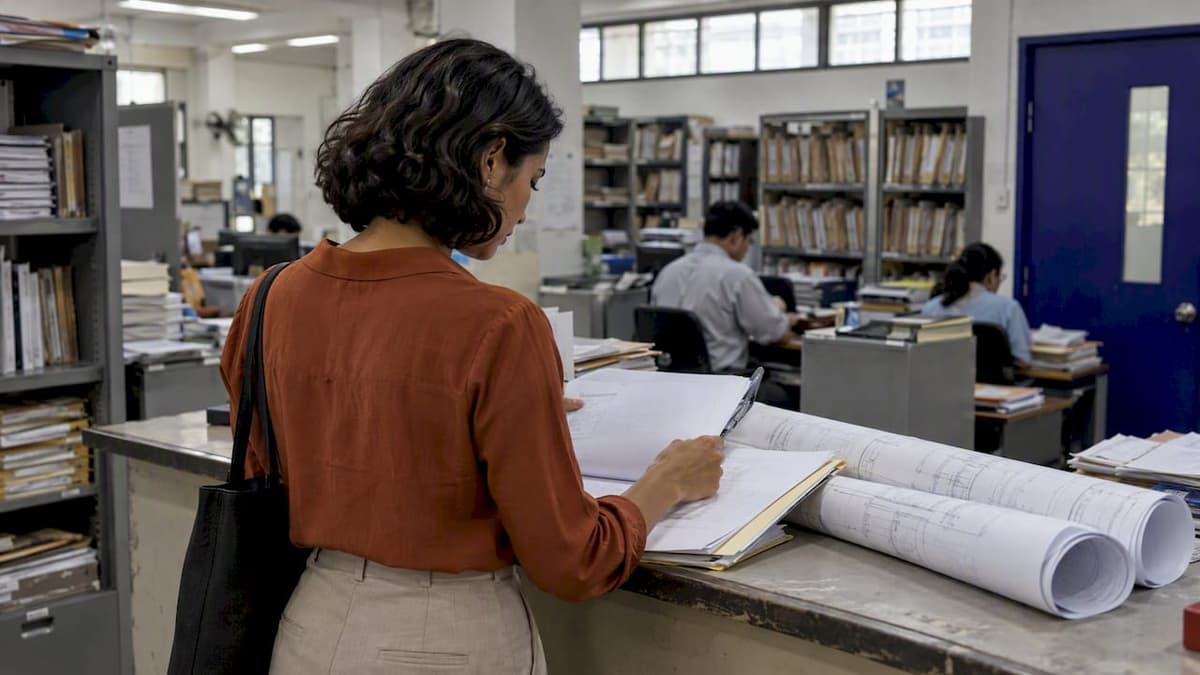

A building permit check in Thailand means obtaining the official permit file for the building from the local authority, then comparing the approved plans, owner, use and floor area with what you are being sold. A brochure, an agent's summary or a screenshot of a search result does not do that. The check also has a limit: a permit shows that construction was authorised, not that the seller owns the land or can transfer the unit.
This guide sets out the sequence we would follow for a Bangkok or Phuket purchase, the documents to ask for, and the gaps that tend to be missed. It is written for UK buyers who are shortlisting a property and have not yet paid a deposit.
TL;DR
- Thailand's Building Control Act B.E. 2522 (1979) is applied locally, so the correct office depends on the property's district or municipality.
- An online permit search only locates the permit number. You still need to obtain a certified or official copy of the file from the district.
- A permit is not a title document. Ownership and registered encumbrances are verified separately through the Land Department and the title deed.
- For a Phuket condominium, hotel or large development, check the environmental impact assessment (EIA) database as well. It is a different record from the building permit.
- Compare the approved drawings with the physical building before you commit any money.
What the Building Control Act covers
The Building Control Act B.E. 2522 (1979), as amended generally requires a person who intends to construct, alter or remove a building to obtain a licence from the local competent official, or to use the statutory notification route under Section 39 bis. The Act also empowers ministerial regulations and local rules on structural safety, fire prevention, sanitation, setbacks, height, parking, use restrictions and change of use.
For a buyer, three points follow.
- The authority is local. There is no single national register you can search for every building. The responsible office is the one covering the property's district or municipality.
- The permit file is the primary technical evidence. Local authority guidance shows that the authority assesses plans, town planning, public access and technical evidence, and that the application itself names the land document, the owner, the professionals and the intended use. Treat the developer's marketing material as an unverified claim until the approved file says the same.
- Use matters as much as construction. A building approved as a residence is not automatically approved for short-term letting, commercial use or an extra storey. Change of use is a matter the rules address.
A permit is not proof of ownership
This is the most common misreading we see. The Act regulates construction, alteration, use and safety. It does not establish who owns the land or whether the seller can lawfully transfer the unit. Those questions sit with the Land Department, the title deed and any registered encumbrances such as mortgages or usufruct rights.
So a clean permit check supports one conclusion only: that the development was lawfully authorised. You still need a separate title search and a review of the foreign ownership position. We cover that in our guides to the 49% foreign quota for condominiums, to freehold versus lease structures for UK buyers and to usufruct registration.
The application for a permit also identifies the land document and, where the builder is not the landowner, the landowner's consent. That makes the file useful for cross-checking the seller's story, but it does not replace the title search.
How to check a permit for an existing Bangkok building
For Bangkok, buyers can start with the Department of Public Works and Town & Country Planning permit service and the Bangkok Metropolitan Administration One Stop Service (BMA OSS). Bangkok's public service portal states that online services operate 24 hours and that the hotline is 1555. As of 2026, BMA OSS supports online submission, status tracking, payment and results, including applications for construction, alteration, demolition or relocation below and above 300 square metres.
That portal is mainly built for applicants. A buyer's practical sequence is different:
- Identify the district. Take the address and title deed details from the seller and confirm which district office covers the plot.
- Search the official permit record. Use the permit number and application year where you have them. Sathon district's instructions describe searching online by construction-permit number and year, then taking that number to the district.
- Contact the district engineering section. The online search locates the number. The copy comes from the engineering section of the district office.
- Obtain a certified or official copy. Ask for the complete permit and approved drawings, not a screenshot or an agent's summary.
- Reconcile the file with the property. Compare the approved plans, address, owner, use, floor area and completion status with what is physically there.
The Thai-language material is the official record. Instruct a translator or a Thai-qualified adviser to read the file, and do not rely on a summary supplied by the seller's side.
What the approval file can tell you
The application and supporting documents can hold information that changes a buyer's risk. Local authority guidance from Rangsit City (19 November 2025) lists the kinds of evidence an applicant submits: title evidence, plans, company documents where relevant, landowner consent, professional certificates, calculations and prior permits for alterations or renewals.
| What to look for | Why it matters to you |
|---|---|
| Land-title details on the application | Confirms which plot was approved and lets you compare it with the title deed you are shown |
| Owner and landowner consent | Shows whether the builder and the landowner are the same, and whether the landowner agreed |
| Architect and engineer credentials | Architecture and engineering are controlled professions, so the named professionals should be properly qualified |
| Structural calculations and approved drawings | The baseline against which any extension or layout change should be judged |
| Intended use | Residential, commercial or mixed use affects letting plans and resale |
| Approved completion period and completion status | Reveals whether the building was finished within the approved terms |
| Previous permits for alteration | A pattern of changes needs an explanation, and each change should have its own approval |
The standard application form (Form Kor 1) shows the same structure: type of building, intended use, parking provision and the parties involved. Reading a real application next to your property is the quickest way to see where the sales description and the official record part company.
Spotting alterations and unapproved work
Many disputes arise not from the original build but from what happened afterwards. Typical differences to look for on a site visit with the approved drawings in hand:
- extra rooms, mezzanines or enclosed balconies that do not appear on the plans;
- an additional storey or a roof structure beyond the approved height;
- a pool, garage or annex built after the permit was issued;
- a change from the approved use, for example a residence operating as guest accommodation.
If the physical building does not match the file, ask the seller how the difference arose and whether an alteration permit exists. Where it does not, the cost and feasibility of regularising the position should be priced before you pay, or the purchase should be reconsidered. We would not advise relying on a verbal assurance that the matter is minor.
Off-plan and new developments
With a building that does not yet exist, you are checking a permit for something that is still being built, so the question becomes whether the approval matches what is being marketed. Compare the unit count, building height, parking and facilities in the brochure with the approved drawings. Brochure features that are absent from the approved file are unverified claims.
Project approval is also layered. Environmental impact assessment approval, land subdivision approval, condominium registration, building permission and an occupancy or use certificate can be separate records held by different authorities. A clean result in one database should not be treated as clearance across all regimes. For a new development, ask the developer for each record by name and check each against the issuing body.
Phuket: add the environmental check
For a Phuket condominium, hotel, resort or large development, check the official Smart Environmental Impact Assessment Plus database as well as the building-permit file. For qualifying projects, the database displays the project identity, developer, company-registration number, location, report type, approval status and approval date. The owner pages list every indexed project for a given developer, which helps you see a developer's record across several schemes.
Read each record carefully. One Phuket hotel project record shows that construction had started and operations had begun, while the permit-number and permitting-authority fields were blank. That does not prove the building lacked a permit, since the database is an environmental record rather than a building register. It does show why you ask for the building-permit file separately and do not treat environmental approval as a substitute for it.
If you are looking at Phuket specifically, our area notes on Patong and Kamala cover costs, access and what is known locally.

Timing and fees: what to expect
Processing times and document requirements vary by authority. Rangsit City's guidance of 19 November 2025 states that ordinary review may take no more than 12 days for a residence of up to two storeys, and 29 days for commercial, large or controlled-use buildings, subject to complications under the Building Control Act. These are an applicant's timescales, not the time it takes a buyer to obtain a copy, so allow for the district's own pace when planning your deposit date.
Official statutory fees are modest. Local guidance gives examples such as 20 baht for a construction licence, 10 baht for an alteration or demolition licence, and plan-review charges ranging from 0.50 baht per square metre for buildings no higher than two storeys or 12 metres to 4 baht per square metre for buildings above three storeys or 15 metres. Those are government-published examples from one authority. They are not the cost of an independent lawyer, surveyor, translator or due-diligence review, which you should budget for separately.

Our perspective
We review property for the buyer, not for the developer or the agent, and the permit file is where the gap between a sales presentation and the evidence is often first visible. Across more than 380 property decisions we have reviewed, one in three reviews identified a significant deal-changing issue. We cannot say how many of those involved permits, since the issues span ownership, finance and regulation, but the pattern shapes how we work: nothing is accepted on the seller's word.
Our approach to a permit check rests on three habits.
- Separate the records. Title, permit, environmental approval and condominium registration are different documents from different bodies. We list what is missing as clearly as what is present.
- Ask for the official file. A permit number seen in a search is not the same as verified compliance. We want the district's copy.
- Tie it back to your plan. A permit that is fine for a family home may be wrong for the rental or resale you have in mind. We review the purchase against intended use, building rules and exit options.
Missing evidence is information. If the seller cannot produce the file, that should be reflected in your decision and in the price.
— Neerraj
When to bring in an independent review
You can do the first pass yourself: identify the district, run the online search and request the file. Bring in specialists when the file is in Thai and technical, when the building has been altered, when the project is off-plan, or when the sum at stake justifies a formal record of your reasoning.
Our Thailand property due diligence service reviews the specific property, coordinates legal, technical and market specialists and produces a structured decision file. If you have not yet paid a deposit, before-buying due diligence is the stage where the findings can still change the outcome, including your negotiating position. For the wider checklist on payments, tax and powers of attorney, see our notes on Thai property taxes for UK buyers and powers of attorney.
A pre-deposit checklist
- Obtain the title deed details and run a separate land office search.
- Identify the district or municipality responsible for the building.
- Get the permit number and year, then search the official record.
- Request a certified or official copy of the permit and approved drawings from the district.
- Compare plans, address, owner, use, floor area and completion status with a site inspection.
- For Phuket large developments, check the Smart EIA Plus record and the developer's other projects.
- Ask for any alteration permits and any occupancy or use documents, and record anything not provided.
- Have a Thai-qualified professional read the file before you sign a reservation agreement or pay a deposit.
FAQ
Can I check a Thai building permit online from the UK?
Partly. Bangkok's portal offers online services and some districts let you search by permit number and year. That search only locates the number. You then need to contact the district engineering section to obtain a copy of the permit.
Does a valid building permit mean the seller owns the property?
No. The Building Control Act regulates construction, alteration, use and safety. Ownership and registered encumbrances are verified through the Land Department and the title deed, which is a separate check.
Is an environmental approval the same as a building permit?
No. For Phuket condominiums, hotels and large developments the EIA record is an additional check. It is held by a different authority and can show a project as under construction while the permit fields are blank, so confirm each record separately.
What should I do if the building differs from the approved plans?
Ask the seller to explain the difference and to produce any alteration permit. If none exists, take advice from a Thai-qualified professional on the cost and feasibility of regularising it before you pay a deposit, and reflect the risk in the price or walk away.
Sources
- Building Control Act B.E. 2522 (1979), English translation
- Bangkok public service portal
- Sathon district: searching construction permits online
- Rangsit City: building licence guidance
- Sok Saeng: application Form Kor 1
- Smart EIA Plus: Phuket project record
- Smart EIA Plus: project owner record

