
Thai House Book (Tabien Baan): A Guide for UK Buyers
What the Thai house book (Tabien Baan) records, what it cannot prove, and which documents UK buyers should verify before paying a deposit on a Thai property.
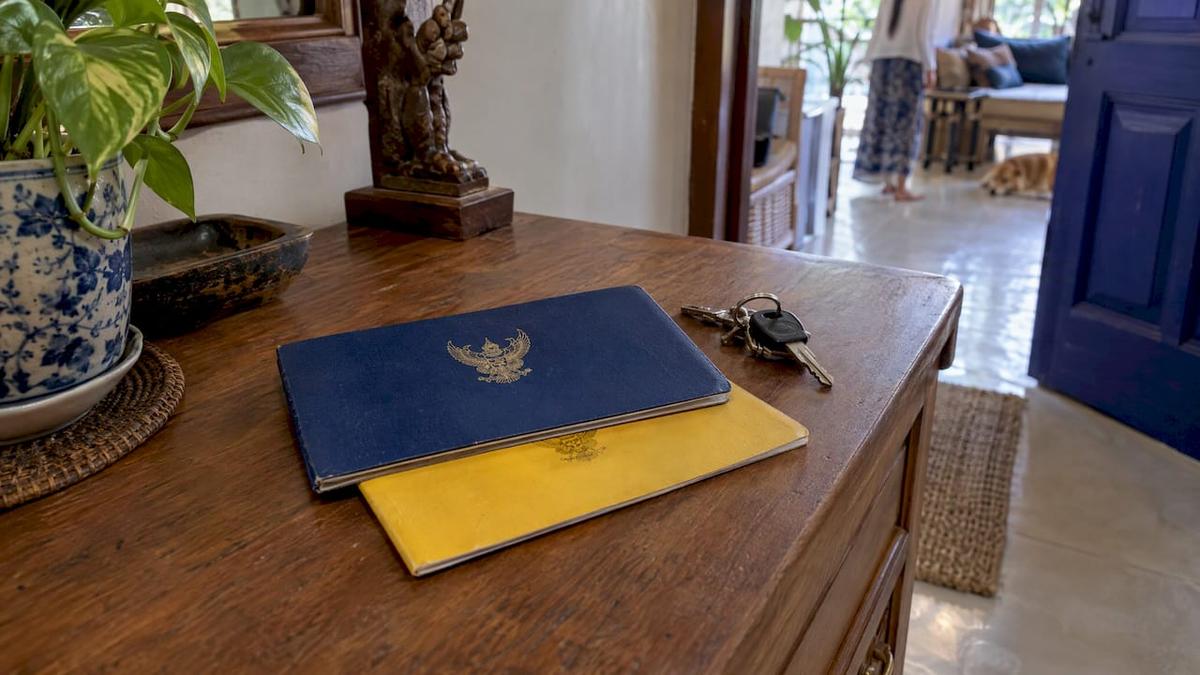

The Thai house book, known as the Tabien Baan, is a house registration record. It shows the address of a property and the people registered as living there. It does not prove that anyone owns the house or the land, so a UK buyer should never treat it as evidence of title. This guide explains what the book contains, how the blue and yellow versions differ, and which documents you should verify before paying a deposit.
TL;DR
- The house book records an address and its registered residents. It is not a title document, and Thai law says so directly.
- Land ownership is evidenced by the title deed held at the Land Office (the Thai land registry). A house standing on someone else's land, or a condominium unit, needs its own separate evidence.
- Compare the house number, project name and building description in the book with the title deed, the building permit and the physical property. Investigate every mismatch before you pay.
- A foreign owner can often obtain a yellow book for residence purposes, but it gives proof of address, not proof of ownership.
- Ask an independent adviser to inspect the original records at the Land Office, not the seller's copies.
What the Thai house book is and what it records
House registration in Thailand is governed by the Civil Registration Act B.E. 2534 (1991). B.E. stands for Buddhist Era, the calendar used in Thai legislation, and 2534 corresponds to 1991. Under this Act, a house registration records a house number and details of the people residing there.
The official form issued by the Department of Provincial Administration is more specific. According to the house registration form, it records the house code, the registration office, the address, the village and other particulars of the house. These are followed by the residents' names, identification numbers, status, nationality, sex, birth details and the history of any transfers in or out.
In practice, a copy of the book will tell you:
- the full address and whether the premises are registered as a house or a condominium unit;
- who the householder is, with their nationality and identification number;
- who else is registered at that address.
What it will not tell you is who owns the building, who owns the land beneath it, or whether anyone has a mortgage, lease or other claim over it. Those questions are answered by different documents, covered below.
Does the house book prove ownership?
No. The Civil Registration Act draws a firm line here. Section 34 states that no person may rely on a house number or house registration to show a right in, or ownership of, land. The Act itself is the authority for that point.
Three practical consequences follow for a UK buyer.
- The householder is not necessarily the owner. A person can be registered at an address they do not own, for example a tenant, a family member or a caretaker.
- The owner is not necessarily in the book. A person whose name is on the title deed does not automatically appear in the registration book. A foreign non-resident owner often will not appear at all.
- The book is tied to the building, not the person. It follows the address. It says nothing about the legal chain of title behind it.
A seller who offers the house book as reassurance that "everything is in order" has shown you a document that cannot answer the question you are asking. That is not necessarily a sign of bad faith, since many Thai sellers treat it as a routine household document, but it is a signal to ask for the real evidence.
Blue book and yellow book: the difference
There are two versions in common use. Both are described in general practice in the same terms, although local district offices apply their own requirements and you should confirm the current position with the office covering the property.
| Feature | Blue book (Thor Ror 14) | Yellow book (Thor Ror 13) |
|---|---|---|
| Generally issued to | Thai nationals and foreigners with permanent residence | Foreigners living in Thailand on temporary stay |
| Tied to | The physical address, listing every registered person there | A single foreign individual's registration at an address |
| Proves ownership? | No | No |
| Typical use | Voting district, proof of address for Thai citizens | Proof of address for a foreign resident |
Thor Ror is the Thai abbreviation for the registration form type, and the numbers 14 and 13 are the form numbers.
A foreign owner who lives in their own condominium or house can usually apply at the district office (the amphoe) responsible for civil registration where the property is located. The office may ask for evidence of lawful residence, often the owner's consent or a lease. Practice varies between districts, and some offices are slow or reluctant, so a buyer should not assume the process will be quick.
A yellow book is useful for daily life. It is generally recognised as proof of address, and banks, driving licence offices and vehicle registration often ask for one. It is separate from the TM30, the immigration form by which a residence or address is notified to Thai immigration. Holding a yellow book does not remove the need to file that notification.
The documents that do establish ownership
The type of property decides which document matters most. According to the Thai government's guidance on ownership of real estate by foreigners, evidence for land is the original title deed or certificate of utilisation, and condominium title and building ownership evidence are listed separately from the house registration copy.

Land: the title deed
The title deed, commonly called the chanote when it is the full form, is the core evidence for land. The deed number, parcel details, area and boundaries must match the property you are being shown. The reverse side records burdens such as mortgages, leases, usufructs, servitudes and court orders.
A house on its own plot
Land and building ownership can diverge in Thailand. The landowner does not automatically own every structure on the plot, so you should prove each separately. Evidence for a building may include the building permit, an official house sale and purchase agreement or a registered superficies, which is a right to own a structure on another person's land. We cover the permit side in our building permit check guide.
A missing or defective permit also matters for the house book itself. Without proper construction documents it can be difficult to obtain a permanent house registration.

A condominium unit
For a condominium, the unit has its own title, and foreign ownership is limited by the 49% foreign quota across the building's total unit area. The transfer typically needs a debt-free certificate from the juristic person (the building's management entity) and a foreign-quota affidavit, together with evidence that the purchase funds came from abroad. Our guide to foreign condo ownership and the quota walks through that check.
Freehold, lease and usufruct
Many foreigners cannot hold land freehold, and buy through a lease or a usufruct instead. Those rights must be registered to be protected. See our notes on freehold versus lease and on registering a usufruct. Such rights are personal in nature and may lapse on death, which matters for succession planning.
How to use the house book in your checks before paying a deposit
Treat the book as a cross-reference tool. It is useful because inconsistencies between it and the other records often reveal problems. Work through these steps in order.
- Obtain an up-to-date Land Office title copy or official search. Do not rely on photocopies or scans supplied by the seller, which may be outdated or altered. An independent legal representative should inspect the master register kept at the Land Office.
- Match the registered owner to the seller's identity. The name on the title deed, not the name in the house book, decides who can sell.
- Compare the title deed with the property. Check title number, area and boundaries. The Department of Lands' LandsMaps portal can give a preliminary comparison of parcel boundaries, but it is not legal evidence of ownership and does not replace an official Land Office check.
- Read the reverse of the deed. Look for mortgages, leases, usufructs, servitudes and court orders.
- Reconcile the house book with the physical property. Compare house number, project or village name, unit or building description and names. A mismatch, such as a different house number from the permit, needs an explanation before you commit.
- Inspect the building permit and approved plans. Check them against the actual layout. Extensions that are not on the plans are a common source of dispute.
- Check who is still registered at the address. Review the book to see whether anyone remains registered as an occupant, and make sure the contract requires the seller to deregister all residents before completion.
- Check access. A plot with no legal road access is a serious problem. Read our guide to right of way in Thailand.
Only after these checks should a deposit leave your account. Once paid, your negotiating position weakens considerably.
What the house book means for you as a foreign owner
Residence and use
If you intend to live in the property, a yellow book can help with proof of address. If you plan to rent it out, including on short-term platforms, the book is not the relevant permission. Read our summary of Airbnb rules in Thailand before you assume that holding the property means you can let it.
Tax on sale
Tax treatment can depend on how long the property has been your registered main residence. Registering it may affect Specific Business Tax on a later sale by a private individual, so ask a Thai tax adviser how the rule would apply to you. For your UK position, including reporting Thai rental income, see our guide to Thailand property taxes for UK buyers.
Succession
Thai property is generally governed by Thai succession law because it is immovable property in the Kingdom. A foreign heir who cannot lawfully hold a condominium unit may be required to notify the authorities and dispose of it within a set period. A Thai-language will, signed before two witnesses and identifying each asset by title deed number or condominium unit number, usually simplifies probate. Take advice from a Thai lawyer on the current rules before you rely on any of this for your family.
How we can help
Buying across borders means you rely on documents you cannot easily read and on people with an interest in the sale. NITARYA provides independent, buyer-side due diligence for Thailand: ownership rights verification, developer and counterparty assessment, regulatory and permit checks, and a review of financial and ongoing obligations. Our process is designed to make material risks and missing evidence visible before you commit capital, with legal, technical and market specialists contributing to a structured decision file.

If you have shortlisted a Bangkok or Phuket property, you can start with our Thailand property due diligence service, or look at how we support buyers before, during and after purchase.
Our perspective
The house book is a good example of why cross-border buyers get into trouble. It is an official-looking document, issued by a government office, with the property's address on the front. It is easy to read it as proof that a house belongs to the person selling it. It does not say that, and the law is explicit.We see the same pattern in many Thai purchases: a buyer has plenty of paper, but not the right paper. The seller's copy of the deed, a brochure, a house book and a verbal assurance can all sit in the same folder, and none of them substitutes for an inspection of the original Land Office record. Our reviews exist to separate what has been verified from what has merely been stated.
Our approach is to treat every document by what it can legally prove. The house book proves registration at an address. The title deed proves rights in land. The building permit and approved plans show what may lawfully stand there. Only when these agree with each other, and with the physical property, do we regard the picture as reliable. Where they do not agree, the discrepancy itself is the finding, and it belongs in your decision before the deposit, not after.
Because we act only for the buyer, we have no commission riding on the sale proceeding. That independence is the point of the work.
Neerraj
FAQ
Can I buy a house in Thailand using only the house book as proof of ownership?
No. The Civil Registration Act states that a house number or house registration cannot be relied on to show a right in or ownership of land. You need the title deed for the land and separate evidence for the building, such as a building permit or registered superficies. Ask your adviser to check the original records at the Land Office.
Can a foreigner get a Thai house book?
Often yes. Foreigners living in Thailand on temporary stay generally apply for the yellow book at the district office where the property is located, usually with evidence of lawful residence such as owner consent or a lease. Requirements and attitudes vary between offices, so confirm the current rules locally before you plan around it.
Should the seller's name be in the house book?
Not necessarily, and its absence is not itself a warning sign. A foreign non-resident owner may never have been registered, and a registered householder may be a tenant or relative. What matters is that the registered owner on the title deed is the person selling to you.
Does a yellow book replace the TM30 notification?
No. The yellow book is a house registration matter, while the TM30 is an immigration notification of your residence. They operate under separate laws, so holding one does not remove the need for the other. Check the current immigration requirements with Thai immigration or your adviser.
What should I do if the house book details do not match the property?
Treat it as a finding to resolve before paying anything. Compare house number, project name and building description against the title deed and building permit, and ask the seller to explain and correct the difference in writing. If it is not resolved, take advice on whether to proceed.
Sources
- Civil Registration Act B.E. 2534 (1991), as amended
- Department of Provincial Administration house registration form
- Ownership of real estate by foreigners in Thailand, Thailand.go.th

