Mortgage Check on a Dubai Title Deed: What to Verify
How a UK buyer checks a Dubai title deed and any registered mortgage before paying: the official DLD services, what each result means and what to do next.


Can foreigners buy property in Dubai? Book a free 15-minute call
On this page
- TL;DR
- What a Dubai title deed proves, and what it does not
- Step 1: Get the deed details from the seller
- Step 2: Verify the deed through the DLD
- Step 3: Check for a mortgage, seizure or suspension
- Step 4: Get the lender's position in writing
- Step 5: Match the seller to the deed
- Step 6: Look beyond the deed
- When the details do not match
- What a UK buyer should assemble before paying
- Our perspective
- Having your Dubai purchase reviewed
- FAQ
- Sources
- Recommended
A Dubai title deed check tells you that the deed is genuine. It does not, on its own, tell you whether a bank holds a mortgage over the property, or whether the person selling it is entitled to sell.
To cover all three questions you need the deed check, a detailed property report from the Dubai Land Department (DLD) and, where a loan is recorded, the lender's written position before any money moves.
We carry out this buyer-side verification for international buyers, and this guide sets out the routine so you know what a sound check looks like before you pay a deposit.
TL;DR
- The DLD's Verify Title Deed e-service confirms the deed's authenticity. It is not a mortgage search.
- For mortgage, seizure and suspension details on a single property, the DLD issues a Detailed Property Report, which costs AED 50 plus two AED 10 fees when requested through the app or website.
- A recorded mortgage does not end a deal, but the lender must be involved and the buyer should see the lender's written figure before signing the sale form.
- Register entries carry strong legal weight in Dubai, so errors found after completion are hard to undo. Check before paying, not after.
What a Dubai title deed proves, and what it does not
Dubai runs a land register kept by the DLD, the emirate's land registration authority.
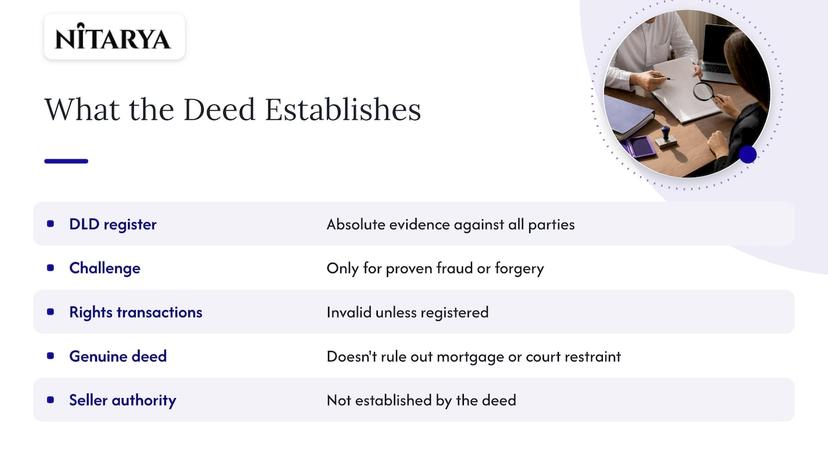
Under Law No. 7 of 2006 on Real Property Registration, the register has absolute evidentiary value against all parties, and can be challenged only where the entry is proven to result from fraud or forgery.
The same law says that transactions creating, transferring or extinguishing rights in real property are invalid unless registered, and that title deeds are issued from register data.
For a UK buyer, used to a system where the Land Registry guarantees title and a solicitor searches it, the practical consequence is this: the register is powerful evidence, so what it says on the day you pay is what you are bound by.
A professional practice guide to UAE real estate notes that land registers are not publicly searchable in the way many buyers expect.
Ownership information is released by government departments on application from, or with the authorisation of, the owner, although some property information is available through the DLD's "Inquiry About a Property" service.
In practice, due diligence leans on seller-provided documents and follow-up enquiries.
That is the gap a buyer has to close. A seller can hand you a genuine deed. The deed itself can be perfectly valid while the property is mortgaged, restrained by a court or being sold by someone without authority.
Step 1: Get the deed details from the seller
Ask the seller, through the agent, for a copy of the title deed and a copy of the passport or Emirates ID (the UAE national identity card) of the registered owner.
You need three things from the deed: the title deed number, the year and the property type. If the owner-name route is used, you also need the owner's name exactly as registered.
Where it goes wrong:
- The deed is shown as a photo, with the number cropped out. Ask for the full document.
- The seller is not the person named on the deed, and offers a power of attorney (a written authority to act for the owner). That is not unusual in Dubai, but it adds a layer to verify: who granted it, whether it is still valid and whether it covers a sale.
- The property is off-plan, so there is no title deed yet. In that case you are looking at a sales contract and a developer-registered interim record rather than a deed, and the checks differ. Our Dubai off-plan resale checklist covers that route.
Step 2: Verify the deed through the DLD
The DLD's Verify Title Deed e-service offers two routes. "Validate Property" needs the title deed number, year and property type. "Validate Owner and Property" needs the same details plus the owner's name.
The DLD lists a support line on +971-8004488 (the +971 prefix is the UAE country code).
Type the DLD address into your browser yourself rather than following a link from a message or an advert.
Fake sites that imitate government pages are a known scam route, and a copied address can differ from the real one by a single character.
What the result means:
| Result | What it tells you | What to do |
|---|---|---|
| Deed validated | The deed is genuine and, on the owner route, matches the name you entered | Move to step 3. You have not yet checked the mortgage or the seller's authority |
| No data found | The details you entered do not match the register | Do not pay. Ask the seller for the correct details or an explanation in writing |
| Name does not match | The deed exists but belongs to someone else | Stop until the seller's authority is documented |
The check is an authenticity test, so a clean result is a starting point. Treat it as one document in a file.
Step 3: Check for a mortgage, seizure or suspension
This is the part the keyword asks about, and it is where a basic deed check stops short.
For the mortgage position on a single property, the DLD's Request Detailed Property Report service issues a statement covering owner, property, mortgage, seizure, suspension and project details.
The published costs are:
- Through the Dubai REST app or the DLD website: AED 50 per letter, plus a AED 10 knowledge fee and a AED 10 innovation fee, with no documents required.
- At a Real Estate Trustee Center (a licensed office that registers property transactions on the DLD's behalf): AED 120 including service partner fees and VAT (value added tax). Individuals bring an Emirates ID; companies bring a trade licence and an official letter.
The DLD gives an expected completion time of 10 minutes. Fees can be revised, so confirm the figures on the DLD page when you apply.
Because the register is not open to casual public search, the practical route to this report depends on your standing. A buyer with no Emirates ID may need the seller's cooperation, a trustee centre or an adviser acting with authority.
If the seller resists a mortgage and encumbrance check, treat that as information about the transaction.
Why a recorded mortgage is not a dead end
Under Law No. 14 of 2008, as summarised in the DLD's Know Your Rights booklet for investors, a mortgage must be registered on the Real Estate Register (completed properties) or the Interim Real Estate Register (off-plan units), or it is void.
So a mortgage the seller took out should appear on the register. That is the reason the check is worth doing: it is meant to be there.
Lots of Dubai properties are sold with a loan still outstanding. The sale is then structured so that the debt is settled as part of the transaction. Our buyer's checklist for mortgaged property in Dubai sets out the full sequence.
Step 4: Get the lender's position in writing
Where a mortgage is recorded, the buyer needs to know how much is owed and how it will be cleared.
In a typical Dubai resale the seller obtains a liability letter from the lender stating the outstanding balance, and the lender later issues a release once the debt is settled.
The letter lets you see the real figure before you sign the sale form (Form F, the standard Dubai memorandum of understanding between buyer and seller).
What to confirm:
- The outstanding balance, and that it matches what the seller has told you.
- That the lender consents to the sale, usually through a no objection certificate (NOC), a lender's written consent to the transfer.
- Who pays what, and in what form. Payment is normally split so that the lender receives the amount owed and the seller receives the balance.
- The release step: the mortgage entry should be removed from the register as part of completion, not left for later.
Timetables vary by lender and property, so allow time for this stage rather than assuming the transfer will be same-day.
The practical point for a UK buyer is that the sequence of settling the loan, releasing the mortgage and registering the sale needs to be agreed in the contract.
For a parallel explanation of why written lender or landlord confirmations matter, see this explainer on estoppel certificate checks.
Step 5: Match the seller to the deed
A deed can be genuine and the person showing it can still be the wrong person. Identity is confirmed at the registration trustee office, where the owner name on the deed is compared with the seller's passport or Emirates ID.
If someone else is signing, the power of attorney must be examined before any payment, not after.
A short rule for the file: the name on the deed, the name on the identity document, the name on the mortgage letter and the name on the payee's bank details should all agree.
A mismatch in any of these is a reason to pause, however attractive the price.
Step 6: Look beyond the deed
A clean title and a known mortgage still leave questions the register does not answer. Service charges owed to the owners' association, tenancy arrangements, and any dispute or restraint attached to the unit all affect what you are buying.
The DLD's own statuses distinguish a property that is simply mortgaged from one that is restrained or blocked, and the latter cannot be dealt with until the restriction is lifted.
Ask for the service charge clearance and any tenancy contract, and confirm what the report shows on restraints.
Our Dubai property due diligence checklist lists these further checks for resales and off-plan purchases, and our note on Dubai property law changes covers recent rule updates buyers should know about.
If you are buying from a developer, the escrow law checks show where your instalments should be held.
When the details do not match
If the deed details do not match the register, do not pay a deposit until they do. A few practical points:
- Ask for the explanation in writing, and for a fresh copy of the deed.
- Do not accept a changed number or name without re-running the DLD check yourself.
- If a mortgage appears that the seller did not mention, ask for the liability letter before signing anything. A seller who omitted it may still be willing to proceed, but the terms must reflect the real position.
- If the property is restrained or blocked, no dealing can complete until the issuing authority lifts the restriction. Do not agree to pay on the promise that it will be sorted.
A point that matters for UK buyers: Dubai has no state guarantee of title in the way some systems do, and there is no Land Registry-style indemnity to fall back on.
The register's evidentiary weight cuts both ways, which is why the checks belong before payment.
What a UK buyer should assemble before paying
A tidy file at the point of signing contains:
- The DLD title deed verification result, dated.
- The Detailed Property Report showing mortgage, seizure and suspension status.
- The seller's identity document and, if relevant, the power of attorney.
- The lender's liability letter and written consent, if a mortgage exists.
- Service charge clearance and any tenancy contract.
- The payment structure, naming who receives each payment.
For an overview of Dubai's freehold framework and how these pieces fit together, see our Dubai property due diligence guide and our wider Dubai and UAE insights.
Our perspective
Most of the buyers who come to us arrive with a deed that has already passed an online check. That is a good sign, and it is also where the real questions begin.
Across more than 380 property decisions we have reviewed, one in three reviews identified a significant, deal-changing issue. The issue is rarely a forged deed.
It is usually something the deed does not show: a debt, an authority that was never documented, an obligation attached to the unit.
That is why our work is independent and buyer-side. We are not paid by a developer or an agent, so we have no reason to present the file more kindly than the evidence allows.
We verify ownership rights, assess the developer or counterparty, check regulatory and permit status, and review the financial and ongoing obligations, then set it out in a decision file you can act on or walk away from.
If you are buying from the UK, you will not be in the room when the registration trustee compares names and documents. Having the evidence assembled beforehand is what lets you pay with confidence.
Neerraj
Having your Dubai purchase reviewed
If you have a specific Dubai property in mind, our Before Buying, During Purchase and After Buying due diligence services cover the point you are at, from the first deed and mortgage check to the closing file.
We review the specific property and give you an evidence-based decision file, so you know what you would own and what obligations come with it before you commit capital.
FAQ
Does the DLD title deed check show a mortgage?
The Verify Title Deed service is designed to confirm that a deed is genuine, and, on the owner route, that it matches the name entered.
For mortgage, seizure and suspension information, request the DLD's Detailed Property Report, which covers those items for a single property.
How much does a Dubai property status report cost?
The DLD lists AED 50 per letter, plus a AED 10 knowledge fee and a AED 10 innovation fee, when requested through the Dubai REST app or website. At a Real Estate Trustee Center the listed price is AED 120 including partner fees and VAT.
Check the DLD page for the current fees before applying.
Can I buy a property that already has a mortgage?
Yes. A registered mortgage can be settled as part of the sale. The buyer should see the lender's liability letter, confirm the lender's consent and make sure the release of the mortgage is part of the completion sequence.
What if the title deed says "No data found"?
The details you typed do not match the register. Re-check the number, year and property type, then ask the seller for the correct details in writing. Do not pay a deposit until the DLD check returns a match.
Sources
- Law No. 7 of 2006 Concerning Real Property Registration, Emirate of Dubai
- Dubai Land Department: Verify Title Deed
- Dubai Land Department: Request Detailed Property Report
- Dubai Land Department: Know Your Rights for investors
- Chambers Real Estate 2026: UAE trends and developments
- Estoppel certificate checks for investors and tenants