
Oqood Registration in Dubai: What UK Buyers Should Check
How Oqood registration works in Dubai, what the certificate proves, how it differs from a title deed, and what UK buyers should verify before paying a deposit.
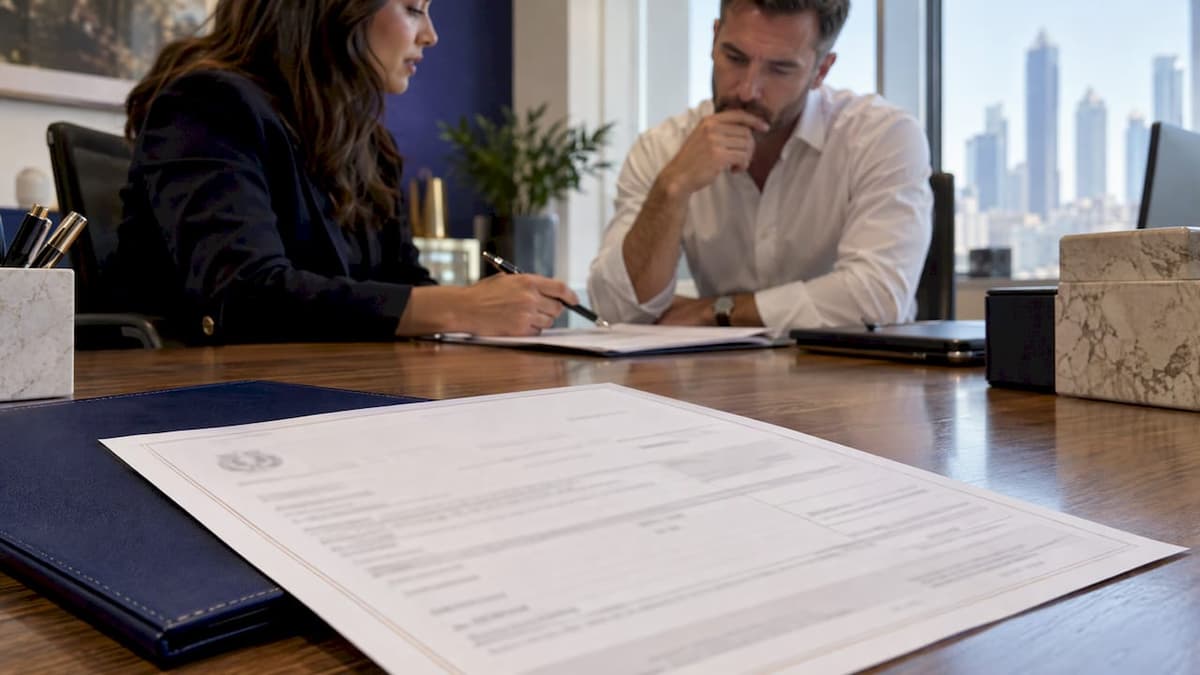

Oqood is the Dubai Land Department's system for registering an off-plan sale in the provisional (interim) property register. It gives you a provisional registration certificate, not a title deed. For a UK buyer paying instalments from abroad, that certificate is the first official record that the unit is yours, so it is worth understanding before the first payment leaves your account.
This guide explains what Oqood registration is, who carries it out, what it costs, what the certificate does and does not show, and how it differs from a title deed. It also sets out the checks we recommend a UK buyer completes before paying a deposit. Throughout, "Dubai Land Department" is abbreviated to DLD, "Real Estate Regulatory Agency" to RERA, "sale and purchase agreement" to SPA, "United Arab Emirates" to UAE and "UAE dirham" to AED.
TL;DR
- Oqood registers an off-plan sale in Dubai's provisional register and produces a provisional registration certificate. It is not a title deed.
- Registration is the developer's job, to be completed through the Oqood portal within 90 days of the SPA being signed. The DLD emails the certificate to the buyer.
- The DLD registration fee is 4% of the sale value, split 2% for the purchaser and 2% for the seller, plus small AED 10 knowledge and innovation fees. In practice, the buyer should confirm who is paying what in the SPA.
- Before paying, check that the developer and project are RERA-registered, that a project escrow account exists, and that the certificate matches your contract.
- A title deed follows only once the property is complete and the contractual obligations have been met.
What Oqood means for an off-plan buyer
Oqood is Arabic for "contracts". In Dubai property, the word refers to the electronic registration of an off-plan sale: a purchase of a unit that is not yet built or not yet fully paid for. The DLD describes its initial sale registration service as the route for registering units sold off-plan, or land plots whose value has not been fully paid, in the provisional register.
The legal weight of that registration is considerable. Reporting on the Interim Property Register explains that an off-plan sale, or another legal disposition affecting ownership rights, is void unless it is registered. Registration produces a certificate in the purchaser's name recording the purchaser, the unit and the payment terms, and it protects the purchaser's right as long as the purchaser is not in breach of the sale contract.
Two points follow for a UK reader. First, the certificate is not the same as the freehold title you would hold on a completed Dubai apartment. It records a contractual interest that is still being paid for. Second, because the interest depends on you meeting your payment obligations, the payment plan in the SPA matters as much as the certificate itself.

How Oqood registration works, step by step
The DLD's published procedure places the work with the developer, not the buyer. The sequence looks like this:
- Reservation and SPA. You reserve a unit and sign the SPA with the developer. This can usually be done remotely, but the signed contract is what registration is based on.
- Developer submission. The developer logs in to the Oqood portal, selects the provisional sale registration service, selects the property, completes the details, attaches the documents and chooses the payment method.
- Documents. For an individual, the DLD lists a copy of the sale and purchase contract, a copy of a valid UAE ID and, for non-residents, a copy of a valid passport. Companies provide a valid trade licence and entity-specific documents. A UK buyer without a UAE ID therefore relies on the passport.
- Online submission and processing. The application is sent online.
- Certificate by email. The DLD sends the output to the purchaser by email.
The DLD service page states that registration must be completed within 90 days of the SPA signing. If you are two or three months into a purchase and have received no certificate, that is the moment to ask the developer for the registration reference in writing.
Why the developer's own registration comes first
A unit can only be registered if the project itself is. The DLD's project registration procedure requires project documents, approved plans and permits, an escrow account request, and a 30% construction guarantee (through construction progress, a bank guarantee or a cash deposit) before project registration is completed. Its published FAQ adds that, after developer registration and project approval by RERA's escrow department, the account trustee opens the escrow account.
For you, the practical meaning is simple: your instalments should go into the project's escrow account, not an unrelated account. Our guide to the four checks under Dubai escrow law walks through how to confirm that.
What the Oqood certificate shows
The certificate is a provisional registration e-certificate. According to the Gulf News explainer cited above, it records the purchaser, the unit and the payment terms. Treat it as a summary of your contract as the DLD has recorded it, and read it against your SPA line by line.
A UK buyer should compare the following:
| Item on the certificate | What to compare it with |
|---|---|
| Buyer name(s) and passport details | Passport exactly as issued, including middle names and spelling; joint buyers each listed |
| Unit and project | Unit number, floor and project name in the SPA and the reservation form |
| Seller | The developer named in the SPA and on the escrow account |
| Price and payment terms | The payment schedule in the SPA, instalment by instalment |
| Date | The SPA signing date, to see that registration fell within the 90-day window |
Mismatches are easier to correct early. A misspelt name or a wrong unit number is an administrative problem at month two. At handover, it can become a delay.
Can a UK buyer verify the certificate is genuine?
Yes, and the principle is to verify against the registry rather than against a document you were handed. We do not rely on a PDF alone. A genuine registration should be consistent in three places: the certificate you received by email from the DLD, the developer's own confirmation of the registration reference, and the project's record with the escrow arrangements. If one of these cannot be produced, pause payments until it is explained. An independent reviewer acting for you, such as a due diligence adviser or a Dubai-licensed lawyer, can cross-check the record with the relevant authority on your behalf. You do not need to be in Dubai for that.
Oqood vs title deed: the practical difference
Buyers searching for this comparison are usually trying to answer one question: do I own this yet? The short answer is that Oqood records your registered purchase during construction, while a title deed records ownership of a completed property.
| Oqood certificate | Title deed | |
|---|---|---|
| Stage | Off-plan, during construction and payment | After completion and handover requirements are met |
| Register | Provisional (interim) register | Final register |
| What it records | The registered sale: purchaser, unit, payment terms | Ownership of the completed unit |
| Issued on | Developer's registration request, certificate emailed by the DLD | The DLD's completion service, as an electronic title deed and map |
| Who initiates | The developer | Completion process after contractual obligations are met |
The transition is described by a Dubai property commentator as provisional registration during construction, followed by a DLD completion service that issues the electronic title deed and map once the applicable contractual obligations have been met. In practice, those obligations typically include completion of the building and settlement of what you owe under the payment plan. Confirm the exact conditions in your own SPA.
Our separate article on verifying Dubai title deeds and the Oqood risks for buyers covers what to check once the title deed stage arrives.
What Oqood registration costs
The DLD lists the fees on its initial sale registration page:
- 2% of the sale value payable by the purchaser
- 2% of the sale value payable by the seller
- AED 10 knowledge fee
- AED 10 innovation fee
- A AED 1,000 self-registration fee payable by the developer
That makes the registration fee 4% of the sale value in total. Gulf News reported in February 2026 that the DLD's 4% fee is commonly payable when the SPA is signed. Many sales material pages describe the whole 4% as the buyer's cost. That is a matter of the commercial terms in the contract, so check your SPA to see who bears which share.
To see the effect on a budget, consider a unit priced at AED 1,500,000. A 2% purchaser share is AED 30,000, and the full 4% is AED 60,000, before the two AED 10 fees. Convert at the rate on the day you pay, through your bank, and add your bank's transfer charges to the total. Other costs, such as agency fees and service charges, sit outside this registration fee. For the wider picture, see what UK buyers pay in Dubai property transfer fees.

Before you pay a deposit: a UK buyer's checklist
The DLD's own investor guidance, know your rights for investors in Dubai, says that before signing an off-plan SPA a buyer should check:
- whether the project and the developer are RERA-registered
- whether the project has an escrow account and an account agent
- the completion percentage and the expected completion date
- whether the required permits and approvals exist
We add several checks that reflect how UK buyers actually transact:
- Match the payee to the escrow account. Ask for the project escrow account details in writing and confirm that the name on your payment instruction matches. Do not pay a deposit into an agent's personal or general account.
- Ask for the registration timeline. The developer should state when it will submit the Oqood registration and send you the reference. Ninety days from the SPA is the outer limit, not a target.
- Read the payment plan against the completion date. If the instalments are front-loaded relative to construction progress, understand the consequence of a delay before you sign.
- Confirm the seller is the registered developer. On resale of an off-plan unit, you are dealing with another buyer, not the developer, and the transfer needs the developer's involvement. Resales are a different process from a first purchase.
- Keep a document file. Retain the reservation form, SPA, payment receipts, the certificate and all correspondence. If you ever need to evidence your position, the file does the work.
- Check the current law. Dubai's property rules change. Our summary of four key updates in Dubai real estate law is a useful place to see what has moved.
Common warning signs
- A request to pay before an SPA has been issued or before the escrow account is named.
- A developer unable to show project registration or permits.
- A certificate that arrives from an agent rather than directly from the DLD.
- Pressure to transfer funds the same day with a limited-time discount.
- Names or amounts on the certificate that differ from the SPA.
None of these automatically means a problem. Each is a reason to stop and obtain a clear written answer first.
Our perspective
Most buyers we speak to treat the Oqood certificate as the end of the checking process. We see it as the middle. It confirms that a sale has been registered. It does not tell you whether the developer is sound, whether the escrow arrangements are as described, or whether the payment plan suits your cash flow.Across more than 380 property decisions we have reviewed, one in three reviews identified a significant issue capable of changing the deal. That figure is why we ask for evidence before capital moves, not after. For an overseas buyer, the work is to put the registry record, the contract and the developer's claims side by side, and to see where they disagree.
Our approach is independent and buyer-side. We are not paid by developers or agents, so the review reflects your interests only. We coordinate legal, technical and market specialists into a decision file you can keep, covering ownership rights, developer and counterparty assessment, permits, and the ongoing obligations you will carry.
If you are about to pay a Dubai deposit from the UK, the cheapest moment to find a problem is before the transfer.
Neerraj
How we can help
If you have shortlisted a Dubai off-plan unit, we review it from the buyer's side: the developer, the project's registration and escrow position, the SPA, the payment plan and the ongoing obligations. You receive a decision file that sets out what we found and what remains unverified. Our Dubai property due diligence service is built for buyers at this stage, and you can see all three stages of our work, before, during and after purchase, on the NITARYA home page.

If you are already past the reservation stage, our during-purchase review checks the documents you are about to sign or have signed. We do not publish prices for these engagements, so please contact us to discuss your purchase.
After registration: what to monitor
Once your certificate arrives, the work does not stop. Diarise each instalment date from the SPA and pay each into the project's escrow account, keeping the receipt. Track construction progress against the developer's stated timetable, and ask for written updates if milestones slip. When the building nears completion, ask the developer which conditions must be met for the title deed to be issued, and which charges, such as service charges for jointly owned property, begin at handover. Our guide to how jointly owned property works under Dubai strata law explains those obligations.
If the developer misses the registration window, delays the project significantly, or asks you to vary payment terms, seek advice from a Dubai-licensed lawyer before agreeing, because your rights under the SPA and the registration may be affected.
FAQ
What is Oqood in Dubai?
Oqood is the DLD's system for registering off-plan sales in the provisional register. The developer submits the SPA and your identification through the Oqood portal, and the DLD emails you a provisional registration certificate. It records your registered purchase while the property is being built.
What is the difference between Oqood and a title deed?
Oqood is provisional registration during construction and payment, and records a registered sale. A title deed is issued after completion, through the DLD's completion service, once the applicable contractual obligations have been met. Only the title deed records ownership of the finished unit.
How long does Oqood registration take, and who does it?
The developer carries it out, through the Oqood portal, and must complete it within 90 days of the SPA signing. The DLD then emails the certificate to the buyer. If you have not received it within that period, ask the developer for the registration reference in writing.
How much is the Oqood registration fee?
The DLD lists a registration fee of 4% of the sale value, made up of 2% for the purchaser and 2% for the seller, plus AED 10 knowledge and AED 10 innovation fees. Check your SPA to confirm who pays each share, since commercial terms can allocate the cost differently.
Can I register Oqood from the UK?
Yes. The developer submits the application and, for a non-resident, the DLD asks for a valid passport copy rather than a UAE ID. Many off-plan purchases are reserved and signed remotely, but you should still verify the developer, the escrow account and the certificate before you pay.
Sources
- Dubai Land Department: Request to register the initial sale
- Dubai Land Department: Register project
- Dubai Land Department: Frequently asked questions
- Dubai Land Department: Know your rights for investors in Dubai
- Gulf News: What is the Interim Property Register?
- Gulf News: Buying an off-plan property in Dubai
- Oqood vs title deed: records at each purchase stage

