
Construction Contract in Thailand: What UK Buyers Should Check
Building a house or villa in Thailand from the UK? See what the construction contract must cover: scope, payments, defects, permits, language and disputes.

Free Thailand ownership guide Book a free 15-minute call
On this page
- TL;DR
- What the law says a construction contract is
- The clauses to read line by line
- Permits: who holds them and why it matters
- Language: Thai and English versions
- Remedies and dispute resolution
- Checks to complete before you pay a deposit
- Our perspective
- Getting the contract and the land reviewed together
- FAQ
- Sources
- Recommended
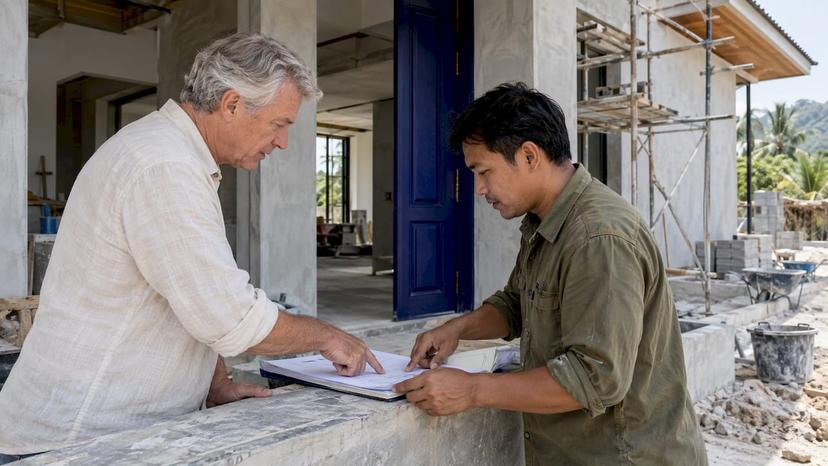
A Thai construction contract is governed by the "hire of work" rules of the Civil and Commercial Code (CCC), and for homes sold to consumers by a mandatory control notice as well.
A UK buyer should not sign until the contract fixes the scope, the price, payments tied to finished work, defect periods, who holds the building permit, and which language prevails.
This guide sets out each point in the order you would test it, and explains how an independent review fits in before you pay a deposit.
TL;DR
- Thai law treats the contractor's duty as delivering a finished result, not supplying labour, so the contract must define that result precisely: drawings, specification, bill of quantities and price.
- Tie payments to verified progress, hold back part of each payment as retention, and consider a performance bond or advance-payment guarantee.
- Structural defects carry a minimum five-year liability for residential contracts under the 2016 control notice, but a court claim must be brought quickly once a defect appears.
- The landowner, or the party with the registered right to build, should hold the building permit. Building outside it risks demolition orders and fines.
- If a bilingual contract conflicts and no governing language is agreed, the Thai version prevails, so have the Thai text reviewed too.
What the law says a construction contract is
Thai construction work falls under the "hire of work" provisions, Sections 587 to 607 of the CCC. These sections define the contractor's obligation as delivering a completed result rather than simply providing labour.
That distinction matters for a buyer abroad. It means you are entitled to judge the contractor against an outcome, but only if the contract describes that outcome in enough detail to measure.
For houses and villas bought by individuals from a business, a second layer applies.
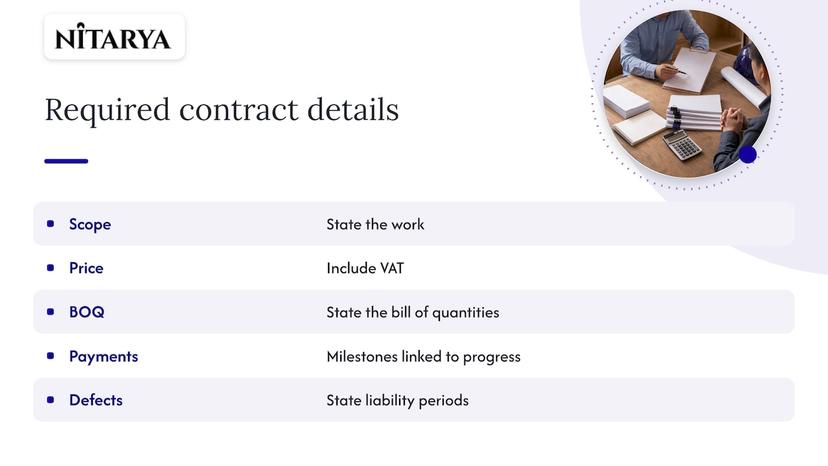
The Residential Building Construction Contract Control Notice 2016, in force from 1 January 2017, requires contracts between businesses and consumers to state the scope of work, the price including value added tax (VAT), the bill of quantities (BOQ), payment milestones linked to progress, and defect liability periods.
A contract missing these items is a warning sign about the contractor, not a formality to fix later.
One further point surprises many foreign buyers. A construction agreement need not be in writing in Thailand, and can be proved by witnesses, photographs or other physical evidence, according to the Ministry of Justice.
That is a reason to put everything in writing, not a comfort. Verbal promises from a salesperson are very hard to enforce in practice.
The clauses to read line by line
Scope, drawings and bill of quantities
The contract should attach the architectural and structural drawings, a written specification of materials and finishes by brand or grade, and a priced BOQ, which is an itemised list of quantities and rates.
Without the BOQ you cannot price a variation fairly, because there is no baseline.
Check that the area, the number of floors, the pool, landscaping, fittings, utilities connections and the boundary wall are each named, since these are the items most often disputed as "extras".
Ask for variation rules in writing: how a change is requested, who prices it, and that no variation is valid unless both parties sign it before work starts.
Price, VAT and payment milestones
The 2016 notice expects the price to include VAT and payments to follow progress.
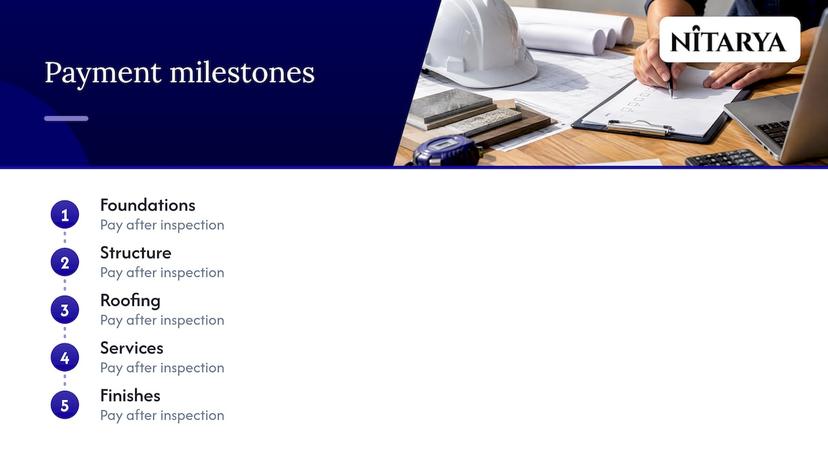
In practice, a UK buyer should translate this into a schedule that pays only against work that has been inspected, for example completion of foundations, structure, roofing, services and finishes, with each stage described by what is physically in place.
Two protections are commonly recommended. First, retention, usually 5 to 10% of each payment, held until defects are corrected.
Second, a performance bond, typically 5 to 10% of contract value, or an advance-payment guarantee if you pay a mobilisation sum.
These are market practice reported by a Thai law firm, not statutory minimums, so they must be written into your contract to apply.
The CCC also helps if things go wrong. Under Section 599, an employer may withhold payment until the contractor provides security where the contractor is late or the work is defective.
Have your lawyer confirm how that right interacts with your payment clauses before you rely on it.
Completion date, delay and liquidated damages
A completion date without a consequence is only a wish.
The contract should state a start date, a completion period, what counts as an excusable delay (such as exceptional weather or an owner-requested variation) and a daily rate of liquidated damages, meaning a pre-agreed sum for each day of delay.
Liquidated damages are enforceable, but Thai courts can reduce them if they are out of proportion to the real loss. Set the rate at a figure you can justify, such as the rent or lodging cost you actually lose.
Defects and warranty
This is where the two layers of law differ, and the difference is worth understanding.
| Source | Structural parts | Other work |
|---|---|---|
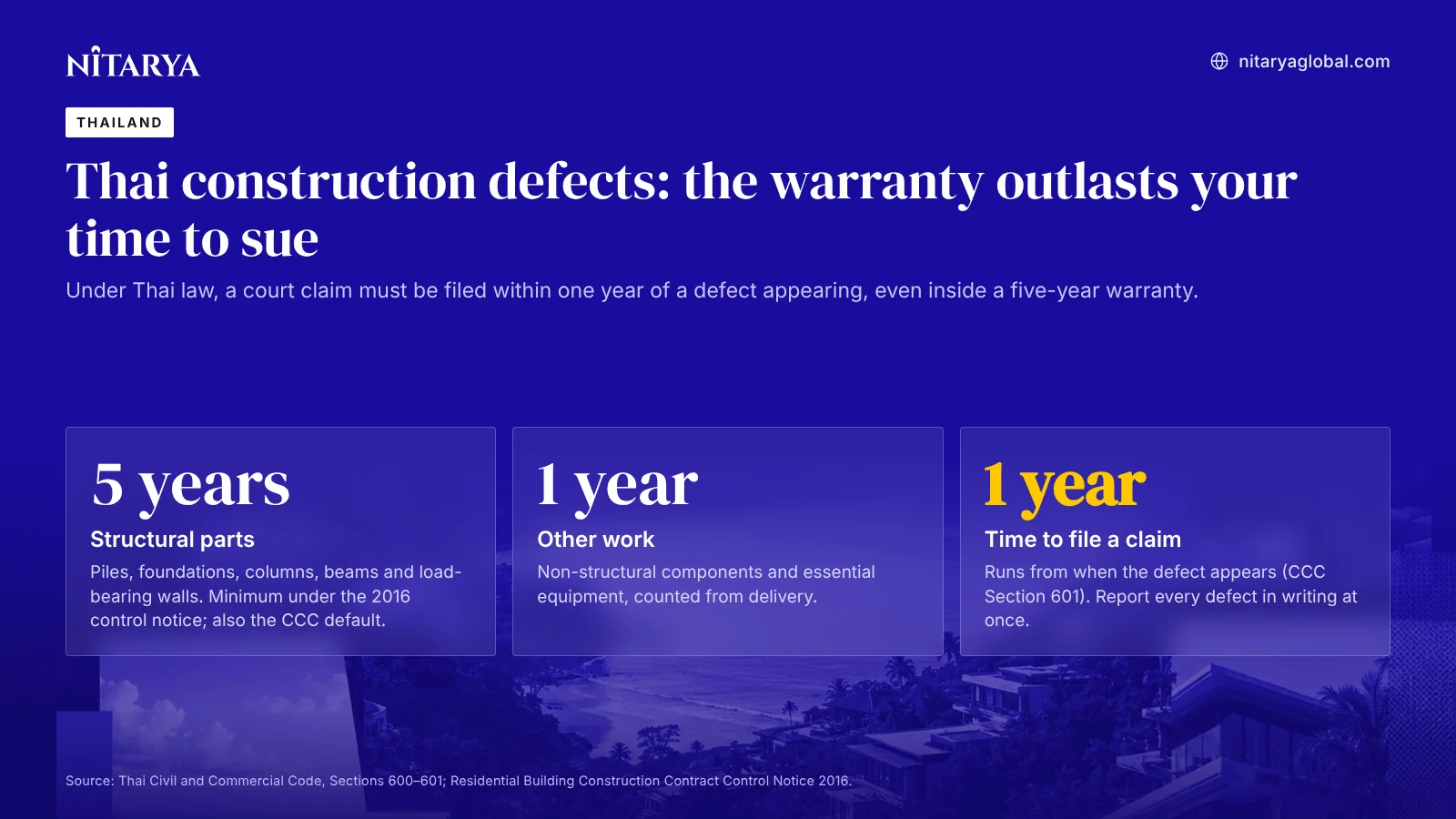
| 2016 control notice (residential contracts with consumers) | At least five years (piles, foundations, columns, beams, load-bearing walls) | At least one year from delivery for non-structural integral components or essential equipment |
| CCC Section 600 (default rule) | Five years for non-wooden structures on land | One year for general work |
The time limit to sue is shorter than the warranty. Under Section 601, legal action must be filed within one year of the defect appearing, or the right to sue expires.
If you live in the UK, that means arranging someone local to inspect the house at least annually and to give written notice of any defect promptly. A warranty you cannot practically invoke has little value.
Inspections and handover
Build in inspection rights at each milestone, a snag list procedure at completion, and a rule that final payment and retention release follow a signed handover certificate.
An independent engineer or architect acting for you, not for the contractor, should sign off the stages. Photograph progress and keep dated records.
Given that evidence can establish what was agreed, a clear paper and photo trail is your strongest asset in any later argument.
Permits: who holds them and why it matters
Before any contract is signed, establish who is applying for the building permit and in whose name. As a guide, the landowner, or the party with the registered right to build, should hold the permit.
Unauthorised construction, such as building without a permit or adding a floor outside the approved plans, can lead to demolition orders or daily fines from local authorities.
This connects directly to what you can own.
A foreign buyer generally cannot hold freehold land, so the structure of your land rights (a lease, a usufruct or another arrangement) affects who can lawfully apply for a permit and who owns the building once built.
Read our guides on freehold or lease and the 30-year checks and on registering a usufruct before you commit to a build. For the permit itself, our building permit check guide explains what to compare against the approved plans.
Your contract should therefore say:
- Who applies for and pays for the permit and any amendments.
- That construction will follow the approved plans and that any change requiring a permit amendment is handled before the work is done.
- That the contractor bears the cost of corrective work if it builds outside the approved plans without your written instruction.
- How access to the plot is secured. Our note on checking right of way shows why a plot with no legal access can stall a build.
Language: Thai and English versions
Most contracts offered to foreign clients are bilingual. Do not assume the English text is the one that counts.
Under Section 14 of the CCC, if the two versions conflict and the intended governing language cannot be established, the Thai version prevails.
The practical answer is twofold: state in the contract which language governs, and have an independent lawyer who reads Thai confirm that the two texts say the same thing.
A short English summary supplied by the contractor is not a substitute.
If you cannot attend signing, a power of attorney is often used. It carries its own risks if drafted too broadly, which we cover in our guide to power of attorney in Thailand.
Remedies and dispute resolution
A well-drafted contract states what happens when the contractor is late, abandons the site or builds badly.
Remedies that may be available include termination for qualifying delay, repair or completion by a third party after notice, and a price reduction for late delivery.
Each usually depends on written notice, so the contract should name a notice address and an email, and require a cure period.
For disputes, the options are the general civil courts, mediation or arbitration, including through the Thai Arbitration Institute (TAI) or the Thailand Arbitration Center (THAC).
Arbitration is attractive for its neutrality and confidentiality, but the International Bar Association notes that the losing party may still try to challenge an award in court, which can add delay.
Its guide dates from 2018, so ask your lawyer to confirm the current position. Choose the forum deliberately, because enforcing a judgment or award against a contractor with few assets is a separate problem from winning it.
Checks to complete before you pay a deposit
The construction contract is only one part of the purchase. Before any money moves, an independent legal representative should do the following.
- Check the title at the Land Office. Confirm ownership and encumbrances directly with the local Land Office, and make sure the title deed matches the physical boundaries of the plot.
- Compare permit and plans. Check the building permit against the approved drawings and, for an existing structure, the as-built layout.
- Verify the contractor. Ask for company registration details, previous projects you can visit, and evidence of financial standing, particularly where you are asked for a large advance.
- Verify the developer's claims. Brochure promises on specification, completion and rental performance are not contract terms unless they are written into the contract.
- Review the whole contract set. Drawings, specification, BOQ, payment schedule and warranty should all be annexed and signed.
If you are buying a unit in a condominium rather than building, the ownership questions change; see our guide to the 49% foreign quota for condominiums.
Our perspective
Most disputes we see reviewed are not caused by a single bad clause. They come from missing evidence: a drawing that was never annexed, a permit held in the wrong name, a payment released against a promise rather than an inspected stage.
Our view is that a buyer in the UK needs someone whose only client is the buyer. Contractors, agents and developers each have a reason to move the deal forward.
Our reviews are designed to make material risks and gaps in the evidence visible before capital is committed, and across more than 380 property decisions we have reviewed, one in three identified a significant issue that changed the deal.
For a construction project, that means reading the contract against the land rights, the permit and the payment plan together, not separately. A sound contract on land you cannot lawfully build on is still a problem.
We would rather you found that out before the deposit than after the foundations.
Neerraj
Getting the contract and the land reviewed together
If you have a shortlisted plot or villa project in Thailand and a draft contract in hand, our Thailand property due diligence service reviews ownership rights, developer and counterparty, permits and ongoing obligations, and sets the findings out in a structured decision file coordinated with legal, technical and market specialists.
No price is published; you can enquire through the service page.

See our Thailand property due diligence service for how a review works before purchase, or our pre-purchase, during-purchase and after-purchase reviews if you are already part-way through a transaction.
FAQ
Do I need a written construction contract in Thailand?
The law does not require one: the Ministry of Justice explains that a construction agreement can be proved by witnesses, photographs or other evidence.
For a buyer abroad that is a risk, not a convenience. Insist on a signed written contract with annexed drawings, specification and BOQ, and for residential work with a business the control notice expects those items anyway.
Which version of a bilingual contract applies?
If the Thai and English texts conflict and the parties' intended governing language cannot be established, the Thai version prevails under Section 14 of the CCC.
State the governing language in the contract and have a Thai-reading lawyer compare both versions line by line before signing.
How long is the contractor responsible for defects?
Under the 2016 control notice, structural parts carry at least five years and non-structural integral components or essential equipment at least one year from delivery.
Under the CCC default rules, general work is one year and non-wooden structures on land five years. Any court action must be filed within one year of the defect appearing, so report defects in writing at once.
Who should hold the building permit?
The landowner, or the party with the registered right to build, should hold it. Building without a permit or outside the approved plans can lead to demolition orders or daily fines.
Check the permit against the approved drawings before you sign, and state in the contract who is responsible for amendments.
How are construction disputes resolved?
Options include the civil courts, mediation and arbitration through bodies such as TAI or THAC. Arbitration offers neutrality and confidentiality, though an award can still be challenged in court.
Choose the forum and the governing law in the contract, with advice from a Thai-qualified lawyer.
Sources
- 587-607 Construction Hire of Work Law, Thai Civil and Commercial Code
- Residential Building Construction Contract Control Notice 2016 (Thai text)
- Residential Building Construction Contract Control Notice 2016 (English summary)
- Section 14, Thai Civil and Commercial Code
- Construction Law in Thailand: Contracts and Disputes
- Ministry of Justice: legal knowledge series on contractors who abandon work
- International Bar Association: Thailand arbitration country guide