
UK Investor Risks in Thailand Property: What to Verify First
The main risks for UK investors buying Thai property, from title and the 49% quota to yield, tax and exit costs, and how a decision file tests each one.

Free Thailand ownership guide Book a free 15-minute call
On this page
The main risks for a UK investor in Thai property are not the headline ones.
They are ownership you cannot hold in the form you expected, a developer's claims you cannot check, a yield that shrinks after costs, UK tax on money that never left Thailand, and an exit that costs more than planned.
Each can be tested before a deposit is paid. At NITARYA we review the specific property independently, on the buyer's side, and issue an evidence-based decision file, so that the risks are visible before capital is committed.
TL;DR
- A foreigner cannot own land in Thailand. Freehold is possible only for a condominium unit within the building's 49% foreign quota, and a villa is normally held on a lease.
- Check title, developer, building permit and quota room before paying a deposit, not after.
- Advertised yields are usually gross. Net returns after vacancy, management, fees and tax are materially lower.
- UK residents are taxed on worldwide income and gains, so Thai rent and sale profits are reportable in Britain.
- Exit costs on a short hold can reach roughly 10% of the price, and a full quota can make resale slower.
Ownership: what you can actually hold
Thai law prohibits foreign individuals from owning land. The only freehold route is a condominium unit within the 49% foreign ownership quota of a registered project.
If the quota is full, no further foreign freehold title will be registered.
The Thai government's own guide adds that condominium purchases are outside the land-ownership test, but the purchase money must be transferred from a foreign bank, with receipts and bank certificates, to prevent money laundering.
In practice, this means two questions come before price. Is there quota room in this building, and will the funds arrive in the form the Land Department requires?
Our guide to foreign condo ownership and the 49% quota sets out the check in order.
Villas and leases
A villa is normally held on a registered lease of up to 30 years.
In March 2025 the Supreme Court reaffirmed that leases beyond 30 years are void, so "30+30+30" renewal clauses are not binding and must be renegotiated at the end of each period.
A renewal that rests on the landowner's goodwill does not automatically pass to the landowner's heirs, so a renewal option has to be written into the original lease.
Nominee company structures, where Thai names hold land on a foreigner's behalf, are illegal.
Recent enforcement looks at effective control rather than share percentage, so a company that is Thai on paper but foreign-controlled in fact can still be barred from owning land.
Our comparison of freehold and lease for UK buyers covers the 30-year checks.
Title and seller claims
There are five main title documents in Thailand. According to Chambers' Real Estate 2026 chapter, only two are true ownership titles: the chanote (land title deed) and the Condominium Unit Title.
The others, Nor Sor 3 Gor, Nor Sor 3 and Sor Kor 1, are possessory rights. The same source says wrongfully issued titles are not unknown and official records are sometimes lost or destroyed, which is why searches matter.
Before a deposit, a title review should confirm:
- The title is a true ownership title, in the name of the seller or developer.
- There is no undisclosed mortgage or encumbrance (a legal claim on the property).
- The seller's identity and authority to sign are verified.
- For a condominium, the juristic-person (building management) letter confirms quota room and that no fees are outstanding.
Chambers notes that buyers typically have a law firm search the land office, local administrative office, forest and natural resources offices, public works and planning office, civil and bankruptcy courts and the department of legal execution.
Sellers usually give contractual warranties of ownership and no third-party rights. Our Thai condo title search guide lists what to ask for before you pay.
Developer and building risks
Off-plan purchases carry the most exposure.
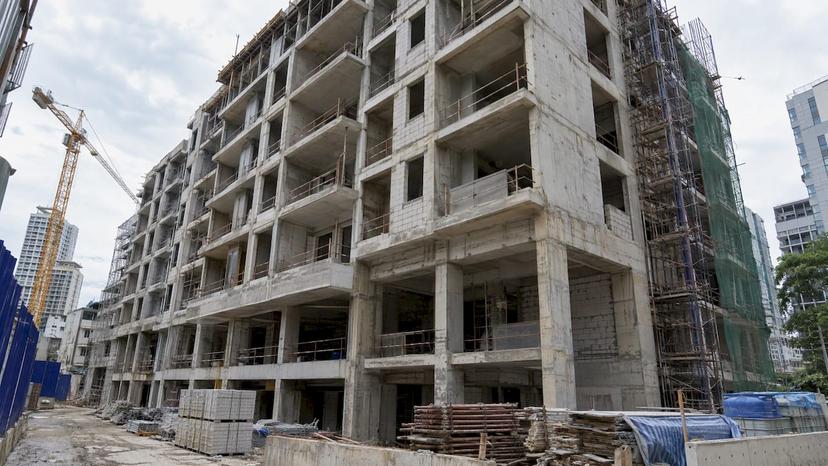
Commonly listed risks include developer insolvency, construction delays of several years, quality gaps against the showroom, rental-pool management on poor exit terms, projects built without required environmental approval, and quota sold through before registration, leaving a buyer with a lease instead of freehold.
The developer check is practical rather than theoretical.
A developer due diligence guide recommends looking at completed buildings for handover delays, common-area condition, who manages the building now and whether units were genuinely transferred to buyers.
It also advises confirming that the building permit was issued to the company signing your contract and matches the floors, units and use, and paying only to the selling company's account.
Condominium sale contracts must follow the government standard form, with the schedules carrying the important detail.
Permits are a frequent weak point, so we have written a building permit check for buyers.
Testing the yield
Advertised rental returns are asking prices, not facts.
One guide reports that developers' quoted 8 to 10% "guaranteed yields" are almost always gross figures, with realistic net yields typically 3 to 5% after management, vacancy and maintenance in its 2026 analysis.
A worked example from a rental yield guide shows the mechanics. At a price of THB 6,000,000 (Thai baht) and annual rent of THB 420,000, gross yield is 7.0%.
After 1.5 vacant months, 12% management on collected rent, THB 48,000 of maintenance and an illustrative THB 12,000 tax input, net yield falls to about 4.4%.
The tax figure is an input, not a rate, and should be confirmed with a qualified adviser.
For your own model:
- Keep it in baht, then convert to sterling at the end.
- Subtract common-area fees, sinking fund, land and buildings tax, insurance, repairs, furniture replacement, management and vacancy.
- Check whether management fees apply to booked or collected rent.
- Stress-test three assumptions: months vacant, rent achieved against rent asked, and years to resell. If the deal only works when all three are optimistic, the margin of safety is thin.
If you plan short lets, read our summary of Airbnb rules in Thailand first, because permitted use is a building and licensing question, not only a market one.
UK tax and currency
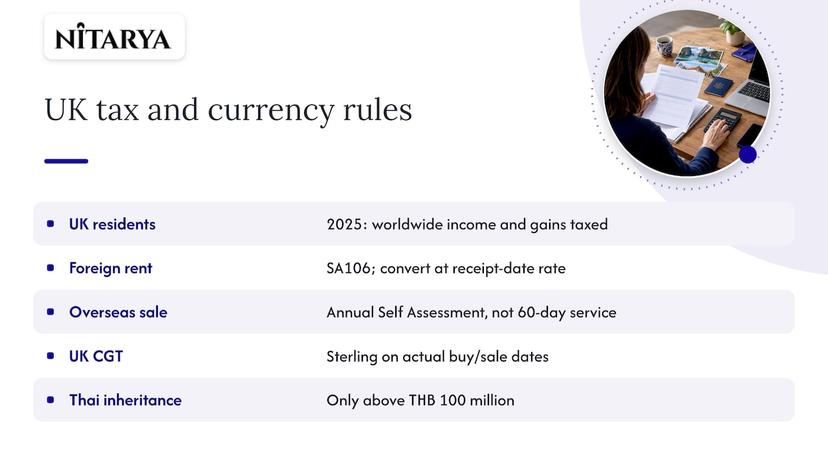
From 6 April 2025 the UK abolished the remittance basis, so UK residents are taxed on worldwide income and gains. Thai rent and sale profits are reportable even if the money stays in Thailand.
The same guide states that foreign rent is declared on the SA106 (foreign pages of Self Assessment), converted to sterling at the rate when received, and that a gain on an overseas sale goes through annual Self Assessment rather than the 60-day UK property service.
Currency is the less obvious risk.
UK capital gains tax is calculated in sterling on the actual purchase and sale dates, so a property flat in baht can still produce a UK gain if sterling weakened, and a real local profit can shrink if it moved the other way.
Inheritance tax also changed. UK inheritance tax moved to a residence-based system from April 2025, and long-term UK residents stay in scope for a period after leaving.
Thailand has its own inheritance tax, applying only above THB 100 million, and without a valid will Thai assets pass under statutory heirship rules.
Record Thai rent and expenses cleanly through the year; tools such as UK income tax record keeping help with the Self Assessment side. Our guide to Thai property taxes for UK buyers covers reporting in more detail.
For your own position, take advice from a UK tax adviser.
Exit costs and liquidity
Foreigners can sell a condominium and repatriate the proceeds, but the buyer's eligibility under the quota must be checked. Sellers pay withholding tax, plus 3.3% specific business tax if the property is held under five years.
One worked example on a 5,000,000 baht unit puts the cost of selling in year 3 at about 515,000 baht, including specific business tax, half the 2% transfer fee, withholding tax and agent commission, against about 375,000 baht in year 6 once stamp duty replaces the business tax.
That is roughly 10% of the price on a short hold. The same source notes that a building with a used-up foreign quota sells more slowly, because some buyers drop out at the checking stage and others ask for a discount to take a lease.
So model resale before you buy: a realistic hold period, a sale discount, and a buyer pool narrowed by quota.
Perspective
Most of the deals we review do not fail because of one dramatic fraud.
They fail because something material was never put in front of the buyer: a quota that was nearly full, a permit issued to a different company, a yield that was a gross figure.
Across more than 380 property decisions we have reviewed, one in three revealed a significant issue that changed the deal.
That is why we work only for the buyer, independently of developers and agents, and why legal, technical and market specialists feed one structured decision file.
Our view is simple. A decision file should tell you what you would own, what remains after costs, and which assumptions would break the deal, before the deposit leaves your account.
Neerraj
How NITARYA supports the decision
We offer independent due diligence before buying, during purchase and after buying, each producing a decision file tailored to the property.
If you have shortlisted a Bangkok or Phuket unit, start with our Thailand property due diligence service, or see the due diligence checklist, costs and timeline first.

The review covers ownership rights, developer and counterparty assessment, regulatory and permit checks, and financial and ongoing obligations, so the risks above are answered with evidence on your specific property.
FAQ
Can a UK citizen own property in Thailand outright?
Only a condominium unit can be owned freehold, and only within the building's 49% foreign quota. Land cannot be owned by foreigners, so a villa is normally held on a registered lease of up to 30 years.
Is Thai rental income taxable in the UK?
Yes. Since 6 April 2025 UK residents are taxed on worldwide income and gains, so Thai rent is reported on the foreign pages of Self Assessment, converted to sterling.
Relief for Thai tax may be available under the UK and Thailand double taxation agreement, so confirm with a UK tax adviser.
What yield should I assume?
Treat any advertised figure as gross. One 2026 analysis puts realistic net yields at 3 to 5% for Phuket condominiums, and your own model should deduct vacancy, management, fees, tax and repairs.
What does it cost to sell?
On a short hold, roughly 10% of the price in one worked example, falling after five years when specific business tax is replaced by stamp duty. Agent commission and withholding tax are part of the total.
Sources
- Foreign property ownership in Thailand, Thai government guide
- Real Estate 2026, Thailand, Chambers
- Property Investment Report: December 2025, Lexology
- Overseas Property for UK Residents: Tax Guide and Pitfalls
- Phuket Property Investment: Should Expats Buy in 2026?
- Checking a Thai Property Developer
- Thailand Property Rental Yield: Rent, Vacancy and Costs
- Understanding ROI on Thai property
- Phuket Property Guide for British Buyers
- Moving to Thailand from the UK
- Financial Planning for European Expats in Thailand
- How a Foreigner Sells Property in Thailand
- Multiple Income Streams and Tax in the UK