
SPA Contract Review for a Thai Property Purchase
What a sale and purchase agreement review should cover before a UK buyer pays a Thai property deposit: title, quota, payments, default, and the evidence to keep.


Free Thailand ownership guide Book a free 15-minute call
On this page
- TL;DR
- What the SPA is, and what it is not
- Step 1: Test the seller before the clauses
- Step 2: Confirm the right you are buying can be registered
- Step 3: Read the clauses that move money and risk
- Red flags that deserve a pause
- Step 4: Keep a decision file
- How the review changes by buyer
- Why a buyer-side review beats relying on the seller's lawyer
- Perspective
- Where NITARYA fits
- FAQ
- Sources
- Recommended

A sale and purchase agreement (SPA) review for a Thai property should test the contract against evidence, not just read the wording.
Before you sign or pay a deposit, the review must confirm that the seller can lawfully deliver what the contract promises, that the right you are buying can be registered in your name, and that your money comes back if it cannot.
In an independent buyer-side review, the contract is one document among several, and every clause is checked against the title, the developer's record and the foreign ownership rules.
This article is for UK buyers who have a Thai condominium or villa on a shortlist and a draft agreement on the table.
It is about the sale and purchase agreement for property, not a share purchase agreement used in company acquisitions, which some search results mix in.
TL;DR
- The SPA is a private contract. Ownership of Thai property changes only when the transfer is registered at the Land Office, so every promise in the SPA matters only if it can be carried through to registration.
- Before paying, check four things against evidence: who owns the unit or land, what the title records against it, whether a foreign buyer can hold it, and what happens to your deposit if either fails.
- The clauses that decide outcomes are the property description, the payment schedule, the completion date and delay remedy, the default clause, the tax and fee split and the governing language.
- Keep a decision file: the evidence you obtained, the clauses you changed, the risks you accepted and the items still unresolved.
- A condominium purchase by a foreigner depends on the 49% foreign quota and on proving funds came from abroad. The contract should say so expressly.
What the SPA is, and what it is not
In Thailand the SPA is the contract between buyer and seller, or buyer and developer for an off-plan unit. It fixes the price, the payment schedule, the completion date and the remedies if someone fails.
UK buyers often assume it works like exchange of contracts in England and Wales, where the buyer becomes the beneficial owner on exchange. It does not work that way here.
The SPA is not the transfer. Ownership passes when the transfer is registered with the competent official at the Land Office, and that registration is a separate step after the SPA.
A UK guide to buying land in Thailand lists signing the SPA as one step in a longer sequence that ends with final payment and registration at the Land Department.
The consequence is practical: you can be contractually committed and have paid a substantial sum while owning nothing. The contract therefore has to describe, precisely and enforceably, what happens if registration does not take place.
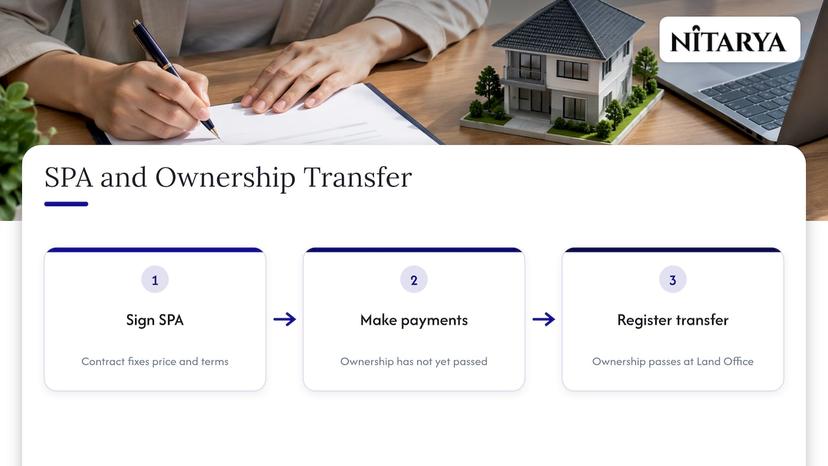
That is why a review that only proofreads the SPA falls short. A well drafted clause is worth little if the seller does not hold clean title, or if the unit cannot be registered in a foreign name.
Step 1: Test the seller before the clauses
Start with the counterparty, because the contract is only as good as the party signing it.
For an individual seller, obtain an official title search or certified copy from the Land Office, not a photocopy supplied by the agent.
The strongest Thai land title is the Chanote (the full title deed, Nor Sor 4 Jor), but it does not by itself prove that the person in front of you is the current owner or that nothing is registered against it.
The back of the deed can record mortgages, leases, usufructs, servitudes, court orders or seizures, and a copy, a stamp or a seller's assurance is not a substitute for an official search.
Our guide to the Thai condo title search before a deposit sets out what to ask for and what each entry means.
For a developer or corporate seller, check the company registration, who is authorised to sign and on what terms, and whether the signatory's authority matches the name on the contract.
Then look at the project itself: the permits for the building, the land the project stands on, and whether the unit exists as described.
Off-plan sales add a further question, which is whether the developer has the land and approvals needed to deliver the unit at all.
A mismatch at this stage is the cheapest problem you will ever find. Found after the deposit, it becomes a refund negotiation.
Step 2: Confirm the right you are buying can be registered
The next question is the one the contract usually answers least clearly: what exactly will you own?
For a condominium, a foreign buyer can hold freehold title only if foreign-owned floor area in the building stays within the 49% quota and the buyer qualifies, most commonly by bringing the full purchase price in from abroad and holding the paperwork to prove it.
The Foreign Exchange Transaction form (often shortened to FET) is the bank-issued record of that inward remittance, and the Land Office asks for it at registration.
Our explainer on the 49% quota check covers how the quota is verified for a specific building.
For a villa or house, the position is different, because a foreigner generally cannot own the land.
Buyers therefore end up with a lease, a usufruct (a registered right to use and take the benefit of property) or another structure, and each of these carries its own risk.
On leases, a 2025 Supreme Court decision in a Phuket case voided pre-agreed 30-year renewal clauses where the tenant had prepaid 90 years of rent, ordered the tenant to leave and set damages.
A lease that reads as 90 years in the brochure may therefore be enforceable for far less. We cover this in Thailand freehold or lease for UK buyers and, for usufruct, in why an unregistered usufruct can be lost.
For the SPA review, translate this into two questions:
- Does the contract name the exact right promised (freehold in a condominium unit on the foreign quota, a registered lease for a stated term, a registered usufruct)?
- Does the contract say what the seller must do, and what you recover, if that right cannot be registered?
If the answer to either is vague, you carry the quota and title risk, whatever the sales brochure says.
Step 3: Read the clauses that move money and risk
With the seller and the right established, read the contract for risk allocation. These are the provisions that most often decide how a dispute ends.
Property description and inclusions
The description should match the Land Office record: exact address, unit number, floor, floor area, title or condominium reference and the name and authority of the signer.
Inclusions (furniture, fittings, parking, storage) should be listed in a schedule, with the price stated in baht.
If the marketing material shows a pool view, a parking bay or a finish level that you are paying for, it belongs in the contract, because brochures are not contractual promises unless the SPA incorporates them.
Deposit and payment schedule
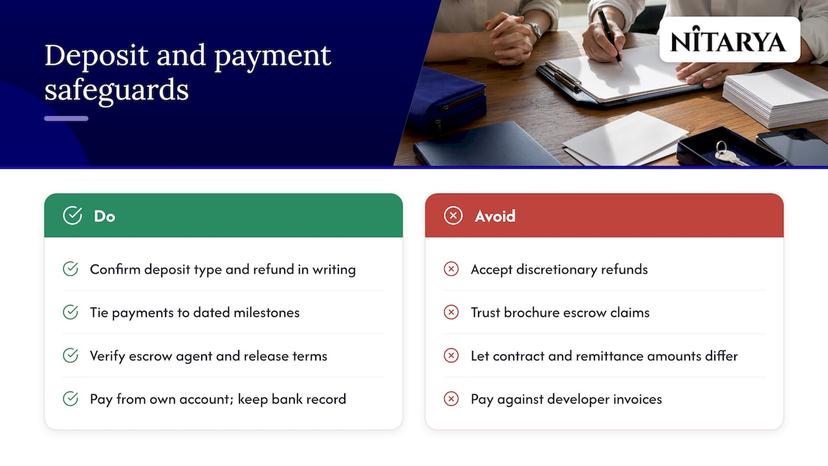
A reservation deposit and the first SPA instalment are different things. Check in writing which one you are paying, whether it is refundable, and on what conditions.
A sound structure ties payments to dated or construction milestones rather than to the developer's invoices, and makes the refund automatic, not discretionary, if due diligence fails or the foreign quota is unavailable.
Deposit sizes vary by project and off-plan contracts commonly ask for a large share up front, so compare the percentage with what you can recover if the project stalls.
If the payment is described as protected by escrow, treat it as direct exposure to the seller until you have identified the escrow agent, the agreement, the account and the release conditions.
A word on a brochure is not a protection.
Pay from your own account in your own name and keep the bank confirmation.
That record underpins the FET and the Land Office registration, and it is also the paper trail your UK lender or accountant may ask for, as with proving the source of a deposit generally.
Make sure the amount in the contract matches the amount on the remittance advice: a mismatch is a common cause of registration delay.
Completion date and delay remedy
Look for a fixed transfer or completion date, not "on or about" or "when the building is ready". Then look at the remedy.
A daily penalty or interest for seller delay, and a right to terminate with a full refund after a stated long-stop date, are what give the date meaning.
For off-plan, check also what counts as practical completion, and whether the developer can substitute materials or change the specification without your consent.
Default and termination
Compare the two sides. A buyer default clause that forfeits the whole deposit for a minor lateness is out of balance, and so is a contract where the seller's default costs the seller nothing.
Ask for a notice and cure period, a proportionate penalty and the same remedies in both directions.
Taxes, fees and ongoing costs
State who pays the transfer fee, specific business or stamp tax where relevant, withholding tax and the registration costs.
A government cut in transfer and mortgage registration fees to 0.01% through June 2026 applied only to Thai nationals buying property of 7 million baht or less, so foreign buyers still face the standard 2% transfer fee on freehold.
If the SPA is silent, ask for the split to be written in. For the wider picture, see Thailand property taxes for UK buyers, and if you will later sell, the withholding tax on a Thai property sale.
Also ask about the ongoing obligations that arrive after transfer: common-area fees, sinking fund contributions, and any arrears attached to the unit.
These belong in the contract as seller warranties, with the arrears settled before transfer.
Language and governing version
Many Thai SPAs exist in Thai and English. The contract should say which version prevails. If the English text is a courtesy translation and the Thai prevails, you need the Thai text checked, not summarised by the party selling to you.
Red flags that deserve a pause
These patterns recur in draft agreements, and each is a reason to stop and ask for a change before any money moves.
| Red flag | Why it matters | What to ask for |
|---|---|---|
| Deposit non-refundable "for any reason" | You absorb quota, title and permit risk | Full refund if due diligence fails or quota is unavailable |
| No stated consequence if the unit cannot be registered in your name | The failure of the whole purpose of the purchase has no remedy | Termination and refund clause tied to registration |
| Open-ended completion date | No leverage over delay | Fixed date, daily penalty and a long-stop termination right |
| Buyer penalty far heavier than seller penalty | One-sided default risk | Mutual, proportionate remedies and a cure period |
| Contract price differs from the remittance or credit advice amount | Registration delay or tax problems | One consistent figure across all documents |
| Signer's authority not evidenced | Contract may bind no one | Company records and authority to sign attached |
| Marketing claims missing from the contract | Brochures are not promises | Schedule of inclusions and specification |
| Thai text differs from English text, and Thai prevails | You are bound by terms you cannot read | Checked translation before signing |
None of these is exotic. They are the ordinary result of a contract written by the seller for the seller.
Step 4: Keep a decision file
A review is only useful if it ends in a decision you can defend. Whoever carries it out, the output should be a file with four parts:
- Evidence obtained: the official title search, company records, permits, the remittance record and any approvals, each dated.
- Clauses to amend: the changes you require before signing, and the seller's response to each.
- Risks consciously accepted: items you have understood and chosen to carry, with the reason.
- Unresolved items: anything that must be settled before you pay. If one stays open, it stops the deal.
This matters later. If you resell, remortgage, bring in a co-owner or plan succession, the file is the record of what you bought and why. Our Thailand property due diligence checklist, costs and timeline shows how the pieces fit together.
How the review changes by buyer
The same contract reads differently depending on what you intend to do with the property.
- Family use and investment (Bangkok or Phuket condominium): the quota and the funds trail come first, then the delay remedy, because an unfinished unit earns nothing.
- Rental investor: check whether the building permits short lets, who manages the project, and what the common-area charges are. These feed directly into net yield, which is lower than the advertised figure once management, vacancy, fees and tax come off.
- Retirement villa: the structure is the question. Confirm what right you hold, its registered term, and what happens to it on your death. Succession for a foreigner in Thailand needs separate advice from a Thai lawyer, so raise it before signing, not after.
- Second home used between the UK and Thailand: check house rules, rental restrictions and the exit route, since your ability to sell depends on the quota and on the tax position described above.
- Family office or finance director: the decision file is the deliverable. Ask for assumptions that would make the deal fail to be stated, and for the downside to be documented.
Why a buyer-side review beats relying on the seller's lawyer
The sales team, the developer's lawyer and the agent all have a reason to close, and none acts for you.
A review commissioned by the buyer starts from the opposite premise: what evidence is missing, and what would make this purchase a mistake?
Our track record shows why that matters. Across more than 380 property decisions reviewed, one in three reviews identified significant issues that changed the deal.
That is a statement about our own caseload, not a market statistic, but it is consistent with the pattern above: the problem is usually in the gap between the contract and the evidence, not in the wording alone.
Perspective
We review the contract last, not first. That order surprises buyers, who arrive with a draft SPA and expect us to mark it up.
A contract can be perfectly drafted and still fail you, because it describes a right the seller cannot deliver or a quota position nobody has verified.
So we start with ownership, the developer and the permits, then the financial obligations, and only then read the clauses against what we found.
The result is a decision file, assembled with legal, technical and market specialists, that tells you what is evidenced, what is missing and what you would be accepting by signing.
Buyers who see that file before paying negotiate from knowledge, and some decide not to proceed. We regard both outcomes as the service working.
Neerraj
Where NITARYA fits
If you have a specific unit or villa and a draft agreement, the Thailand property due diligence service reviews that property for you as the buyer: ownership rights, the developer and counterparty, permits, and the financial and ongoing obligations.
It is independent of the seller and the agent. If you have already signed or paid, the during-purchase review covers the stage between contract and completion.

The sensible time to start is before the deposit, when every item in this article can still be changed.
FAQ
When does a Thai SPA become binding?
The SPA is binding between buyer and seller once signed, but ownership does not pass until the transfer is registered at the Land Office.
A sale of real property is legally effective as a transfer only when it is in writing and registered, so a signed SPA alone does not make you the owner.
Treat the SPA as a commitment to a process, and make sure it says what happens if registration fails.
Can I get my deposit back if the foreign quota is full?
Only if the contract says so. Many reservation agreements are silent or say the deposit is non-refundable.
Ask for a written clause making the deposit fully refundable if due diligence finds a problem or the unit cannot be sold to you on the foreign quota.
Confirm the quota position for the building before you pay, as set out in our 49% quota guide.
Should a Thai SPA be checked in Thai or English?
Both, if both exist. The contract should name the version that prevails, and if it is the Thai text, that is the text that needs reviewing.
A courtesy English translation that differs from the Thai can leave you bound by terms you have not seen.
What should I keep after signing?
Keep the signed contract in both languages, the official title search, the company records, the receipts, and the bank record of your remittance from your own UK account.
Keep also the inward remittance form that the Land Office asks for at registration. Together with your list of amended clauses and accepted risks, these form the decision file that supports a later sale, a tax return or a succession plan.
Sources
- Buying land in Thailand as a foreigner: UK guide
- How to Read a Thai Chanote Land Title, Chiang Rai Times
- Freehold or leasehold in Thailand, The Thaiger
- Proving your deposit as a self-employed mortgage applicant