
Thai Condo Title Search: What to Check Before a Deposit
How a Thai condo title search works, which Land Office documents to check, what it cannot prove, and what a UK buyer should verify before paying a deposit.

Free Thailand ownership guide Book a free 15-minute call
On this page
- TL;DR
- What a Thai condo title search actually covers
- Step 1: Match the seller to the recorded owner
- Step 2: Read the back of the title, not just the front
- Step 3: Confirm the 49% foreign quota with evidence
- Step 4: Translate and certify documents early
- Step 5: Look beyond the Land Office
- Step 6: Test the building, not just the unit
- Step 7: Understand the transfer mechanics
- What a title search will not tell you
- What the wider review adds
- Our perspective
- Getting the review done before you pay
- FAQ
- Sources
- Recommended
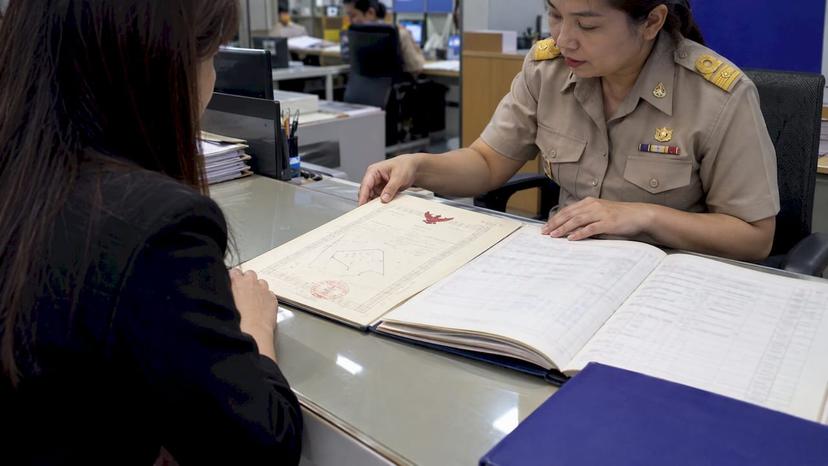
A Thai condo title search answers a narrow question: what is registered against this unit now? It does not settle the building's condition, foreign quota, accounts or rental permission.
Check those separately before agreeing to a deposit you cannot recover. NITARYA brings the evidence together and coordinates specialist review where needed.
TL;DR
- A title search shows the recorded owner, the unit's registered details and registered rights. It does not show structural condition, building arrears or the true remaining foreign quota.
- Match the seller's name to the title, read the back of the title for mortgages, leases and other rights, and obtain written discharge arrangements for any mortgage.
- Foreign buyers must evidence that foreign ownership in the building does not exceed 49% of total unit area, and foreign-language documents must be translated into Thai and certified.
- Resale units need checks beyond the title: the juristic person's accounts, the building's permits and a physical inspection.
- Do all of this before the deposit, while you can still walk away at no cost.
What a Thai condo title search actually covers
The phrase "title search" sounds like the English and Welsh process, so it helps to compare.
In England and Wales, a title register names the owner, gives the title number, records rights of way and shows whether a mortgage has been discharged.
The UK Government also explains that official copies, rather than ordinary online copies, serve as proof of ownership. That is the standard a UK buyer instinctively expects.
Thailand's equivalent is a condominium title deed held at the Land Office, and the system differs in three ways that matter.
First, a condo has two layers. There is the land and building registered as a condominium, and there are the individual units.
The Condominium Act requires registration filings to include the land title deed, the condominium plan, apartment and common-property details and ownership ratios.
Your unit's title therefore depends on the project's registration being correct.
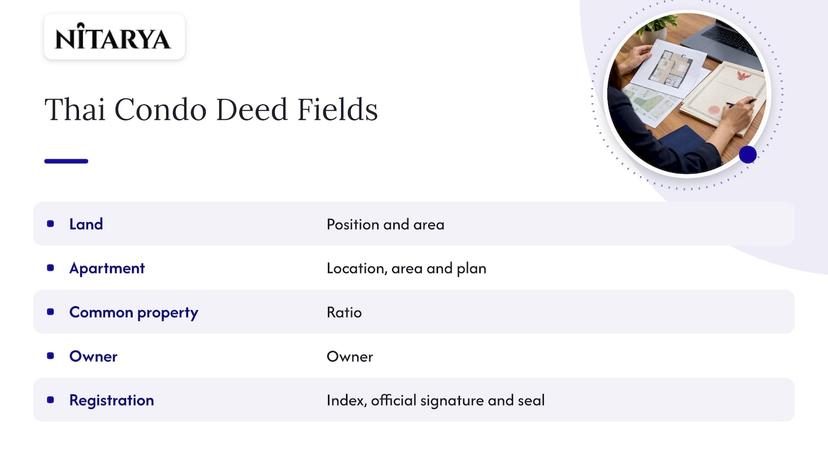
Second, the unit deed is a document with a defined content.
According to the same Act, the apartment title deed records the land position and area, the apartment's location, area and plan, the common-property ratio, the owner, the registration index and the official signature and seal.
Each of those fields is something to read, not skim.
Third, the title answers a narrow question: what is registered. It cannot answer what is true outside the register.
A clean title tells you nothing about leaking pipes, a sinking fund that has been spent, or a developer's promised rental guarantee.
Step 1: Match the seller to the recorded owner
Start with the most basic check. The name on the title must be the person or company selling to you, and they must be legally able to sell.
In practice:
- Ask for a copy of the condominium title deed for the specific unit, and compare the unit number, floor area and registration details with the sales contract and the floor plan.
- Check the seller's identity documents against the name on the deed. If the seller is a company, ask for company registration evidence and the authority of the person signing.
- If someone is acting under a power of attorney, treat that as a risk point in its own right. Our guide to power of attorney in Thailand explains why weak authority documents are a common cause of delay and dispute.
- Ask whether the unit is co-owned or marital property, since a second person's consent may be needed.
Where it goes wrong: buyers accept a photocopy supplied by an agent and never ask for a current extract. A copy supplied by the seller shows what the seller wants you to see on the day they chose.
A current record obtained through the Land Office, or through a licensed professional acting for you, shows the position now.
Step 2: Read the back of the title, not just the front
The first page identifies the unit. The registered burdens appear in the entries recorded on the back. Look for:
- mortgages and their discharge status;
- leases, including long leases registered in favour of someone else;
- court orders and seizures;
- liens and easements;
- usufructs, superficies (a right to own structures on another's land) and habitation rights.
This list reflects what property due diligence checklists commonly recommend reviewing, including obtaining written mortgage-discharge arrangements before completion.
A usufruct is worth particular attention, because it can give another person the right to use the unit for life.
See our note on usufruct in Thailand for how registration works and why an unregistered promise is a different matter from a registered right.
A point on developer mortgages: the Condominium Act states that when a mortgage was recorded against the apartment titles before registration, the first sale by the condominium applicant transfers the apartment free of that mortgage encumbrance.
That helps on a first sale from a developer. It does not mean a resale unit is free of a mortgage.
On a resale, a bank mortgage entered by the current owner stays on the title until it is formally discharged, so the discharge must be arranged in writing and tied to the transfer day.
Step 3: Confirm the 49% foreign quota with evidence
Foreign freehold ownership of a condo unit is possible, but only within a limit.
The official Thai guidance requires, for a condominium transfer, original property evidence, evidence for the foreigner as transferee, translated and certified foreign-language documents, a debt-free certificate and a juristic-person affidavit confirming that foreign ownership does not exceed 49% of total unit area.
The official guide also states that a foreign buyer must provide a letter confirming the building's foreign proportion to the Department of Lands when requesting condominium ownership.
This is the check most often skipped by buyers who assume that a unit advertised to foreigners must have quota available. Three practical points:
- The quota belongs to the building, not to your unit. Someone else may buy the last foreign-eligible space between your reservation and the transfer.
- The funds must be brought in correctly, since the Land Office needs evidence of the source of money for a foreign buyer. Confirm the exact paperwork with your lawyer and bank before sending money.
- Do not treat the agent's statement as the letter. Ask for the juristic person's confirmation in writing.
Our separate guide, foreign condo ownership in Thailand: check the 49% quota first, goes through the quota in more depth.
If your plan involves a villa or land rather than a condo, Thailand freehold or lease and the 30 year checks covers the different structures.
Step 4: Translate and certify documents early
Confirm the translation and certification requirements for each document with the receiving Land Office and your Thai lawyer. Do not assume every passport or UK-issued document follows one identical process.
Arrange the accepted documents and originals before fixing a transfer date.
Step 5: Look beyond the Land Office
A title search stops at the register. Legal practitioners in Thailand describe a wider set of searches.
The Chambers Thailand Real Estate 2026 guide says buyers commonly conduct searches at the Land Office, local administrative, forest resources, environmental and planning offices, civil and bankruptcy courts, and the Department of Legal Execution.
For a condo, these wider searches answer questions the title cannot:
| Question | Title search shows it? | Where the answer lives |
|---|---|---|
| Who is the registered owner? | Yes | Condominium title deed |
| Are there mortgages, leases or other registered rights? | Yes | Entries on the back of the title |
| Is the seller bankrupt or subject to enforcement? | No | Bankruptcy and civil courts, Department of Legal Execution |
| Is there foreign quota left in the building? | No | Juristic person's confirmation, Land Office |
| Was the building lawfully permitted and built to plan? | No | Local permit records and an inspection |
| Are common fees and utilities in arrears? | No | Juristic person's statement |
| Is the building financially healthy? | No | Accounts, meeting minutes, sinking fund |
| Do house rules allow your intended use? | No | Building regulations, including short-term rentals |
The building permit line deserves its own attention for older or unusual projects. Our building permit check guide for Thailand explains what to request and what a gap means for a buyer.
Step 6: Test the building, not just the unit
On a resale, you are buying into a shared asset.
Guidance for Bangkok buyers recommends inspecting the unit and building independently, reviewing juristic-person accounts and meeting minutes, checking sinking funds and major works, speaking with residents, and not replacing independent legal review with an agent's assurances.
In plain terms, ask for:
- Registration details of the juristic person (the legal entity that manages the condominium).
- The latest annual general meeting (AGM) minutes and financial statements.
- The sinking fund balance and any planned major works that could lead to a special levy.
- A written statement of common fees, utilities and any arrears on the unit. Debts normally follow the unit, so the seller should clear them before transfer.
- The building rules on pets, alterations and short-term letting. If you plan to rent to holidaymakers, this single rule can decide the whole investment.
If you are testing a rental plan, also read Thailand property taxes for UK buyers, since Thai rent has to be considered for UK tax reporting as well.
Step 7: Understand the transfer mechanics
Transfer is the point at which unresolved questions become harder to manage. Agree the payment sequence, mortgage discharge, debt clearance and documents before completion.
A registered title is an important record, not a substitute for the checks around it.
This is why the order of payments matters. A deposit paid on the strength of a brochure, a reservation form or an agent's confidence is money exposed while the checks above are still incomplete.
Settle the sequence in the contract: deposit conditional on satisfactory title and quota evidence, balance on transfer at the Land Office, mortgage discharge and debt clearance on the same day.
What a title search will not tell you
This is the question most buyers do not ask, and it is where decisions go wrong. A search does not:
- confirm the price is fair against recent comparable sales;
- show construction quality or defects behind the walls;
- predict rental demand, vacancy or what remains after management fees and tax;
- confirm the developer's promises, such as guaranteed returns, completion dates or facilities;
- verify the foreign quota in real time at the moment you sign.
It is one document set within a wider decision. That is why we describe the output as a decision file: the title evidence, the building evidence, the financial case and the exit options, each with its source and its open points.
What the wider review adds
A useful review does not stop at a clean title. It connects the unit record with the building accounts, permits, quota evidence and contract, then identifies which unanswered point could change the decision.
NITARYA organises property evidence and coordinates review by appropriately licensed specialists. It does not provide legal, tax, valuation or engineering conclusions.
Relevant service, referral or transaction-linked compensation and relationships should be disclosed before an engagement.
When you work with us, the review covers ownership rights verification, developer and counterparty assessment, regulatory and permit checks and the financial and ongoing obligations.
Legal, technical and market specialists contribute to a structured file, so you see where the evidence is firm and where it is missing, before you commit.
Our perspective
Most buyers come to us with a title copy and a feeling that the hard part is done. In our experience of reviewing cross-border purchases, the title is the start of the file, not the end of it.
A unit can have a perfect deed and still carry a quota problem, an arrears problem or a permit problem. A seller can be the recorded owner and still be unable to deliver what the brochure promised.
These gaps sit in different offices and different documents, which is why we review them together.
NITARYA organises property evidence and coordinates review by appropriately licensed specialists. It does not provide legal, tax, valuation or engineering conclusions. Relevant service, referral or transaction-linked compensation and relationships should be disclosed before an engagement.
Neerraj
Getting the review done before you pay
If you have shortlisted a Bangkok or Phuket unit and want the title, quota, building and financial position checked before a deposit, our Thailand property due diligence service is built for that moment.
We review the specific property and give you an evidence-based decision file. Our work runs before, during and after purchase, and you can see the full range on our main page.
Send us the unit details, the draft reservation agreement and whatever the agent has supplied, and we will tell you what is verified and what still needs evidence.
FAQ
Who can carry out a Thai condo title search?
The record is held at the Land Office, and a buyer normally has it checked through a licensed Thai lawyer or another qualified professional acting under written instructions.
A UK buyer who cannot attend in person may need a properly drawn power of attorney. We handle the verification as part of the review, working with Thai legal specialists.
Does a clean title mean the condo is safe to buy?
No. A clean title means that the registered entries show no encumbrance. It does not cover foreign quota, building arrears, permit status, seller insolvency or the physical state of the unit.
Those need separate checks before you pay.
What does a foreign buyer need to show at transfer?
Official Thai guidance lists original property evidence, evidence for the foreign transferee, certified Thai translations of foreign-language documents, a debt-free certificate and a juristic-person affidavit confirming foreign ownership is within 49% of total unit area.
A letter confirming the building's foreign proportion is also required. Confirm the current list with the Land Office or your adviser before the transfer date.
Should I check a resale condo differently from a new one?
Yes. On a first sale from a developer, the Condominium Act treats pre-registration mortgages differently, and the building has no history.
A resale adds the seller's own mortgage, years of building accounts, sinking fund, and possible major works. The checks on the juristic person and an independent inspection matter more.
When should the checks happen?
Before the deposit. After it, you have less leverage, and a problem may cost you the deposit or the deal. A deposit conditional on satisfactory title and quota evidence keeps your options open.
Sources
- Get information about property and land: search the register (UK Government)
- Condominium Law, Thai Condominium Act
- Ownership of real estate by foreigners in Thailand (Thailand.go.th, issue focus)
- Ownership of real estate by foreigners in Thailand (Thailand.go.th, guide book)
- Real Estate 2026: Thailand law and practice (Chambers)
- Due diligence checklist for buying property in Thailand
- Bangkok Condo Market 2026 Buyer Guide