International Property Due Diligence: What to Verify Before You Pay
A UK buyer's guide to international property due diligence: verify title, developer claims, ownership limits and costs before any deposit, with Thailand as the worked example.

Free guides and tools Book a free 15-minute call
On this page
- TL;DR
- Why cross-border purchases need their own due diligence
- The five areas every review must cover
- Verifying the seller, the title and the developer's claims
- What a foreign buyer can actually own
- Testing the numbers: rental yield and total cost
- Language, translation and independence
- What a decision file contains
- Before, during and after the purchase
- Our perspective
- Reviewing a specific property with NITARYA
- FAQ
- Sources
- Recommended
International property due diligence is an independent, buyer-side examination of a specific property, its seller and the rules that govern it, completed before you commit money.
For a UK buyer it answers four questions: who really owns this, what can a foreign buyer lawfully hold, what obligations come with it, and what is left after costs when you sell or let it.
We use Thailand as the worked example throughout, because its ownership rules make the questions unusually sharp.
Our own review work is built around them: across more than 380 property decisions reviewed, one in three reviews identified significant, deal-changing issues.
TL;DR
- Verify before you pay: title, encumbrances, the seller's or developer's right to sell, and the legal form of what you would own.
- Use an independent English-speaking lawyer and an independent translator, not people the agent or developer recommends.
- Check the foreign ownership limit and your exit route before the deposit, because both shape what the property is worth to the next buyer.
- Test advertised returns against management, vacancy, fees, tax and resale costs, written into the contract.
- Keep everything in one decision file, so the purchase rests on evidence rather than on a sales presentation.
Why cross-border purchases need their own due diligence
In a UK purchase you rely on a familiar framework: Land Registry entries, a regulated conveyancer, standard searches and a surveyor who speaks your language.
Abroad, each of those is replaced by a local equivalent that works differently, in another language, often with sales material doing the job of independent information.
The risk is not usually fraud.
It is gaps: a title that carries a mortgage you were not told about, a unit that exceeds the building's foreign quota, a project whose promised utilities are not connected, a rental figure that ignores half the costs.
Each is discoverable, but only if someone looks at the primary evidence before the deposit leaves your account. After payment, your leverage is gone.
The UK government's own guidance for buying abroad starts from the same point: appoint an independent lawyer who is licensed to practise and experienced in property sales, and have documents checked rather than taken on trust (GOV.UK guidance for buying property abroad).
The five areas every review must cover
Whatever the country, a proper review works through the same five areas. Missing one is how otherwise careful buyers are caught out.
| Area | The question it answers | Typical evidence |
|---|---|---|
| Title and ownership | Does the seller own it and can they transfer it? | Title deed inspected at the land registry, not a copy |
| Encumbrances | Is anything registered against it? | Search showing mortgages, leases, servitudes, liens |
| Permissions and use | Is the building lawful and is your intended use allowed? | Permits, land classification, building rules |
| Developer or counterparty | Can they deliver what they promise? | Completed projects, utilities, guarantees |
| Financial and ongoing obligations | What does it cost to hold, run and exit? | Fee schedules, management agreement, tax position |
Verifying the seller, the title and the developer's claims
Inspect the original record
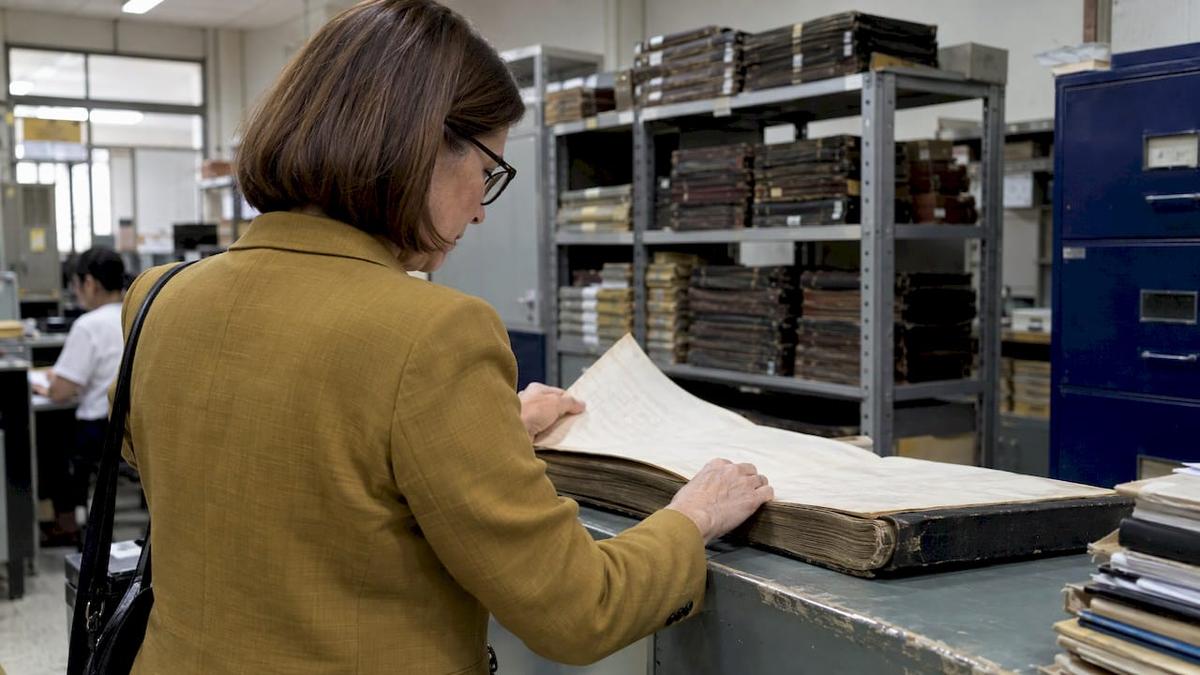
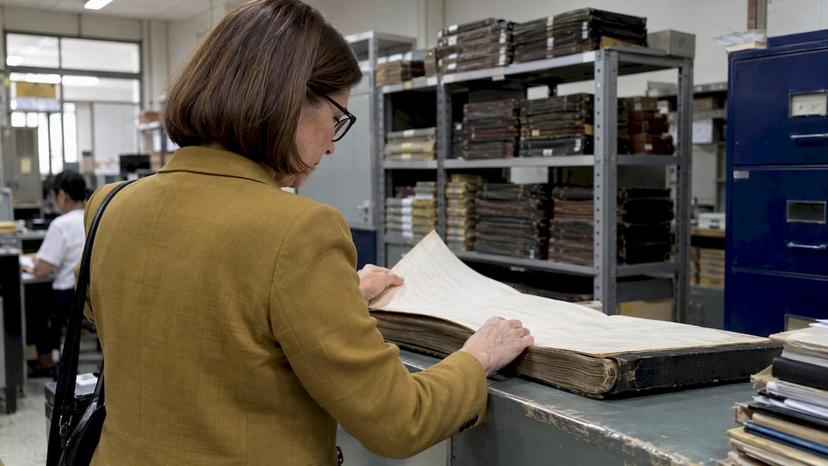
A photocopy or a scan supplied by the seller shows what the seller wants you to see.
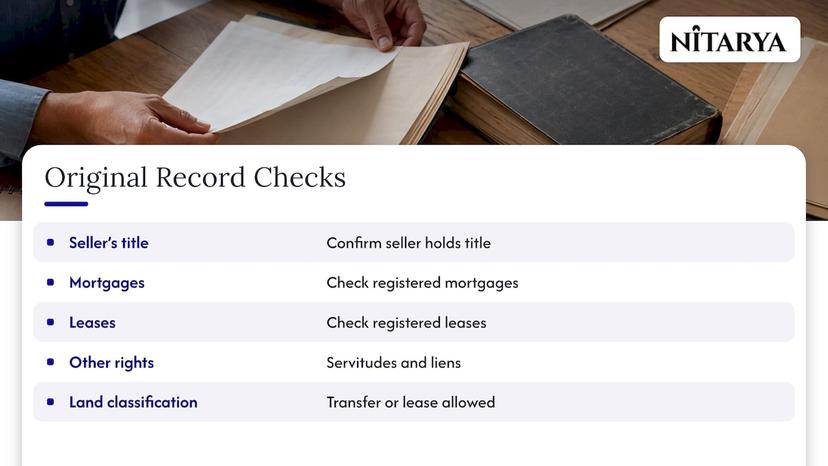
In Thailand, the guidance is that an independent legal representative should inspect the title deed at the Land Office archives, because copies and digital scans can be outdated or altered (Thailand Property Due Diligence Checklist).
The Land Office is the government registry where Thai property title is recorded, the closest equivalent to HM Land Registry.
The search should confirm the seller's title, any registered mortgages, leases, servitudes (rights another party holds over the land) and liens, and whether the land's classification allows a legal transfer or lease registration (same checklist).
What GOV.UK says to check before a deposit
For a new or partly built property, GOV.UK advises checking that the seller or developer owns transferable title deeds and that deeds actually exist for the unit.
It also says to get agreements in writing and keep receipts for every payment (GOV.UK). Before paying, confirm that:
- The deeds have not been offered as collateral for a loan.
- Outstanding utility bills or local taxes will not become your liability.
- Water, sewage and electricity are connected.
- The developer has met its commitments to provide utilities.
For off-plan purchases, where you pay before the building exists, the same guidance advises requiring a bank guarantee before you pay. That single step changes your position from creditor of a company to holder of a secured claim.
Check the building, not only the unit
A clean unit title does not make a lawful building. Permits, the approved use of the land and access to it all sit outside the unit's paperwork.
We cover the permit side in our building permit check guide for Thailand and the question of whether a property can actually be reached in checking right of way before you pay.
What a foreign buyer can actually own
This is where a purchase most often changes shape.
Foreign nationals in Thailand may own condominium units freehold, provided total foreign ownership in the building does not exceed 49% of the total saleable floor area, a limit set by the Thai Condominium Act B.E. 2522 (1979) (The Thaiger).
The building's juristic person, the legal entity that manages the condominium, holds the figures, and independent due diligence should confirm the quota with it before you pay (Thailand Property Due Diligence Checklist).
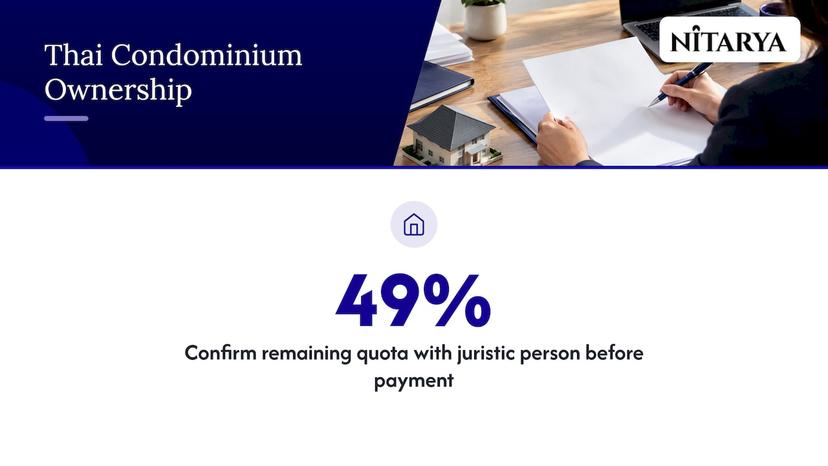
If the quota is already used, the unit is not available to you on a freehold basis, whatever the sales agent says. Our guide to the 49% quota in foreign condo ownership explains how to test it.
Villas and land are different, and so is the question "what happens to it later?"
Leasehold, usufruct (a registered right to use and take income from a property) and other structures each carry different control, inheritance and resale consequences.
Two pages go deeper: freehold versus lease, including the 30-year checks and usufruct and why registration matters.
Read them before you accept any structure a seller proposes, because the structure determines what the next buyer will be willing to pay.
Testing the numbers: rental yield and total cost
An advertised yield is a gross figure divided by a price. What you receive is what remains after management fees, vacancy, maintenance, service charges, tax and the cost of selling.
Compare that with your UK buy-to-let net return, calculated the same way, or the comparison is meaningless.
A workable test has five lines:
- Rent you can evidence. Use actual achieved rents for comparable units in the same building, not the developer's projection.
- Vacancy. Assume empty months, and ask what the management company's policy is on them.
- Management and fees. Management contracts in Thailand are not regulated by statute, so the fee structure and vacancy policy need to be spelled out in your agreement (thailandguide.co.uk).
- Holding costs. Building service charges, sinking fund contributions, utilities and local taxes.
- Exit. Transfer costs and tax on resale, set against the realistic price a buyer of the same restricted ownership type would pay.
If the investment still works with weak assumptions on the first two lines, you have a margin of safety. If it only works at the developer's occupancy figure, that is the assumption most likely to make the deal fail.
If your purchase depends on UK finance as well, lenders will want to see where your deposit money comes from; proving a deposit to UK lenders is worth understanding before funds move, since the same documentary discipline applies on the Thai side.
Language, translation and independence
You cannot verify what you cannot read.
GOV.UK recommends having contracts and key documents translated by an independent translator and having an interpreter accompany you to meetings, and it cautions against using someone recommended by the agent or the lawyer (GOV.UK).
The principle is independence: everyone who advises you should be paid by you and by no one else in the transaction.
That applies to the lawyer too. A lawyer introduced and paid by the developer acts, in practice, inside the developer's process.
Independent legal review is what lets you ask the uncomfortable question about the quota, the deeds or the guarantee.
What a decision file contains
The output of due diligence should be a document you can act on and show to a partner, an adviser or a lender: a decision file. A sound one holds:
- The verified title position and the search that produced it, with the date.
- Registered encumbrances, and who will clear them before transfer.
- The ownership structure, the quota confirmation and the exit route.
- Permit, land-use and access findings.
- Developer findings: completed projects, utilities, the bank guarantee for off-plan.
- Your net-return model with its assumptions listed.
- The translated contract, with the payment schedule and receipts.
- A clear list of open items that must close before you pay.
The last item matters most. A decision file that says "proceed" is less useful than one that says exactly what is missing.
Before, during and after the purchase
Due diligence is not a single event. Before you pay, it decides whether to proceed. During the purchase, it makes sure the contract, payments and transfer match what was verified.
After completion, it checks that obligations such as management, utilities and registration are in place. We offer each stage as a separate service, so the work can start where you are in the process.
Our perspective
Most buyers who contact us have already been shown a persuasive sales presentation. What they have not seen is the evidence behind it. Our job is to be the part of the transaction that works only for the buyer.
We built our approach around three questions: what exactly would you own, what obligations come with it, and what would make this deal fail.
Legal, technical and market specialists review the same property so that the answers sit in one decision file rather than in separate opinions that nobody reconciles.
The point of a review is not to talk anyone out of a purchase. It is to make sure that when you commit capital, you know what you are committing it to.
Where a property passes, you proceed with a documented position. Where it does not, you have found out at the cost of a review rather than the cost of the property.
Neerraj
Reviewing a specific property with NITARYA
If you have shortlisted a property, the next step is a review of that property and its seller, not more general reading. Our Thailand property due diligence for buyers is independent and buyer-side.
It covers ownership rights verification, developer and counterparty assessment, regulatory and permit checks, and a review of financial and ongoing obligations, and it ends in a decision file.
You can see all three stages, before, during and after purchase, on our main page.
The same method applies to other markets we cover, including legal due diligence for Indian real estate and, for company buyers, commercial property due diligence.
FAQ
When should international property due diligence start?
Before any deposit or reservation fee is paid. Once money has moved, your ability to negotiate or walk away drops sharply. Start as soon as you have a specific property, so findings can shape the price and the contract terms.
Can I rely on the developer's lawyer or the agent's recommended adviser?
GOV.UK cautions against using a translator recommended by the agent or lawyer, and the same logic applies to advice generally. Appoint advisers yourself, so their only client is you (GOV.UK).
What is the single most important check on a Thai condominium?
Confirming that you can hold the unit freehold at all. Foreign ownership in a building cannot exceed 49% of the saleable floor area, so the juristic person's quota figures should be confirmed before payment.
Title and encumbrances come next.
Does due diligence cover the rental return?
It should. A financial review tests the advertised yield against vacancy, management, fees, tax, holding costs and resale costs, and puts the assumptions on the page so you can see which ones the deal depends on.
Do I need to inspect the property in person?
A site visit is useful, but it does not replace record checks. A building can look finished and still lack permits, connected utilities or a transferable deed, which is why the registry search and developer checks come first.
Sources
- Guidance for buying property abroad, GOV.UK
- Thailand Property Due Diligence Checklist
- Property Management in Thailand Guide
- Can foreigners really buy a condo in Thailand, The Thaiger
- Proving your deposit as a self-employed mortgage applicant