
Proof of Funds for a Property Purchase: What UK Buyers Need
What proof of funds means for a UK property purchase, which documents are accepted, and how to prepare evidence for a Thai purchase before paying a deposit.

Free guides and tools Book a free 15-minute call
On this page
- TL;DR
- What proof of funds means in a UK purchase?
- When you are asked, and when you can say not yet
- Which documents are accepted
- Practical ways to avoid delays
- Applying the same discipline to an overseas purchase
- Our perspective
- How we help before you pay
- A short checklist before any deposit
- FAQ
- Sources
- Recommended
Proof of funds is documentary evidence that you can pay for the property and that the money came from a legitimate source. when you are buying property in UK, estate agents, lenders and solicitors can all ask for it, and you can prepare the same evidence once and reuse it.
If you are buying abroad, for example in Bangkok or Phuket, the same discipline applies in reverse: you should be able to verify the seller's side as carefully as they verify yours.
This guide covers what UK professionals ask for and when.
It then explains which documents are accepted, how to avoid delays, and how a buyer should assemble a data room (an organised evidence folder) before paying a deposit on an overseas property.
TL;DR
- Proof of funds shows that you have enough money. Source of funds shows where it came from. UK solicitors and agents need both.
- You do not have to provide proof of funds before making an offer, but once an offer is made you must provide it if asked.
- Accepted evidence depends on the origin of the money: savings, sale proceeds, a gift, an inheritance or investments each need a different paper trail.
- For an overseas purchase, build a data room covering your own funds trail and the property's ownership, developer and income claims before any deposit leaves your account.
- Missing or inconsistent documents are findings in their own right. Treat them as a reason to pause, not as paperwork to fix after payment.
What proof of funds means in a UK purchase?
Proof of funds answers two questions. Can you afford the full price, either as cash or as a deposit plus a mortgage? And where did that money come from?
According to a UK guide to solicitor checks on proof of funds, both questions must be answered before a solicitor can act, because of their anti-money-laundering (AML) obligations.
The legal basis is the Money Laundering, Terrorist Financing and Transfer of Funds (Information on the Payer) Regulations 2017.
The same guide explains that these require solicitors in England and Wales to verify not only that the money exists but where it originated, and that the Solicitors Regulation Authority (SRA) regulates this for solicitors.
It helps to separate two terms that are often used interchangeably:
| Term | Question it answers | Typical evidence |
|---|---|---|
| Proof of funds | Do you have enough money to complete? | Bank statements, mortgage agreement in principle, investment statements |
| Source of funds (SOF) | Where did the money for this transaction come from? | Sale completion statement, gift letter, probate documents, payslips and savings history |
| Source of wealth (SOW) | How did you accumulate your wealth overall? | Business sale records, employment history, inheritance records |
Her Majesty's Revenue and Customs (HMRC) defines these in its Economic Crime Supervision Handbook. Source of funds is the origin of the money used in a particular transaction.
Source of wealth is the customer's entire wealth and how it was accrued. The handbook also states that both checks must be performed in certain higher-risk situations, including where the customer is a politically exposed person.
When you are asked, and when you can say not yet
The timing causes more friction than the paperwork. An estate agent may ask for proof of funds before you make an offer, to confirm genuine interest and avoid disappointment for the seller.
Propertymark's consumer guide on money laundering checks when buying a house confirms that you do not have to provide it at that stage.
Once an offer is in, you must provide it if asked, because the check also confirms that the money was not acquired through criminal means.
In practice:
- Before an offer: you can decline politely. Many buyers share a mortgage agreement in principle or a recent statement to show they are serious.
- After an offer is accepted: expect the agent to verify your position before the property is marked as sold subject to contract.
- At instruction of a solicitor: expect a fuller source-of-funds request, including the evidence behind every pound of the deposit.
- Before completion: the solicitor will want to see the money has arrived from the account they were told about.
Which documents are accepted
The right evidence follows the origin of the money.
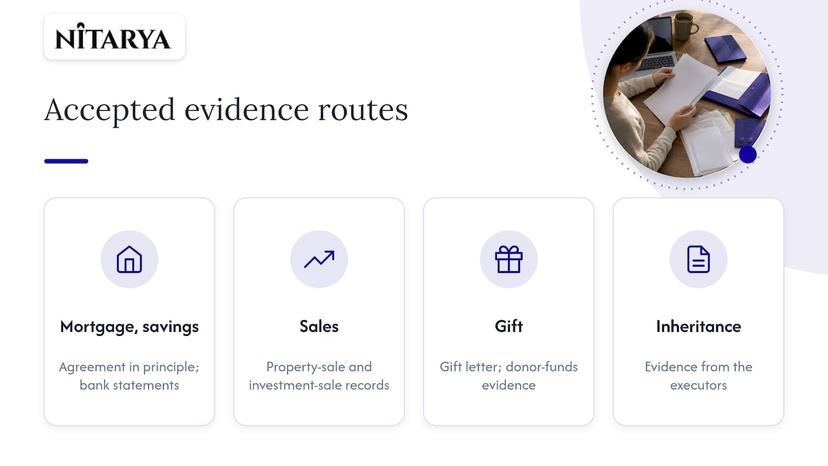
The HomeOwners Alliance guide lists a mortgage agreement in principle, bank statements, property-sale evidence, a gift letter with evidence of the donor's funds, investment-sale records and inheritance evidence from the executors.
Savings
Bank statements show your deposit or cash balance. If you built the money up over time, provide statements covering that period so the build-up is visible.
A single screenshot of a balance rarely satisfies a solicitor. Download full statements showing your name and address.
Sale of a previous property
Provide the completion statement from the sale and the bank statement showing the proceeds arriving. If the sale has not completed, the evidence is the agreed sale and your solicitor's confirmation of timing.
Gifts
A gift letter states that the money is a gift and not a loan, and that the donor has no interest in the property.
Solicitors then usually ask for evidence of where the donor's funds came from, so ask the donor to prepare their own statements early.
Inheritance
Probate or letters of administration, a letter from the estate's solicitor or executor, and the bank statements showing the distribution are the usual set, as described in a conveyancing guide on proof of funds.
Investments, shares and ISAs
The same guide notes that proceeds can be evidenced by account or portfolio statements showing the holding, confirmation of the sale or redemption, and a bank statement showing the cash arriving.
Plan for the settlement time of the sale, which can add days.
Do not forget the extras
Proof of funds should cover more than the headline price. Budget for Stamp Duty Land Tax (SDLT), legal fees and survey costs on a UK purchase.
On an overseas purchase, budget for transfer taxes, registration fees, currency conversion costs and any ongoing charges.
Practical ways to avoid delays
- Use full documents. Download complete statements rather than photographing a phone screen.
- Explain internal transfers. Moving money between your own accounts hides the original source. Keep the statement for the account where the money first arrived.
- Explain large or unusual deposits. A bonus, a business distribution or a transfer from a relative should have a one-line note and a document behind it.
- Start with the donor or executor. Third parties are the slowest part of most files.
- Share securely. Send documents through your solicitor's secure portal or a consent-based banking link, not by ordinary email attachments.
Applying the same discipline to an overseas purchase
A UK solicitor will test your money. Nobody automatically tests the seller's claims.
If you are buying in Thailand, the reverse check is the one that protects you: before you pay a deposit, ask for evidence that the seller or developer has the right to sell, that the unit is what it is described to be, and that the advertised income is realistic.
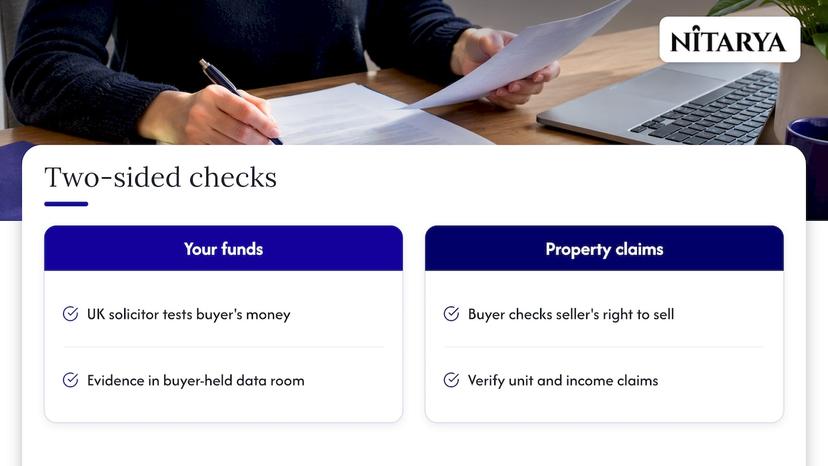
This is where a buyer data room helps. It is a single organised folder, kept by you or by your adviser, that holds every document in the transaction.
It works in both directions: your funds evidence on one side, and the property evidence on the other.
What to put in the data room
| Section | Contents | Why it matters |
|---|---|---|
| Your funds | Statements, sale or gift evidence, a record of the route the money will take abroad | Shows that your own money trail is clean and traceable |
| Ownership | Title document for the unit or land, seller identity, a land office search | Confirms who can actually sell and what the right is |
| Developer or counterparty | Company registration, project approvals, track record, sales contract draft | Shows whether the developer can deliver what it promises |
| Building and permits | Building permits, completion certificates, juristic person (building management entity) documents for condominiums | Shows that the building is lawful and managed |
| Financials | Service charges, sinking fund, utility and tax obligations, any arrears | Reveals ongoing obligations that reduce your return |
| Income claims | Actual booking history, management agreement, fee schedule | Tests the advertised rental figures |
| Contract | Reservation form, sale and purchase agreement, payment schedule | Defines what you are committing to and when |
Thai property documents a buyer should request
The title document is the first item. In Thailand, different titles carry different rights, and the full title deed, commonly called a Chanote, is the strongest.
Condominium units are held under a separate condominium title. Ask for the document itself, not a summary, and have it checked against the land office record.
Our guide to verifying property ownership abroad sets out six checks worth commissioning before any purchase.
For a foreign buyer, the funds trail also matters on the Thai side.
Buyers should confirm with their Thai legal adviser what evidence is required to show that funds were brought in from abroad in the buyer's name, because that record can matter at registration and later at resale.
Ask your adviser for the current procedure rather than relying on a sales presentation.
For new developments, check the permits, the status of construction against the payment schedule, and what protection exists if the project stalls. Our note on off-plan property risks explains what UK buyers should check first.
Testing advertised rental returns
An advertised yield is a sales figure until it is tested. Ask for the figures that sit behind it:
- The actual occupancy and nightly or monthly rates achieved over at least a full year, not a projected best case.
- The management fee, the platform commission and any cleaning, furnishing and maintenance costs.
- The building's service charge and any sinking fund contributions.
- Tax on rental income, including your UK reporting position as a UK resident.
- Selling costs and the realistic time to resell.
Subtract each line from the gross figure and compare what remains with a UK buy-to-let on the same capital. If the seller will not provide the underlying figures, that is a finding to record in the data room, not a gap to overlook.
Assessing missing or inconsistent evidence
Treat the data room as a scoring sheet. For each document, mark it as received and verified, received but unverified, inconsistent with another document, or missing.
Pay particular attention to:
- Names that differ between the title, the contract and the seller's identification.
- A payment schedule that asks for money before permits or ownership are evidenced.
- Rental projections without a track record behind them.
- Urgency, such as a discount that expires if the deposit is not paid within days.
An item that remains missing or inconsistent after a reasonable request should hold the deposit back.
Our perspective
Most buyers prepare their own proof of funds carefully, because a solicitor insists on it. They then pay a deposit on a sales brochure.
The checks are asymmetrical: the buyer's money is examined in detail, while the seller's right to sell and the developer's claims are often taken on trust.
We built NITARYA's work around closing that gap. We act for the buyer only, with no connection to a developer or agent, and we organise legal, technical and market specialists around a single decision file.
In our experience of more than 380 property decisions reviewed, one in three reviews identified an issue significant enough to change the deal.
That is why we encourage buyers to run the data room before the deposit, not after. A missing document found before payment is a negotiation point. The same document found after payment is a problem.
Neerraj
How we help before you pay
If you have shortlisted a property abroad, our Thailand property due diligence service reviews the ownership, the developer, the permits, the ongoing obligations and the income claims, and presents the findings in a decision file.
If you have already reserved a unit and are negotiating the contract, our during-purchase due diligence covers the stage between reservation and payment.

You can see the full range of reviews on our main site.
A short checklist before any deposit
- Confirm what your own solicitor or adviser will need from you, and gather it in one folder.
- Check that the source of every pound is documented, including gifts and sale proceeds.
- Obtain the seller's title document and have it independently verified.
- Review the developer's approvals and delivery record.
- Rebuild the rental income figure line by line.
- Read the contract's payment schedule against what has been evidenced.
- Record every gap, and decide in advance which gaps will stop the purchase.
FAQ
Can I make an offer on a property without proof of funds?
Yes. An estate agent may ask for proof of funds before an offer, but you do not have to provide it at that stage, according to Propertymark. Once your offer is made, you must provide it if asked.
What is the difference between proof of funds and source of funds?
Proof of funds shows that you have enough money to complete. Source of funds shows where the money for the transaction came from, such as savings, a property sale, a gift or an inheritance.
HMRC's handbook definition describes source of funds as the origin of the money used in a particular transaction.
Is a bank statement enough?
Often it is the starting point, but not always the end. If the money was saved over time, statements should cover that period, as the HomeOwners Alliance explains.
Gifts, inheritances and investment sales need their own supporting documents.
Does a seller abroad need to prove anything to me?
There is no automatic equivalent of the UK process for the buyer. You should request the title document, seller identification, developer approvals and income evidence yourself, and have them independently reviewed before paying.
Sources
- When Does a Solicitor Check Proof of Funds? UK Guide 2026
- Money laundering checks when buying a house, Propertymark
- Do Estate Agents Need Proof Of Funds? HomeOwners Alliance
- ECSH33358: Source of funds and source of wealth, HMRC
- Proof of funds for conveyancing