
Thai Spouse Ownership or Leasehold: What a UK Buyer Holds
Thai spouse ownership, leasehold, a company or personal ownership: what a UK buyer actually holds in each, and what to verify before paying a deposit.


Free Thailand ownership guide Book a free 15-minute call
On this page
- TL;DR
- What a foreign buyer can own in Thailand
- Thai spouse ownership: what you hold and what you do not
- Leasehold: a secure 30 years, not 90
- Company or SPV: what "51% Thai" really means
- Personal ownership: where your name can be on the title
- The four routes compared
- Choosing by what you need the property to do
- What to verify before paying a deposit
- How our reviews handle this
- Our view
- FAQ
- Sources
- Recommended

Putting land in a Thai spouse's name and registering a lease answer different questions. One identifies the owner; the other defines a right to use the property for a stated term.
Before comparing prices, separate the land, the building and the rights you would actually hold.
TL;DR
- Thai spouse route: land bought during a marriage to a foreigner is registered as the Thai spouse's separate property. The foreign spouse owns nothing in it, and any protection has to be registered separately.
- Leasehold: a registered lease is capped at 30 years under Section 540 of the Civil and Commercial Code. Renewal clauses promising 60 or 90 years are not a guaranteed term.
- Company or SPV: a Thai company with Thai majority shareholders can hold land only if the Thai shareholders are genuine. Nominee structures carry dissolution and criminal risk.
- Personal ownership: a foreigner can own a condominium unit within the 49% foreign quota, funded from abroad. Land is generally closed to foreigners.
- Before paying: check the title deed at the Land Office, the registered rights on its reverse, and the exact structure in writing.
What a foreign buyer can own in Thailand
The starting point is the law on land.
Thailand's government guidance states that a foreigner generally cannot own land, with a narrow exception of up to 1 rai (1,600 square metres) for residential use, which requires at least 40 million Thai baht (THB) invested and the Minister of Interior's permission.
The same guidance says a foreigner may own a condominium unit if eligible, with combined foreign ownership limited to 49% of the total unit area in the project, and that the purchase money must be transferred from a foreign bank to a bank in Thailand.
A condominium title and a right over someone else's land are different assets.
A foreign buyer may also hold separate building rights where lawfully structured; a condo is not the only situation in which a right can be registered in the buyer's name.
The land itself remains subject to foreign-ownership restrictions.
Thai spouse ownership: what you hold and what you do not
Marrying a Thai national does not give a foreigner the right to own land. Land bought by the Thai spouse is registered in the Thai spouse's name as separate property, and the foreign spouse has no ownership claim to it.
Since a 1999 Ministry of Interior regulation, both spouses must sign a declaration at the Land Office confirming the purchase funds are the Thai spouse's separate property (known as sin suan tua) and not marital property (sin somros).
The Land Office records that declaration before it registers the transfer.
For a UK buyer this has three practical consequences.
- Control sits with the Thai spouse. The title holder can, in law, sell, mortgage or deal with the land. Nothing in the foreign spouse's passport, marriage certificate or payment record changes that.
- Your money has no legal claim attached. If you funded the purchase, the declaration you signed records that the money was the Thai spouse's. It is worth reading it in English before you sign it, not after.
- Protection has to be registered separately. Without a registered right, the foreign spouse's position is a matter of trust and of the marriage, not of the land register.
Rights that can sit alongside the Thai spouse's title
Three registered rights are commonly used to protect the foreign spouse, all under the Civil and Commercial Code:
- Usufruct (Sections 1417 to 1428): the right to possess, use and take the benefit of property owned by someone else, for life or for a fixed term. As Chiang Rai Times reported in August 2026, it can cover living in the home, controlling its ordinary use or receiving income from a lawful rental. A lifetime usufruct ends when the holder dies and does not pass automatically to heirs.
- Superficies (Sections 1410 to 1416): the right to own a building on land owned by another, so the house can be yours while the plot is not.
- Registered lease (Section 540): a contractual right to occupy that becomes a real right once registered at the Land Office.
Each one is worth only what is written on the registered deed. An unregistered promise from a spouse, a developer or an agent is not a registered right.
Our due diligence guide to usufruct in Thailand sets out what to check before relying on one.
Leasehold: a secure 30 years, not 90
Leasehold is the route most often offered to foreigners buying a villa. The lessee holds the right to use the land for a term, and the freehold stays with the Thai owner.
The central point is the length of that term.
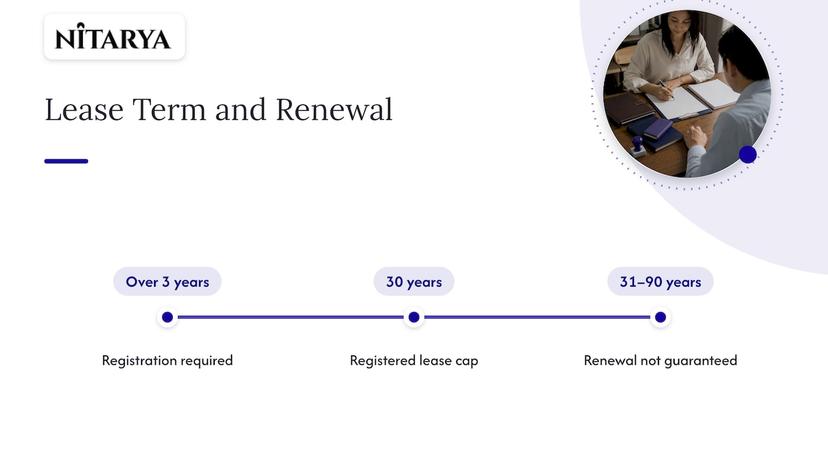
A registered lease of land in Thailand is capped at 30 years under Section 540 of the Civil and Commercial Code, and a lease longer than three years must be registered with the Land Department to be enforceable beyond three years, as Victaura explains.
Many sales brochures describe leases as "30+30+30 years". In Supreme Court Judgment No. 4655/2566, the Thai Supreme Court held renewal provisions in the parties' lease agreements void.
The judgment was handed down on 18 March 2025, and it applies Section 540 directly: a pre-signed renewal is a personal promise, not a right attached to the land.
The practical reading, as set out by AIProperty Phuket in June 2026, is that the registered first 30-year term stands, while years 31 to 90 rest on a promise that a court may not enforce and that does not bind a later landowner.
At year 30 you would negotiate fresh terms with whoever then owns the freehold. As of that June 2026 review, no later government had revived the 99-year leasehold bill and Section 540 still applied.
That does not make a lease unusable. It means you should value it as a 30-year right, check what the price per remaining year looks like against that, and read any renewal clause as a bargaining position and not as a guarantee.
Our guide to Thailand freehold or lease, with the 49% quota and 30-year checks walks through the same test for UK buyers.
What to confirm on a lease
- It is registered at the Land Office, not only signed between the parties.
- The registered term is 30 years or less, and the start date is the registration date.
- The lease says what you may do: live, sublet, sell the lease or build.
- Who the lessor is, and whether the lessor's title is clean (see the checks below).
- What happens on resale: whether the lessor's consent is needed and what a buyer would inherit.
Company or SPV: what "51% Thai" really means
A special purpose vehicle (SPV) is a company set up to hold one asset. In Thailand the usual version is a limited company with 51% Thai shareholding that buys the land.
In principle, such a company can own land as a genuine Thai juristic person under the Land Code. The difficulty is the word genuine.
According to Victaura, the structure becomes a nominee arrangement when the Thai shareholders' capital is not real, their shares carry no genuine economic risk and a side agreement returns full control to the foreign minority shareholder.
It also reports that more than 26,000 Thai companies were under review in 2024 by the Department of Business Development (DBD) for suspected nominee shareholding.
The enforcement picture has tightened since. Sukhothai Inter Law wrote in January 2026 that the DBD database is now linked with the Revenue Department and the Land Office.
Companies fitting a nominee profile can be flagged: no staff and no revenue, low-income Thai shareholders, and a foreigner holding sole directorship and signing power.
The penalties it lists include dissolution, an order to sell the land within 180 days and criminal charges for the foreigner and the Thai nominees.
For a UK buyer, the company route therefore adds three questions the other routes do not raise:
- Are the Thai shareholders real people with their own money at risk?
- Does the company have a business that justifies its existence, with accounts and tax filings?
- Who signs, who votes and who can remove whom, in writing and in practice?
A company also brings annual accounting and filing obligations, and a sale of the property can mean a sale of the company or a transfer of the land out of it, each with its own costs.
Our overview of Thai property taxes for UK buyers covers how Thai tax and UK reporting of Thai rent fit together.
Personal ownership: where your name can be on the title
Personal ownership works for a condominium unit.
You hold the unit in your own name, on a title that is registered with the Land Office, provided foreign ownership in the building stays within the 49% limit and you transfer the purchase money from abroad.
The official guidance on the quota and the foreign transfer rule is the reference point. The bank documentation of the transfer is what the Land Office relies on to register a foreign-owned unit, so keep it.
For most UK buyers investing Bangkok or Phuket for family use and investment, this is the cleanest route: no spouse declaration, no lease expiry, no nominee exposure.
Its limits are the quota itself (a building that has used up its foreign share may only offer leasehold or Thai-name units), and the fact that a condominium gives you a unit, not land.
The four routes compared
| Thai spouse holds | Registered leasehold | Company or SPV | Personal (condominium) | |
|---|---|---|---|---|
| Whose name is on the title | Thai spouse | Thai landowner (lessor) | Thai company | You |
| What you hold | Nothing in the land unless a usufruct, superficies or lease is registered | A registered term of up to 30 years, subject to its conditions | Shares in the company | The unit, inside the 49% foreign quota |
| Control | Thai spouse | Within the terms of the lease | Whoever genuinely controls the company | You |
| Rental | Depends on the registered right | Depends on the lease terms | Company can rent, with company tax and filings | Yours to rent, subject to the building rules |
| Transfer | Thai spouse sells; foreign spouse's rights follow the registered deed | Lease transfer subject to its terms | Sale of shares or of the land | Sale of the unit, with a foreign quota check |
| Main risk | No ownership claim; rights only as registered | Years beyond 30 are not guaranteed | Nominee scrutiny and penalties | Quota exhausted; building-level issues |
On succession, no route passes automatically as the buyer expects.
A lifetime usufruct ends at death, a lease runs to a fixed term, company shares pass under whatever the shareholder documents and wills provide, and a condominium unit passes under Thai succession rules.
Our guide to overseas property inheritance planning for Thailand is the next read if succession is your main concern.
Choosing by what you need the property to do
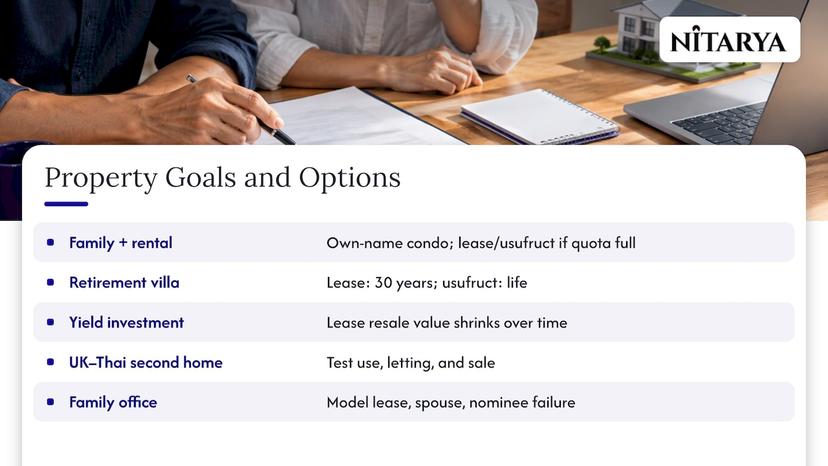
A home for family use and rental income in Bangkok or Phuket. Start with a condominium in your own name. If the building's foreign quota is full, a registered lease or a usufruct is the fallback, valued as a 30-year right.
A villa for retirement. Ask what you would actually own and what happens later. A villa on a lease is a right for 30 years.
A villa on a Thai spouse's land, with a registered usufruct, is a right for life that does not pass to heirs automatically. Neither is ownership of the land.
An investment held for yield. The structure sets your exit. A lease with years running down has a shrinking resale value.
A company needs to survive scrutiny at the point of sale as well as at purchase.
A second home between the UK and Thailand. You need to use it, let it and sell it as planned. Write those three uses down and test each structure against them.
A family office or finance team.
Treat the structure as an assumption in the investment case, and ask which structural failure would make the deal fail: a lease that is not registered, a spouse who is no longer a party, a company that is reclassified as a nominee.
What to verify before paying a deposit
- Inspect the title deed at the Land Office, not a copy. Thailand Guide UK advises against relying on photocopies, scans or vendor-supplied documents, which can be out of date or altered. An independent legal representative should inspect the master register held at the Land Office to confirm the seller's title.
- Read the reverse of the deed. It is where registered mortgages, long-term leases, servitudes and court-ordered liens appear.
- Confirm the land classification allows transfer or lease registration.
- Get the structure in writing and registered. A usufruct, superficies or lease counts only once registered at the Land Office. Check term, transfer and succession wording against the registered deed.
- If a Thai spouse is the buyer, read the declaration of separate property in a language you understand before signing.
- If a company is the buyer, ask for the shareholder register, capital contribution evidence, accounts and tax filings.
- For a condominium, confirm remaining foreign quota and arrange the foreign-currency transfer so the paperwork is issued in your name.
- If you will not be in Thailand to sign, check how a power of attorney in Thailand is made and what it can authorise.
An official Land Office search is a low-cost step: Thailand Guide UK puts the counter fee at under 500 THB. The cost of skipping it is far larger.
How our reviews handle this
NITARYA helps you separate the ownership claim from the evidence behind it. A decision file can bring together title records, contract terms, counterparty questions and open points for your own advisers.
NITARYA organises property evidence and coordinates review by appropriately licensed specialists. It does not provide legal, tax, valuation or engineering conclusions.
Relevant service, referral or transaction-linked compensation and relationships should be disclosed before an engagement.
If you have a specific property shortlisted, our Thailand property due diligence service is the place to start, and the ownership guide for Thailand sets out how foreigners buy.
If you are before the deposit, the Before Buying Property Due Diligence review is designed for exactly that point.
Our view
The question we hear most is "who owns it?", and the honest answer is often a name that is not the buyer's. Structures in Thailand are not wrong in themselves.
Trouble starts when the buyer believes the structure gives more than it does: a 90-year lease that is really 30, a spouse's title that carries no claim, a company that looks Thai on paper only.
We start from the registered evidence and work outwards.
What is on the title, what is on its reverse, what the contract says and what the developer says are four separate things, and the decision file shows where they agree and where they do not.
NITARYA organises property evidence and coordinates review by appropriately licensed specialists. It does not provide legal, tax, valuation or engineering conclusions. Relevant service, referral or transaction-linked compensation and relationships should be disclosed before an engagement.
Neerraj
FAQ
Does marrying a Thai national let me own land in Thailand?
No. Land bought during a marriage to a foreigner is registered as the Thai spouse's separate property, and the foreign spouse has no ownership claim to it.
The foreign spouse can hold registered rights such as a usufruct, a superficies or a registered lease, which depend on the deed.
Is a 90-year or 999-year lease as good as freehold?
No. An ordinary lease under Section 540 cannot create a registered 60- or 90-year term from the outset. Judgment 4655/2566 concerned prepaid future terms designed to create a 90-year arrangement from the outset.
It does not establish that every possible renewal clause is void. Treat the registered term and any future renewal as different rights, and have a Thai lawyer review the actual wording.
Can a UK buyer use a Thai company to own a villa?
A Thai company with majority Thai shareholders can hold land if the Thai shareholders are genuine.
It becomes a nominee arrangement if their capital is not real or control returns to the foreigner, and penalties can include dissolution and criminal charges.
Can I own a condominium in my own name?
Potentially, if the buyer meets an eligible category and the building remains within the 49% foreign area quota. Confirm the category, current quota and bank evidence with the Land Office before paying.
For a non-resident buying under the foreign-funds route, agree the qualifying payment route and bank evidence before sending money.
Do not apply that route to every eligible foreign buyer: permanent-residence and investment-promotion categories need their own checks under the Condominium Act.
Sources
- Foreign property ownership in Thailand: Acquisition of real estate (Thailand government guide)
- Buying Land Under a Thai Spouse's Name in Chiang Rai (Chiang Rai Times)
- Thai Spouse Property Ownership in Thailand: 1999 Rule
- Thai Supreme Court strikes down automatic long-term lease renewals
- The Freehold Question: SPV, Lease or Nominee
- Freehold vs Leasehold Thailand: 49% Foreign Quota Guide
- Setting Up a Thai Company to Buy Land: Is It Still Safe in 2026?
- Thailand Property Due Diligence Checklist