
Branded Residences in Thailand: What to Check Before You Buy
Buying a branded residence or condo hotel in Thailand? How to check the hotel licence, the operator contract and any rental guarantee before you commit.

Free Thailand ownership guide Book a free 15-minute call
On this page
TL;DR: A hotel brand on the building doesn't guarantee anything by itself.
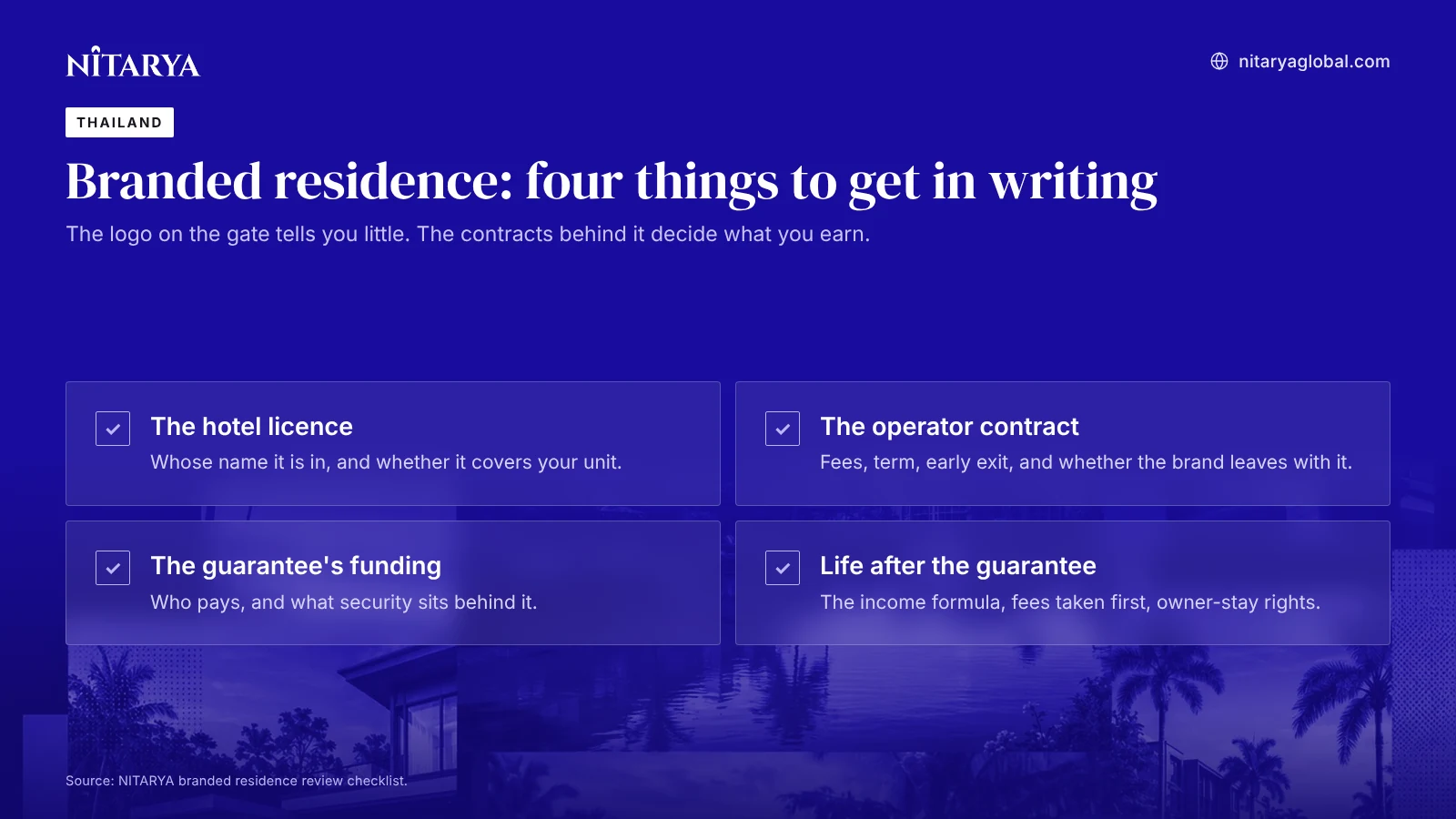
Before you buy a branded residence or condo hotel in Thailand, get four things in writing: who holds the hotel licence, what the operator's contract says about fees and how long it runs, how the rental guarantee is paid for, and what happens to your income and owner stays once the guarantee ends.
Branded residences sell on a simple idea. A hotel group you recognise runs the building, guests fill your unit while you're away, and money lands in your account without you lifting a finger.
Sometimes it works exactly like that. But the logo on the gate tells you very little about the contracts behind it, and those contracts decide what you actually earn.
Thailand is now Asia's biggest branded residence market by launched supply.
C9 Hotelworks' Asia Branded Residences Market Review 2026 puts Thailand at 26% of the region's launched supply, with 13,124 units worth THB 205.3 billion, and Phuket is the largest resort market for branded units in Asia.
This guide covers what to read before you sign. If you're already looking at a specific project, our Thailand property due diligence checklist covers the title, quota and money checks that apply to every purchase.
What is a branded residence in Thailand?
It's a condo or villa built, marketed or run under a hotel brand, usually with hotel services for owners and a rental programme for when you're not there.
Some are full condo hotels with their own hotel licence. Others only license the brand name.
A brand agreement doesn't prove your unit can legally take short-stay guests.
Ask for the hotel licence, or the exemption the project relies on, and have a Thai lawyer check that it covers your unit, the building rules and the way the rental programme actually runs.
A logo or a sales manager's word doesn't settle it.
Nitarya insight: you pay extra for the brand, so check what it buys

Thailand has more luxury-tier branded residence projects in the pipeline than anywhere else in Asia: 30, against 18 in Vietnam and 13 in South Korea.
Savills estimates that branded residences sell at an average premium of about 31% over comparable unbranded luxury homes.
That premium pays for something specific: the operator, the services and, in hotel-run projects, the right to take daily guests. Two findings from 2026 make it worth checking what you're getting.
First, more projects are standalone, with lifestyle, fashion and car brands entering the market, and C9 Hotelworks found standalone projects now make up 17% of Asia's branded residence supply.
A standalone project may have no hotel and no hotel licence, which changes what you can do with the unit.
Second, the brand licence and the management contract are often separate agreements, so the name on the building is only as permanent as the contracts behind it.
Who holds the hotel licence?
Ask for a copy of the licence, then check whose name is on it and which buildings and units it covers.
The licence might sit with the developer, the operator or a separate company. If it's in the developer's name, find out what happens if the developer sells the project or the operator leaves.
If your unit isn't covered, the "hotel income" in the brochure may depend on letting that isn't legal. Our guide to Airbnb rules in Thailand explains how the 30-night rule works in practice.
Can the hotel operator leave or be removed?
The hotel operator, the brand owner and the condo's juristic manager can be three different companies, and ending one contract doesn't automatically end the others.
Have the signed agreements checked: who can terminate, at what cost, whether the brand name comes off the building, and what happens to the owners' rental arrangements.
That can help you if the operator performs badly. It can also hurt you if the brand goes and resale prices go with it. Ask to see the hotel management agreement, or at least a summary of it, and check:
- how long it runs and whether either side can end it early
- whether the right to use the brand name ends when the management contract ends
- what happens to owner services, bookings and the rental programme if it does
If the brand can walk away and take its name with it, you're buying a hotel-run building today with no promise it stays one.
How do rental guarantees work in Thailand?
A rental guarantee is a promise to pay you a set return for a set period. What it's calculated on, which units qualify, how long it runs and what gets deducted all come from the contract, not the brochure.
It isn't always a percentage of what you paid, and it's only worth as much as the company standing behind it.
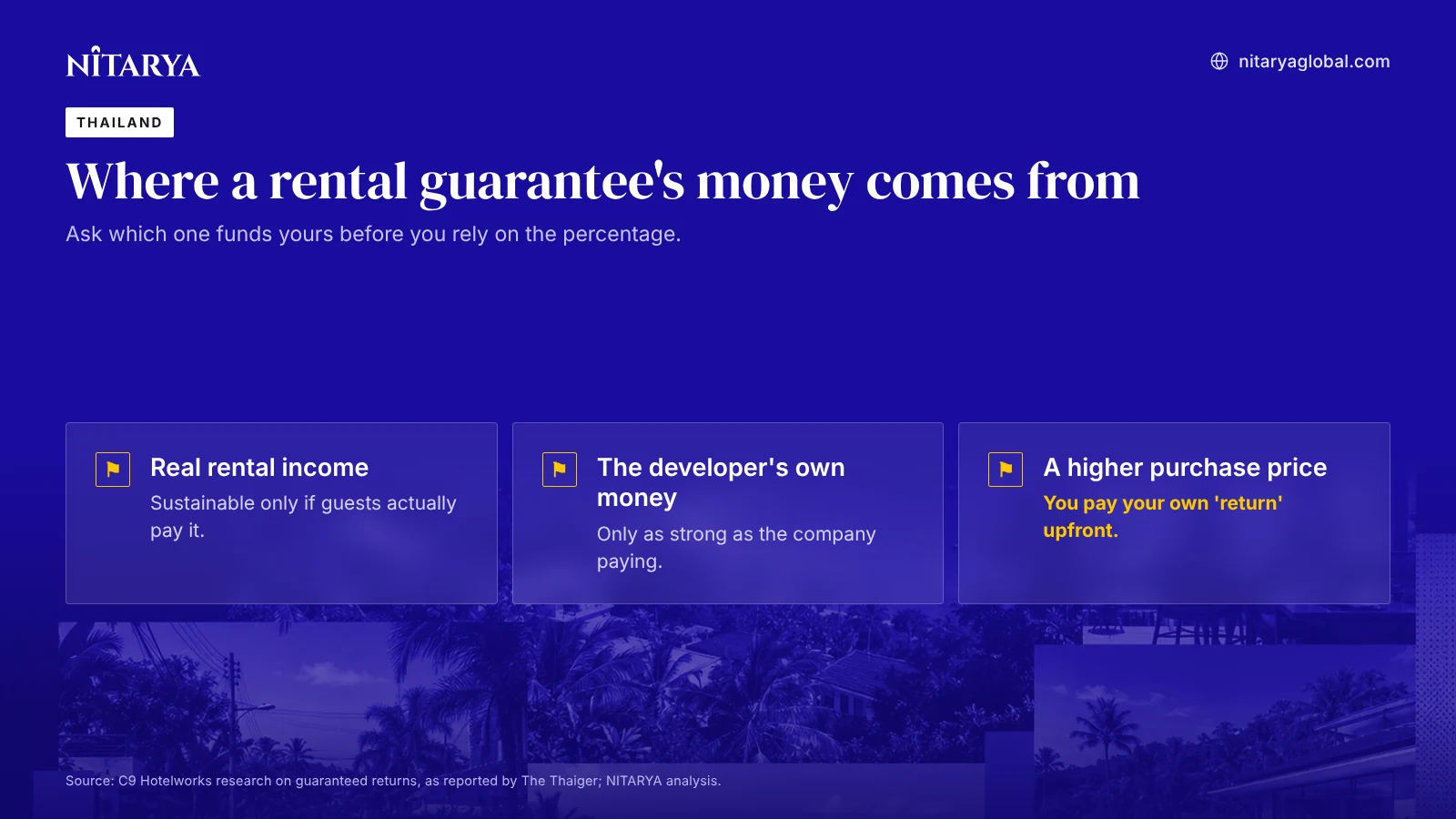
Guarantees are usually funded in one of three ways: from real rental income, from the developer's own money, or from a higher purchase price, where part of what you pay comes back to you as "returns".
The third is the one to watch for.
Before you rely on one, ask:
- Which company pays it? A project company with no other assets is a weak promise.
- Is there a bank guarantee, escrow or other security behind it?
- How was the percentage set, and how does it compare with what similar units actually earn?
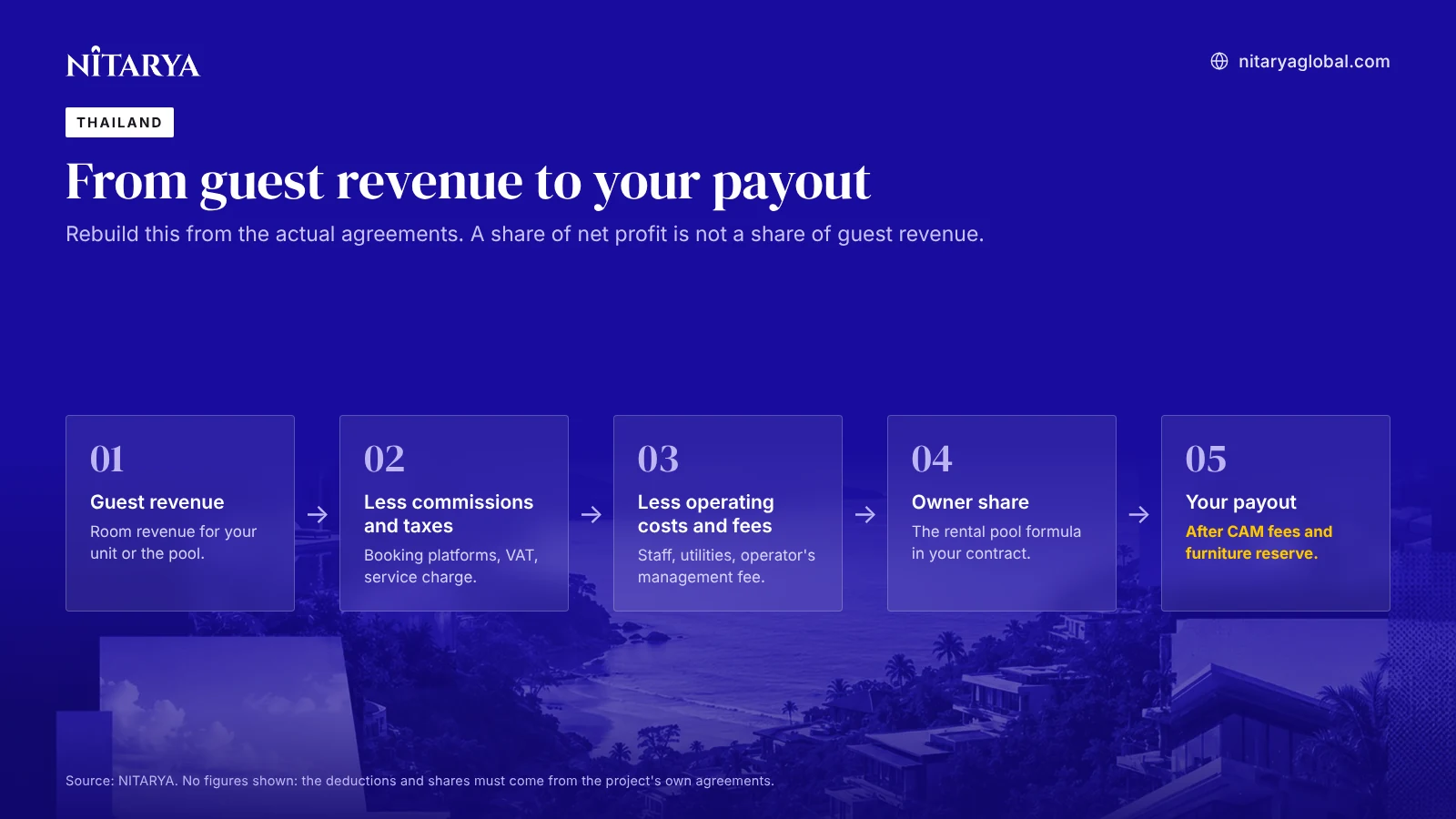
- What happens when the guarantee period ends? Does income switch to a share of a rental pool, and what fees come off first?
Nitarya insight: test the guarantee against the market, not the brochure
Don't hold a promised net payout up against a gross yield figure from somewhere else. Run the same sum for both: guest revenue, operating costs, the operator's share, owner charges and tax.
If the developer can't give you those numbers, treat the guarantee as unexplained, not as proven.
A missing number isn't proof of a problem, and our guide to gross versus net yield shows how to compare the two fairly. Well-run hotel residences can outperform ordinary condos.
It just means a high guarantee needs a clear explanation, in writing, of where the money comes from.
What to check in the contracts
A branded purchase usually comes with three documents: the sale and purchase agreement, the rental programme or rental pool agreement, and the guarantee itself.
Read them together, because they often point to each other.
- Ownership: is it a freehold condo unit within the 49% foreign quota, or a leasehold? See our guide to foreign condo ownership and the 49% quota.
- Owner use: how many nights a year you can stay, and which dates are blocked.
- Fees: management fee, rental pool costs and any furniture reserve taken from your income.
- Reporting: whether you get audited accounts for the rental pool, or just a figure.
- Opting out: whether you can leave the rental programme, and at what cost.
- Resale: whether the guarantee passes to a buyer, and whether the operator has to approve the sale.
Red flags in a branded residence sale
- A guarantee paid by a company with no assets beyond the project.
- No copy of the hotel licence, or a licence that doesn't cover your unit.
- A management agreement you're not allowed to see.
- "Guaranteed" returns well above local market yields with no security behind them.
- A buyback promise at a fixed price years from now, with no collateral.
How Nitarya reviews a branded residence
We check the hotel licence against your unit, read the operator and rental pool agreements alongside the sale contract, test the guarantee against local market yields, and set out what happens when it ends.
Legal questions go to a licensed Thai lawyer. You get one file showing what's verified, what's pending and what's missing. See Nitarya's Thailand property due diligence service.
This article is general information only. It is not legal, tax, investment or valuation advice. Get advice from appropriately licensed professionals for your own purchase.
Looking at a specific branded project now? Book a free 15-minute call and we'll tell you which documents to ask the developer for first.
Comparing areas before you shortlist a project? Nitarya Property Insights lets you compare locations side by side. Check Nitarya Tools and Insights.
Sources and method
- Thailand's 26% share, luxury pipeline and standalone share: C9 Hotelworks, Asia Branded Residences Market Review 2026, as reported by Hospitality Net, June 2026.
- Branded premium of about 31%: Savills, via Asia News Network, 2026.
- Earlier C9 Hotelworks research on guaranteed returns, as reported by The Thaiger.
- Daily rentals under hotel licences in branded residences: Bangkok Post.
- Operator tenure and owner votes: The Thaiger.
FAQs
Are branded residences a good investment in Thailand?
Some are. The ones that work tend to have an established operator, a hotel licence covering every unit and a rental programme with clear, audited reporting.
The brand alone isn't enough, so judge the contracts and the location before the logo.
Can a foreigner own a branded residence freehold in Thailand?
A branded condo unit can be owned freehold if it falls within the building's 49% foreign quota and you pay with money brought in from abroad.
Branded villas are usually sold on a registered land lease, often with a separate right to own the building.
What happens when a rental guarantee ends?
Usually your income switches to a share of what the rental programme actually earns, after fees. Check the contract for the formula, the fees that come off first and whether your owner-use rights change.
Do I still need due diligence if a big hotel brand is involved?
Yes. The brand runs the hotel side. It doesn't check your title, your quota position, the developer's finances or whether the guarantee is funded.
Those checks are still yours to make.
Is rental income from a branded residence taxed?
Yes. Rental income from Thai property is taxable in Thailand, and UK residents usually need to report it in the UK as well. See our guide to Thailand property taxes for UK buyers.