
Buying Property in India From the UAE: A Guide for Gulf NRIs
For NRIs in Dubai and Abu Dhabi: what you can buy, NRE vs NRO, home loans, a UAE-signed power of attorney, TDS under the 2026 rules and checks before booking.

Free guides and tools Book a free 15-minute call
On this page
- What NRIs can and can't buy in India
- Paying from the UAE: NRE, NRO and what you can take back out
- Home loans for Gulf NRIs
- Signing from the UAE: a power of attorney that registrars accept
- TDS when you buy: what changed in 2026
- Checks before you book
- Tax: nothing in the UAE, but India still taxes Indian income
- How Nitarya helps
- Sources
- FAQs
You earn in dirhams. The flat is in Pune, Kochi or Gurugram.
The money has to leave the UAE the right way, the paperwork has to be signed in Dubai or Abu Dhabi, and someone in India has to register it without you standing in the sub-registrar's office.
This guide is for NRIs and OCI cardholders living in the UAE who are buying in India.
It reflects the rules as of November 2026, including India's new Income-tax Act, 2025, which took effect on 1 April 2026, and the TDS changes that started on 1 October 2026.
Resident in India and buying in Dubai instead? That's a different set of rules. See our guide to buying property in Dubai from India.
What NRIs can and can't buy in India
As an NRI or OCI, you can buy residential and commercial property in India without RBI permission and without filing anything with the RBI. The exceptions are agricultural land, plantation property and farmhouses (RBI FAQ).
Those need RBI approval, which in practice means you shouldn't plan on buying them.
There's no cap on how many flats or offices you can buy. The limit that matters comes later, when you sell and want the money back out of India.

Watch for listings described as "farm plots" or "farmhouse plots" near cities. If the land is still classified as agricultural in the revenue records, an NRI can't buy it, however the brochure describes it.
Paying from the UAE: NRE, NRO and what you can take back out
The money has to reach India through normal banking channels: an inward remittance, or a payment from your NRE, FCNR(B) or NRO account (RBI FAQ). Cash and traveller's cheques don't count.
Which account you pay from decides what you can take out of India later:
- Paid from abroad or from your NRE or FCNR(B) account: when you sell, you can send the proceeds back out, up to the amount you paid in foreign exchange, for a maximum of two residential properties (MEA).
- Paid from your NRO account: the proceeds can still go out, but within the general NRO limit of USD 1 million per financial year, after tax.
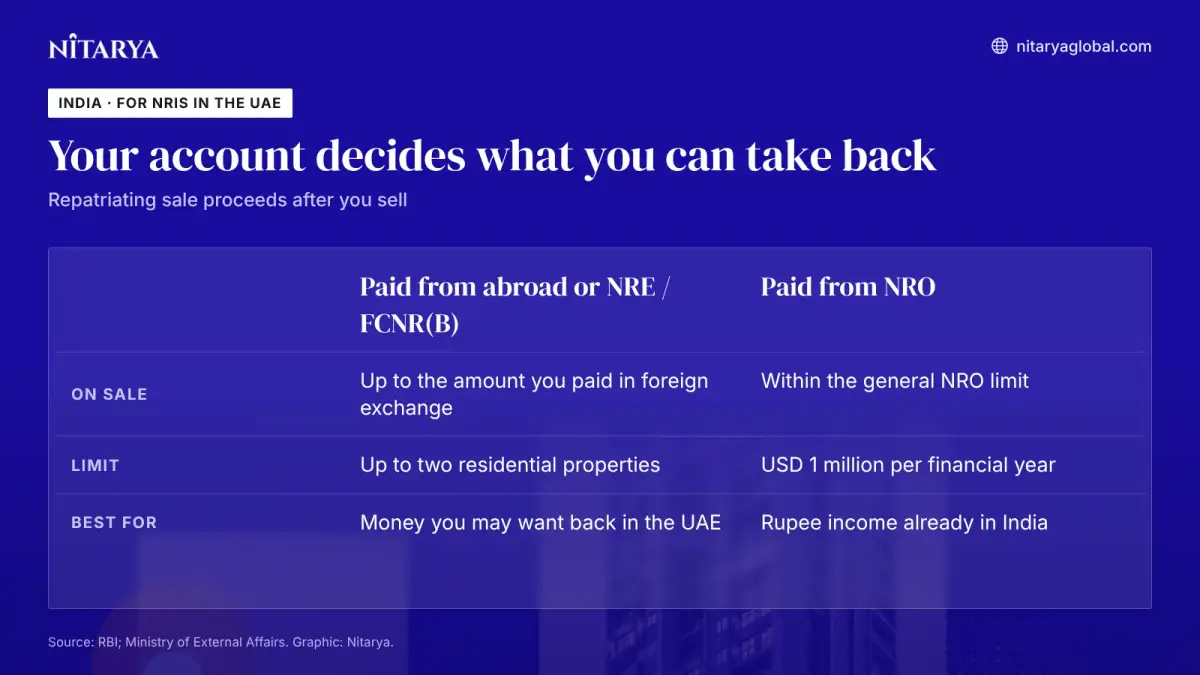
What this means for you: if there's any chance you'll want the money back in the UAE one day, pay from abroad or from NRE, and keep every remittance certificate and bank statement.
Rebuilding that paper trail years later, when you sell, is hard.
Home loans for Gulf NRIs
Indian banks and housing finance companies can lend to NRIs to buy a home in India. The loan is in rupees, it's paid to the seller or builder in India, and it can't be credited to your NRE or FCNR account.
You repay it by inward remittance, from your NRE, NRO or FCNR(B) account, or out of rent from the property (RBI Master Direction; RBI circular).
The same loan-to-value caps apply to you as to a resident: 90% for loans up to ₹30 lakh, 80% from ₹30 lakh to ₹75 lakh, and 75% above ₹75 lakh (Bajaj Housing Finance).
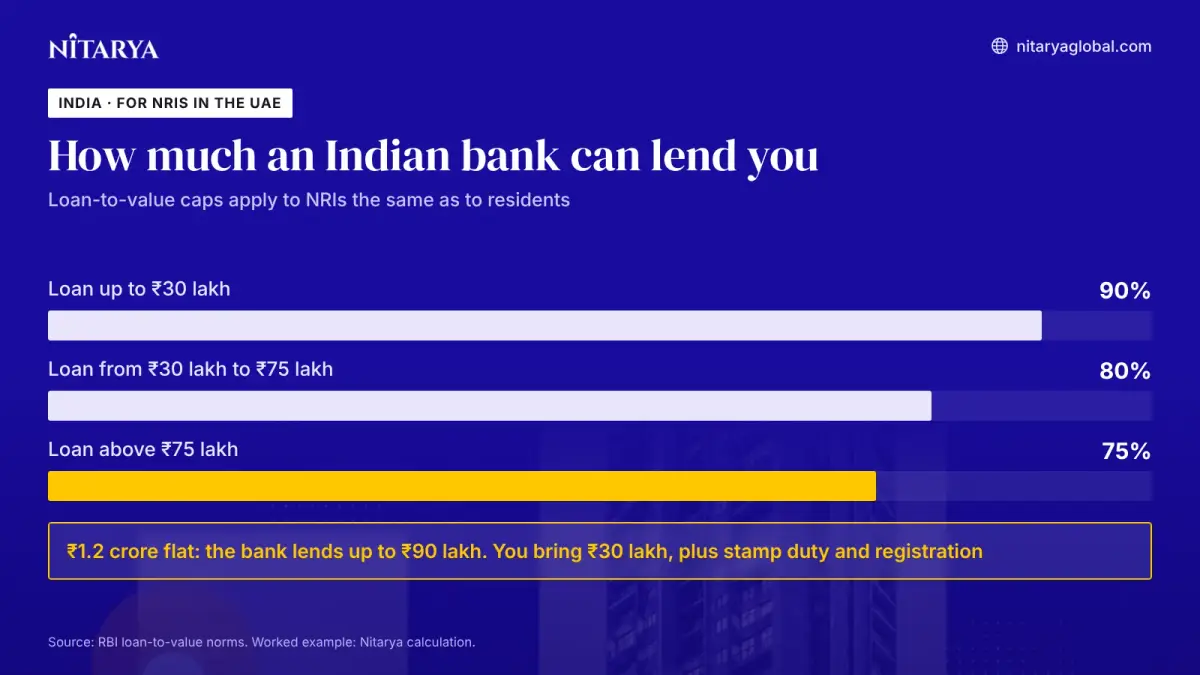
Worked example: on a ₹1.2 crore flat, the most a bank can lend is 75%, or ₹90 lakh. You bring at least ₹30 lakh yourself, plus stamp duty, registration and any GST, which banks don't usually finance.
In most large states, stamp duty and registration alone come to about 6% to 7% of the value.
Signing from the UAE: a power of attorney that registrars accept
You don't have to fly to India for registration. A power of attorney lets someone you trust present the documents for you. The process is where most UAE-signed POAs fail, so do it in this order:
- Draft it in the format the state needs, for one named property and one transaction. A specific power of attorney is safer than a general one.
- Sign it in the UAE in front of the Embassy of India in Abu Dhabi or the Consulate General of India in Dubai, through their attestation service (CGI Dubai). The Registration Act accepts a POA from someone living abroad if it's authenticated by an Indian consul or a notary.
- Courier the original to India. A scan won't do.
- Get it stamped within three months of it arriving in India. The Indian Stamp Act gives an instrument executed abroad three months from first receipt in India to be stamped. Registrars have rejected POAs presented later (Mondaq).
- Your attorney presents the sale deed at the sub-registrar's office.

Our guide to a valid power of attorney for NRIs covers the clauses and the fraud checks in more detail.
TDS when you buy: what changed in 2026
When you buy property in India, you deduct tax from the price and pay it to the government. You don't get it back. It's the seller's tax, collected through you.
If you don't deduct it, the tax department can come after you for it.
From 1 April 2026 the rules sit in section 393 of the Income-tax Act, 2025, and Form 141 replaced Form 26QB (TaxGuru). The amount depends on who's selling:
- Buying from a resident seller or a builder: deduct 1% if the price is ₹50 lakh or more. You file Form 141 from your own PAN login. No TAN is needed.
- Buying from an NRI seller: there's no ₹50 lakh threshold. You deduct on the whole price, not just the seller's gain, at 12.5% plus surcharge and cess for a long-term asset, an effective 13% to 14.95% depending on the amount (TaxGuru). The seller can apply for a lower deduction certificate on Form 128.
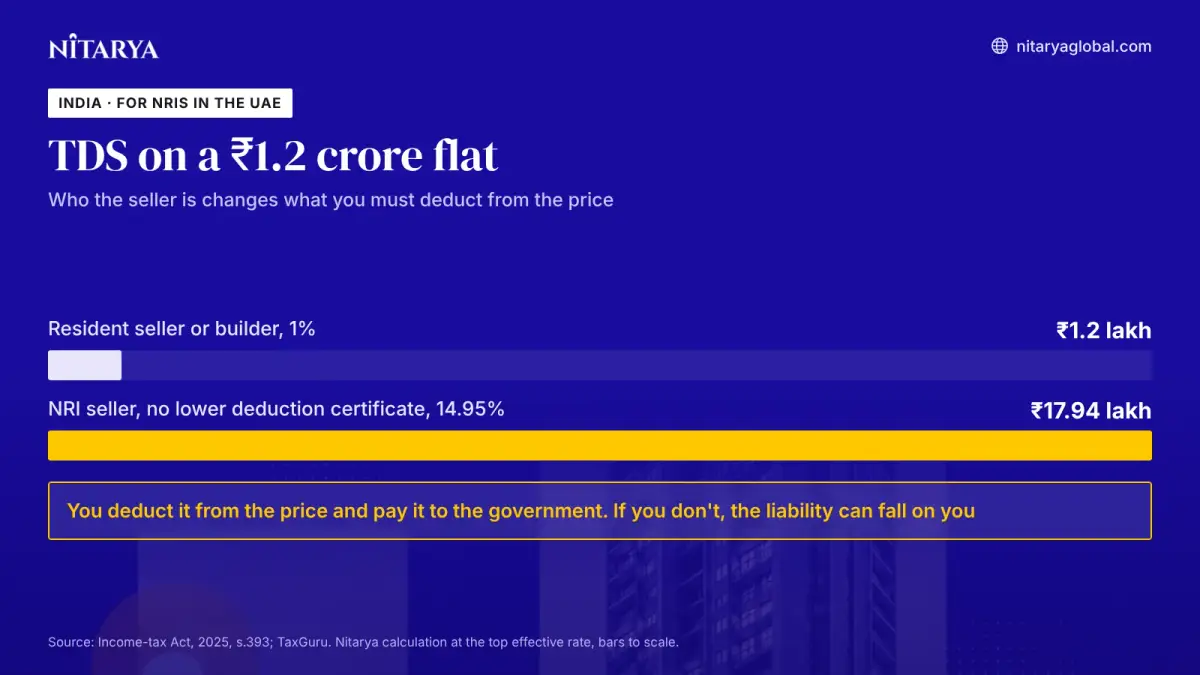
On a ₹1.2 crore flat, that's ₹1.2 lakh of TDS if the seller lives in India, and about ₹17.9 lakh if the seller is an NRI with no lower deduction certificate.
Nitarya insight: the October 2026 TAN relief may not cover you
From 1 October 2026, a buyer purchasing from an NRI seller can file through Form 141, Schedule E, with a PAN instead of a TAN. The relief is written for resident individuals and HUFs.
Companies and firms stay on the TAN route (TaxGuru).
That leaves a gap that matters in the Gulf, where it's common to buy a resale flat from a friend or relative who's also an NRI. If you're a non-resident buying from a non-resident, the PAN-only route doesn't clearly apply to you.
Plan to get a TAN, and have your CA confirm the filing route before you pay the first instalment.
Checks before you book
- RERA registration: the project's registration, approvals and completion date on the state RERA portal. See RERA verification for international buyers.
- Title: a title search going back around 30 years. See our guide to title search in India.
- Encumbrance certificate: checked line by line against the registered documents. See the five red flags to look for.
- For a ready flat: the occupancy certificate and completion certificate.
- The builder-buyer agreement: carpet area, delay compensation, cancellation charges and the payment schedule tied to construction stages.
- Total cost in writing: stamp duty, registration, and GST at 5% on an under-construction flat (1% for affordable housing). See our stamp duty estimate guide.
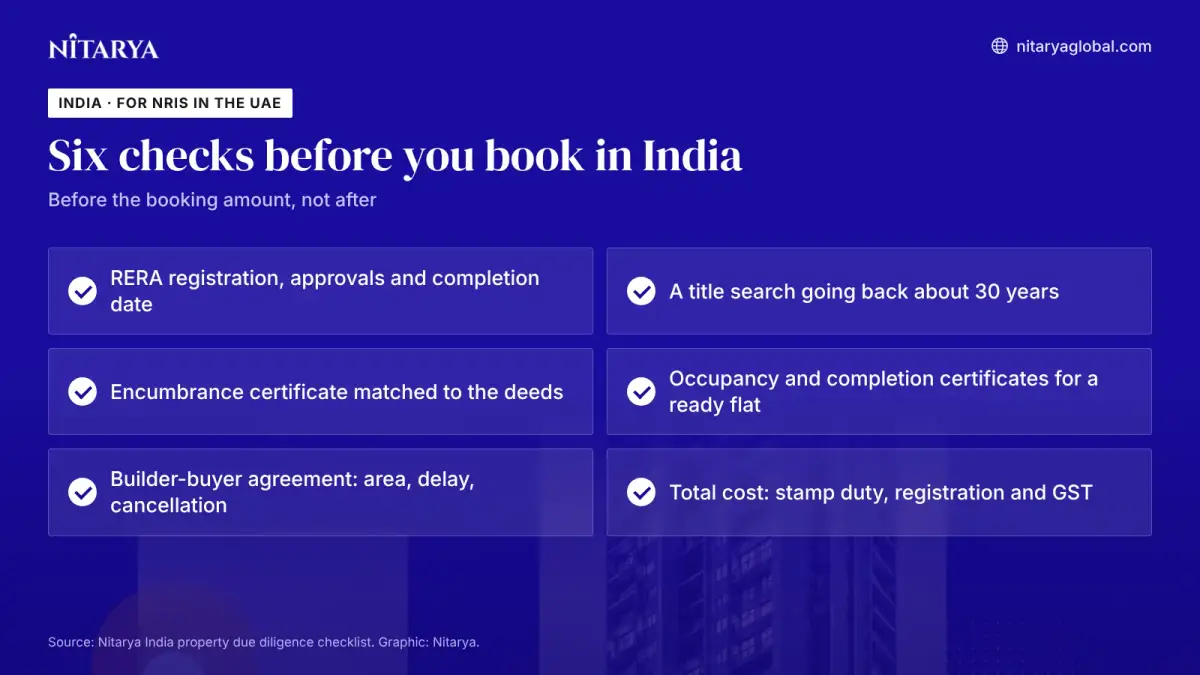
Our India property due diligence checklist explains what each document proves.
Tax: nothing in the UAE, but India still taxes Indian income
In the UAE. There's currently no personal income tax on individuals (PwC).
In India. As an NRI, India taxes your Indian income: rent from the flat, interest in India, and the capital gain when you sell. Long-term gains on property are taxed at 12.5%.
Deemed residency. An Indian citizen who isn't liable to tax in any other country, and whose Indian income is more than ₹15 lakh in a tax year, is deemed resident in India.
The rule was carried into the new Act as section 6(7) (Income Tax Department). Living in the UAE doesn't automatically trigger it, because "liable to tax" is a technical test, so get advice on your own position (TaxGuru).

The point most people miss: the ₹15 lakh counts all your Indian income, and a capital gain counts too. You may sit comfortably under it while you're collecting rent, then cross it in the year you sell.
Plan the sale year with your CA.
How Nitarya helps
We work on the buyer's side only. Before you book, we check the RERA record, the title and encumbrances, the approvals and the builder-buyer agreement, and we give you one file showing what's verified, what's pending and what's missing.
The legal opinion comes from an independent, licensed Indian lawyer, and it flags the fees and tax risks on your purchase.
- Still comparing projects or cities? Start with a pre-purchase property evaluation. Evaluations start at US$89.
- Found the flat? Our India property due diligence service for NRIs covers the checks above, end to end.
- Want the numbers first? Use our property buying cost calculator for India, or book a free 15-minute call.
Looking at Thailand as well? Read our guide to buying property in Thailand from the UAE.
This article is general information as of November 2026. It isn't legal, tax or investment advice. Get advice from a licensed lawyer and chartered accountant for your own purchase.
Sources
- What NRIs and OCIs can buy, and how to pay: RBI FAQ on purchase of immovable property.
- Repatriating sale proceeds: Ministry of External Affairs.
- Home loans to NRIs: RBI Master Direction and RBI A.P. (DIR Series) Circular No. 93; loan-to-value bands: Bajaj Housing Finance.
- Power of attorney: Consulate General of India, Dubai; the three-month stamping rule: Mondaq.
- TDS under the Income-tax Act, 2025: TaxGuru on Form 141 and TaxGuru on NRI sellers. The ₹1.2 crore comparison is a Nitarya calculation at the top effective rate.
- Deemed residency: Income Tax Department and TaxGuru. UAE personal income tax: PwC.
FAQs
Can an NRI in the UAE buy property in India?
Yes. NRIs and OCI cardholders can buy residential and commercial property in India without RBI permission. Agricultural land, plantations and farmhouses are the exceptions.
Can I sign the sale deed in Dubai?
The deed is registered in India, before the sub-registrar.
If you can't be there, sign a specific power of attorney in front of the Indian Embassy or Consulate in the UAE, send the original to India, and have it stamped within three months of arrival.
Does TDS apply when an NRI buys property in India?
Yes. If you buy from a resident seller or a builder, you deduct 1% when the price is ₹50 lakh or more.
If you buy from an NRI seller, you deduct on the whole price at the non-resident rate, unless the seller has a lower deduction certificate.
Do I need a TAN to buy a flat in India?
Not when you buy from a resident seller. From 1 October 2026, resident individuals buying from an NRI also don't need one. If you're an NRI buying from another NRI, plan to get a TAN and confirm the route with your CA.
Can I send the sale money back to the UAE later?
Yes, if you paid in foreign exchange or from your NRE or FCNR(B) account, up to the amount you paid, for up to two residential properties. Money paid from your NRO account can go out within the USD 1 million a year NRO limit.
Should I pay from my NRE or NRO account?
If you might want the money back in the UAE one day, pay from abroad or from NRE, and keep every remittance record.