How to Buy Property in Thailand From the UAE
Living in Dubai or Abu Dhabi and buying in Thailand? What you can own, how to send dirhams so the FET works, costs in AED and the checks before a deposit.

Free guides and tools Book a free 15-minute call
On this page
- What a UAE resident can own in Thailand
- Sending money from the UAE: the FET rules that catch Gulf buyers
- What it costs, in baht and in dirhams
- Bangkok, Phuket or Koh Samui: what changes
- Signing from Dubai: power of attorney
- Checks before you pay a deposit
- Tax: the UAE, Thailand and your home country
- How Nitarya helps
- Sources
- FAQs
If you live in Dubai or Abu Dhabi and you're looking at a condo in Bangkok or a villa in Phuket, most of the guides you'll find were written for someone sitting in London or Berlin.
The Thai rules are the same for you. Three things are different: how your dirhams travel, how you sign from the UAE, and what happens with tax at home.
This guide reflects the position in November 2026. Currency figures use THB 9.19 per dirham, the reference rate on 2 November 2026 (exchangerate.guru).
The dirham is pegged at AED 3.6725 to the US dollar.
If you already have a unit in mind and want it checked before you pay, that's what our Thailand property due diligence service is for.
What a UAE resident can own in Thailand
Thai law looks at your nationality, not where you live. A UAE residence visa doesn't put you in a special category. Unless you hold Thai nationality, you're a foreign buyer.
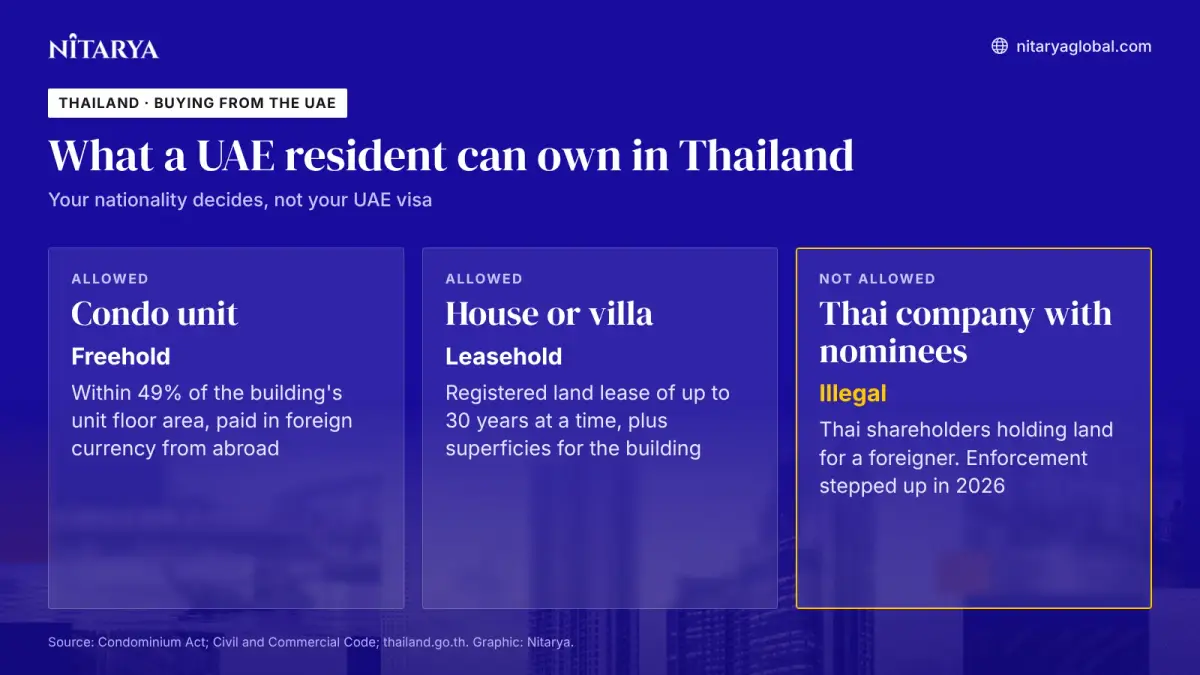
That leaves three routes, and only two of them are legal:
- A condo unit, freehold. Foreigners can own condo units outright as long as foreign ownership stays within 49% of the building's total unit floor area, and the purchase money comes in from abroad in foreign currency (Thai government guidance). The 49% is counted by floor area, not by the number of units.
- A house or villa, leasehold. Foreigners can't own land in their own name. The usual structure is a registered land lease, capped at 30 years per registration, plus a registered right of superficies so you own the building. Anything promised beyond the registered 30 years is a promise, not a right.
- A Thai company with nominee shareholders. Illegal, and an enforcement priority in 2026, especially on Phuket and Koh Samui.
Our guides to the 49% foreign condo quota and leasehold vs freehold in Thailand go deeper on each route.
Sending money from the UAE: the FET rules that catch Gulf buyers
For a freehold condo, the way the money arrives is a legal condition of ownership, not an admin detail.
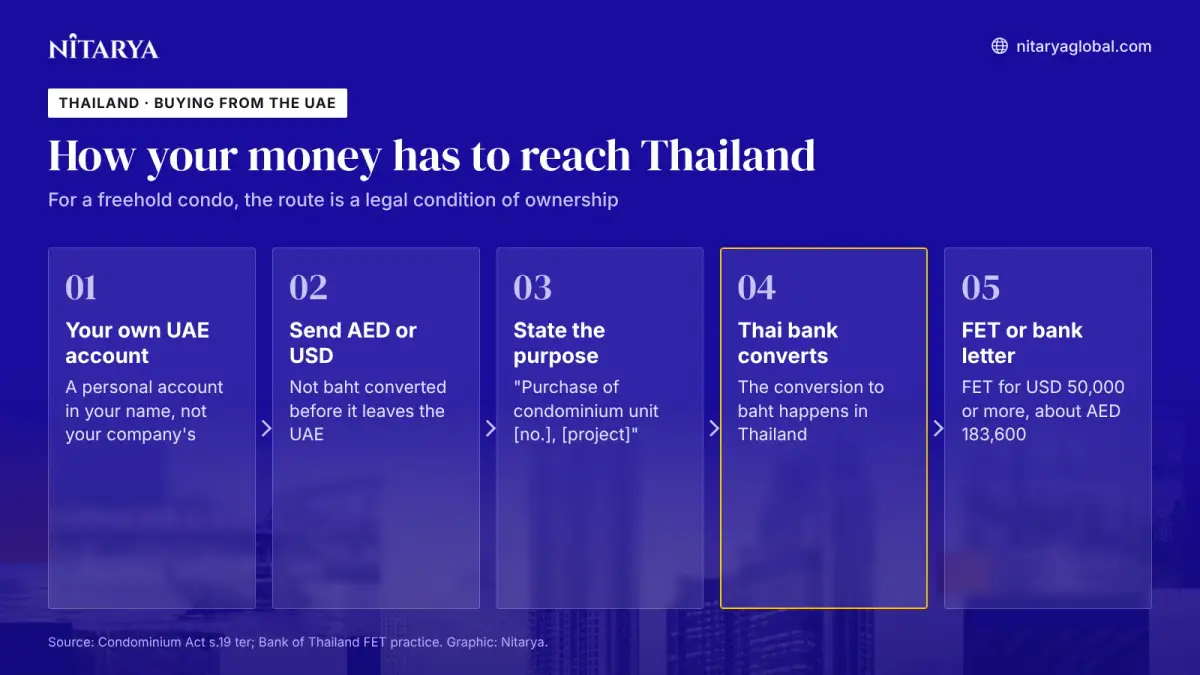
Section 19 ter of the Condominium Act requires a foreign buyer to show that at least the purchase price was brought into Thailand in foreign currency (Thai Law Online).
In practice that comes down to four things:
- Send from an account in your own name. The FET must show the foreign buyer as the sender or the receiver of the money (PropertyScout).
- Send dirhams or dollars, not baht. The conversion has to happen at the Thai bank.
- Write the purpose on the transfer: "purchase of condominium unit [number], [project name]". Vague wording like "investment" gets rejected.
- Collect the record. For a transfer of USD 50,000 or more (about AED 183,600), the Thai bank issues a Foreign Exchange Transaction form, the FET. Below that, ask the bank for a letter confirming the money came from abroad in foreign currency, and its purpose (Siam Legal).
Here's where UAE residents in particular get caught:
- Exchange houses and remittance apps that pay out in baht. They're cheap and quick, and they convert your money before it reaches Thailand. That works for living costs. For a condo, Thai Law Online calls these services "useless for a property purchase".
- Paying from your company account. If your savings sit in a free zone company or an LLC account, the sender on the bank record won't be you. Move the money to a personal account first, or get a Thai lawyer to confirm the Land Office will accept it before you send.
- Paying an agent. Pay only the developer's or seller's Thai account named in the contract. Never a personal account.
Keep every FET and bank letter with your title deed. You'll need the original FET, the purchase contract and the transfer receipt again when you sell and want to send the money out of Thailand.
A lease, a usufruct or a house on leased land doesn't need an FET at all, because none of them is a foreign freehold purchase.
What it costs, in baht and in dirhams
On transfer day the Land Office collects its charges, and the buyer and seller split them however the contract says.
| Charge | Rate | Worked out on | Usually paid by |
|---|---|---|---|
| Transfer fee | 2% | Official appraised value | Often split 50:50 |
| Specific business tax | 3.3% | Higher of price and appraised value | Seller |
| Stamp duty, if business tax doesn't apply | 0.5% | Higher of price and appraised value | Seller |
| Withholding tax | Varies | The seller's circumstances | Seller |
Thailand's reduced 0.01% transfer fee is for Thai nationals only. As a foreign buyer you pay the full 2% on your share.
Worked example: a THB 6 million Bangkok condo with an official appraised value of THB 5 million.
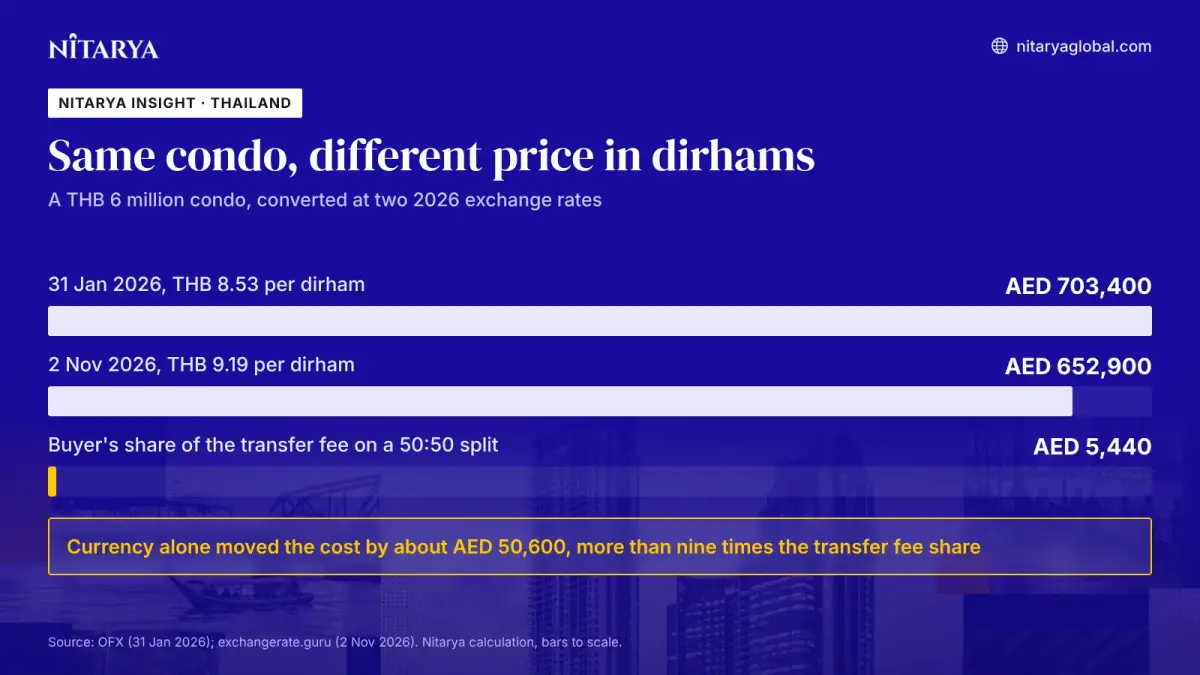
- Transfer fee: 2% of THB 5 million is THB 100,000. On a 50:50 split you pay THB 50,000, about AED 5,440.
- If the contract puts every Land Office charge on you, your share jumps to THB 298,000, about AED 32,400, plus the seller's withholding tax.
Then add what the Land Office doesn't collect: the developer's up-front sinking fund and advance common fees, your lawyer, and bank charges at both ends.
Get each one in writing, or run your numbers through our property buying cost calculator for Thailand. Our stamp duty estimate guide explains each line.
Nitarya insight: the exchange rate moved more than the fees
The same THB 6 million condo cost a dirham earner about AED 703,400 at the end of January 2026, when one dirham bought THB 8.53 (OFX). At THB 9.19 in early November, it cost about AED 652,900.
That's a difference of roughly AED 50,600, or 7%, from currency alone, and more than nine times the buyer's share of the transfer fee in the example above.
What this means for you: if you're buying off-plan with payments spread over two years, the price is fixed in baht but your cost in dirhams isn't.
Ask your bank about locking in a rate or converting in stages before you sign a payment plan, and keep a buffer.
Bangkok, Phuket or Koh Samui: what changes
The law is national. What changes by location is the kind of property you'll be offered, and that decides which route you're on.
- Bangkok. You'll mostly be looking at condos, so freehold within the quota is realistic. The checks that matter are the quota letter, the building's finances and the FET. If you're comparing high-end towers, see our guide to luxury condo due diligence in Bangkok.
- Phuket. Condos and pool villas. A condo can be freehold. A villa will be leasehold plus superficies, and the land title, access road and building permit all need checking. Our Phuket villa due diligence guide walks through it.
- Koh Samui. Mostly villas on land, often on slopes. Leasehold again, with the land title, legal access and hillside building rules doing most of the work.
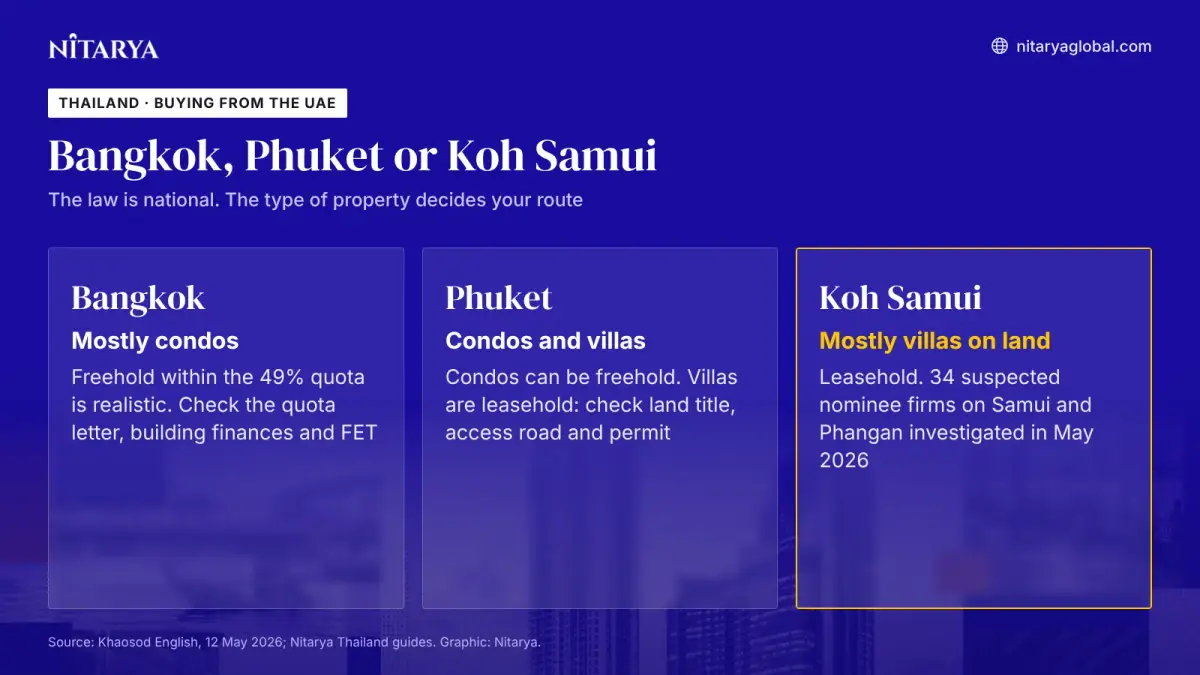
Two island points. First, in May 2026 Thailand's Department of Special Investigation opened cases against 34 suspected nominee companies on Koh Samui and Koh Phangan (Khaosod English).
If you lease a villa, check who owns the land under it. Second, if your plan is holiday lets, stays of under 30 days generally need a hotel licence or a valid exemption.
Leave short-let income out of your numbers until a Thai lawyer confirms it's allowed for that unit. Our guide to Airbnb rules in Thailand explains why.
Signing from Dubai: power of attorney
You don't have to fly to Thailand for the transfer. Most UAE-based buyers sign a power of attorney so a Thai lawyer can register the unit for them.
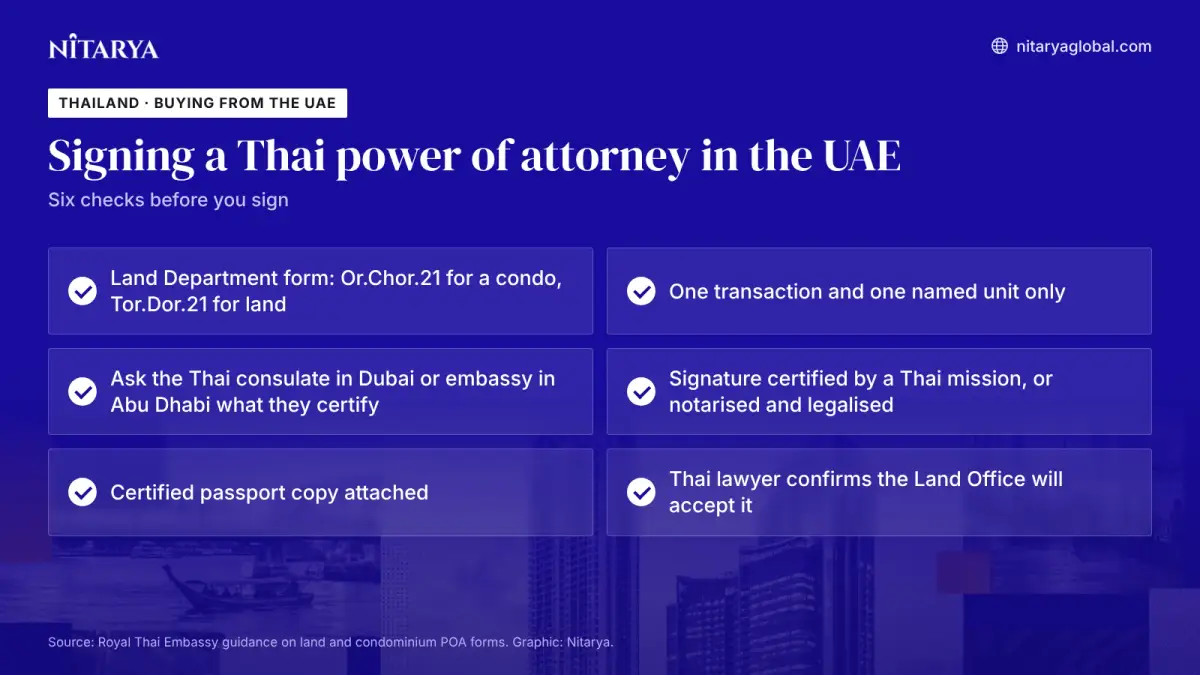
- Use the Land Department's own form: Or.Chor.21 for a condo unit, Tor.Dor.21 for land (Royal Thai Embassy, Washington).
- Keep it narrow: one transaction, one named unit.
- Get your signature certified. Thai missions certify signatures on these forms, but practice differs by mission, and some only do it for Thai nationals. Ask the Royal Thai Consulate-General in Dubai or the Royal Thai Embassy in Abu Dhabi what they'll do for your nationality before you book. If they won't, ask your Thai lawyer which notarisation and legalisation route the Land Office will accept.
- Attach a certified passport copy. Land offices often ask for one with the power of attorney.
You also don't need a Thai bank account to buy. The money can go straight to the developer's or seller's Thai account, as long as the bank record names you.
Your own account helps later for common fees and utilities. Our guide to power of attorney in Thailand covers the common reasons a POA gets rejected.
Checks before you pay a deposit
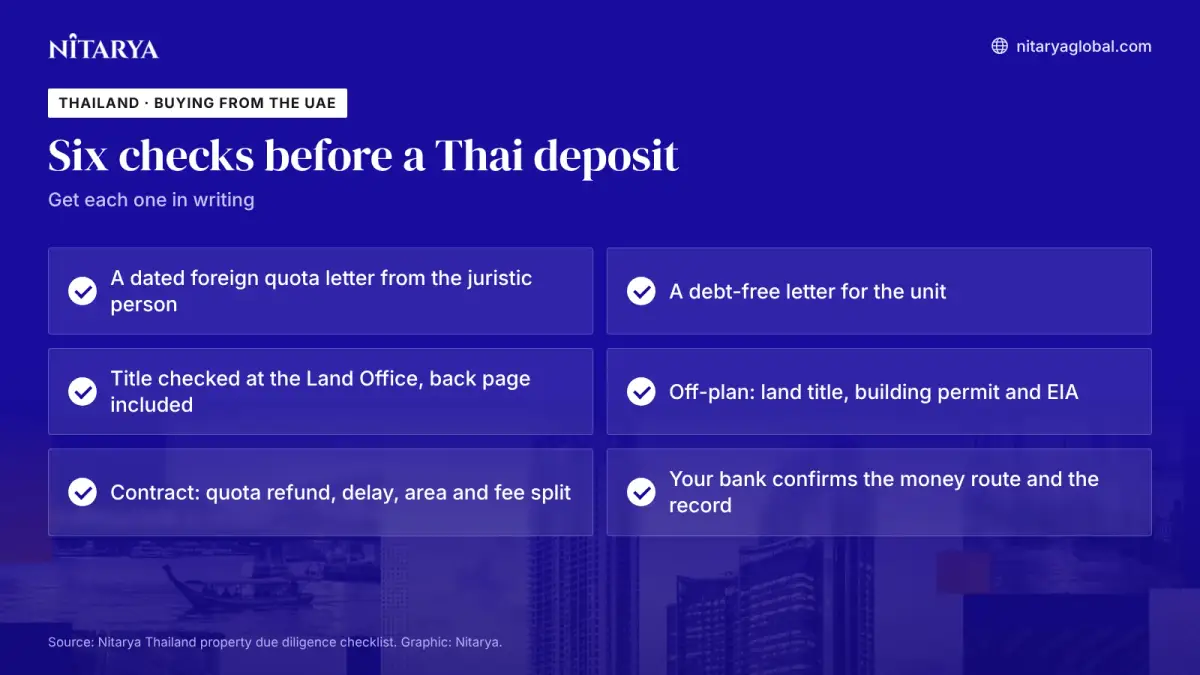
- A dated quota letter from the building's juristic person, showing how much foreign quota is left.
- A debt-free letter for the unit.
- The title checked at the Land Office, including the back page, where mortgages and leases are recorded.
- For off-plan: the project land in the developer's name, the building permit and, for larger projects, EIA approval.
- Contract terms: a refund if the quota is full by transfer day, a remedy for delay, area tolerance, and who pays which fee.
- Written confirmation from your UAE bank of how it will send the money, and what record the Thai bank will issue.
The full list, with what each document proves, is in our Thailand property due diligence checklist.
Tax: the UAE, Thailand and your home country
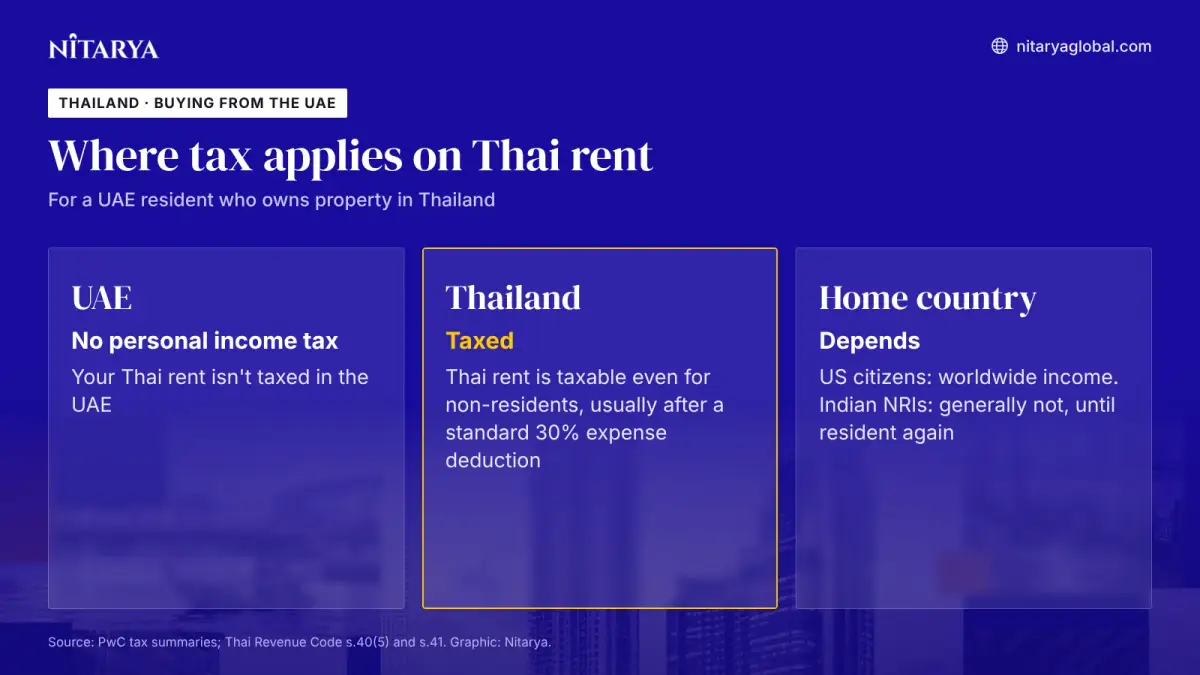
UAE. There's currently no personal income tax on individuals in the UAE (PwC), so your Thai rent isn't taxed there.
Thailand. Rent from Thai property is taxable in Thailand even if you're not a Thai tax resident and the rent is paid abroad, under section 41 of the Revenue Code (Mondaq).
Individuals can usually deduct a standard 30% for expenses before the progressive rates apply (Global Property Guide). There's also a small annual land and building tax on the official appraised value, and tax on sale.
Your home country. This is where UAE residents differ from each other. US citizens are taxed on worldwide income wherever they live.
Indian citizens who are non-resident in India generally aren't taxed in India on foreign income such as Thai rent.
That changes if you move back and become ordinarily resident, and Indian residents also have to report foreign property every year in Schedule FA. Check your own position before you buy, not when you sell.
How Nitarya helps
We work on the buyer's side only.
Before you pay a deposit, we check the title and the Land Office record, the quota and debt-free letters, the contract and the money route, and we show you what's verified, what's pending and what's missing.
The legal opinion comes from an independent, licensed Thai lawyer.
- Still choosing the building, area or price? Start with a pre-purchase property evaluation. Evaluations start at US$89.
- Found the unit? Our Thailand property due diligence service covers the checks above, end to end.
- Prefer to talk first? Book a free 15-minute call.
Buying in India too? Read our guide to buying property in India from the UAE.
This article is general information as of November 2026. It isn't legal, tax or investment advice. Get advice from licensed professionals for your own purchase.
Sources
- Foreign condo ownership and the 49% floor-area quota: Thai government guidance.
- Section 19 ter and the FET rule: Thai Law Online; FET threshold: Siam Legal; buyer's name on the FET: PropertyScout.
- Land Office charges and the THB 6 million worked example: Nitarya stamp duty estimate, using Revenue Department rules.
- Exchange rates: exchangerate.guru (2 November 2026) and OFX (31 January 2026). Currency comparison: Nitarya calculation.
- Nominee investigations: Khaosod English.
- Power of attorney forms: Royal Thai Embassy, Washington.
- Tax: PwC tax summaries, UAE; Mondaq on Thai rental income; Global Property Guide.
FAQs
Can a UAE resident buy property in Thailand?
Yes. Your UAE residence doesn't change anything. As a foreign national you can own a condo unit freehold within the building's 49% foreign quota, or lease land and own a villa through a registered lease and superficies.
Do I need a Thai bank account to buy a condo?
No. The money can go straight to the developer's or seller's Thai bank account. What matters is that the bank record names you and the money arrives in foreign currency.
Can I send dirhams, or do I need to send dollars?
You can send dirhams or dollars. What you can't do is send baht that was converted before it left the UAE. The conversion has to happen at the Thai bank, and the transfer has to come from your own account.
What is an FET form?
It's the Thai bank's record that foreign currency came into Thailand and was converted to baht. Banks issue it for transfers of USD 50,000 or more. The Land Office uses it to confirm your condo purchase qualifies for foreign ownership.
Can I rent out my Thai condo while I live in Dubai?
Yes, for leases of 30 days or more. Shorter holiday stays generally need a hotel licence or a valid exemption, and many buildings ban them. The rent is taxable in Thailand whether or not you live there.
Is the 49% foreign quota counted by units or by floor area?
By floor area. A building can show units for sale and still have no foreign quota left for a large unit. Get a dated quota letter before you pay.