
Phuket Villa Due Diligence: How to Buy a Villa in Phuket Safely in 2026
Buying a villa in Phuket as a foreigner in 2026? Lease, superficies, title, slope, access and the nominee crackdown: what to check before your deposit.

Free Thailand ownership guide Book a free 15-minute call
On this page
- How can a foreigner own a villa in Phuket?
- Why the nominee crackdown matters for Phuket villas
- Title, land and access checks
- Slope, building permit and planning
- What to check in the lease and superficies
- Can you rent a Phuket villa out to holiday guests?
- Before you pay a deposit: Phuket villa checklist
- Sources and method
- FAQs
TL;DR: A registered lease and separate building rights can be part of a Phuket villa structure, but neither makes the purchase safe by itself. Check the landowner, title, legal access, actual building, permits and contract together.
Resolve the rental plan and exit rights before a non-refundable deposit.
Phuket's villa market runs on foreign buyers.
Sotheby's International Realty Thailand has said international buyers account for the overwhelming majority of activity at the top end, in areas like Bang Tao, Laguna, Kamala, Surin and Cape Yamu.
That's exactly why the paperwork deserves a slow read. Two things changed the picture recently: a nominee-company crackdown aimed squarely at the islands, and a Supreme Court judgment on long lease renewals.
Both are covered below.
If you're buying from abroad, decide early who will walk the plot, the access road and the boundaries for you, and who will compare the villa with its approved plans.
This guide covers Phuket. Koh Samui has its own planning and environmental rules, so don't assume a Phuket answer carries across.
How can a foreigner own a villa in Phuket?
In practice, not by owning the land. Thai law allows foreign land ownership only through a few narrow routes with strict conditions and approvals, and they rarely fit a normal villa purchase.
If a villa is offered leasehold, find out exactly who owns the land and how the building will be registered to you.
The usual structure has two registered parts: a land lease, and a right of superficies that lets you own the building on someone else's land.
Our guide to superficies in Thailand explains how that right works and why it can be inherited when a usufruct can't.
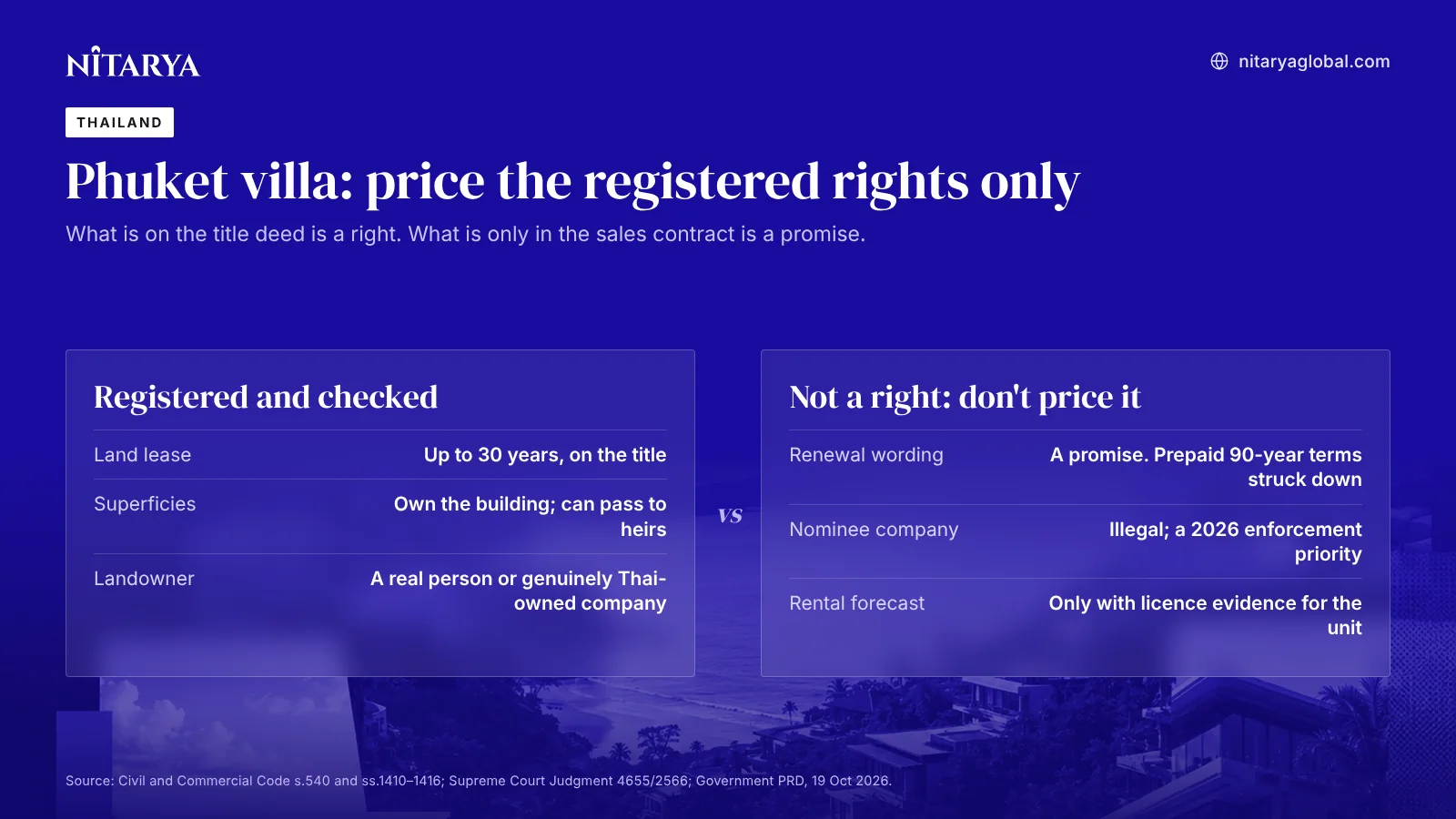
The lease term is where many buyers get caught. A lease can only be registered for 30 years at a time.
In Supreme Court Judgment 4655/2566, the court struck down an arrangement built from day one to run for 90 years, with the future terms paid upfront. That doesn't make every renewal clause void.
It does mean the registered 30 years is the only term you hold for certain, and anything after that is a promise. Have a Thai lawyer read the actual wording.
A condo unit inside the 49% foreign quota is a different asset altogether. And a brand name on the estate doesn't change the land rules. Compare what's registered, not what the brochure calls it.
Why the nominee crackdown matters for Phuket villas
Using Thai shareholders who aren't real investors to hold land for a foreigner has always been illegal. In 2026 it became an enforcement priority, and the islands are at the centre of it.
Nitarya insight: the checks are focused where villas are sold

The Department of Business Development named Phuket and Surat Thani, the province that includes Koh Samui, among six areas for its 2026 inspections.
In May 2026 the Department of Special Investigation opened cases against 34 companies on Koh Samui and Koh Phangan.
And Nation Thailand reported that in Surat Thani alone, risk modelling flagged more than 3,500 property-holding companies with foreign shareholding sitting just below the 50% legal threshold.
If a seller offers you a villa "through a company, with Thai partners", that's the structure being looked for. There's a quieter risk too. Even if you're only taking a lease, check who owns the land you're leasing.
If the landowner is a company under investigation, you're taking on its problem.
Title, land and access checks
Start with the land, because everything else sits on it.
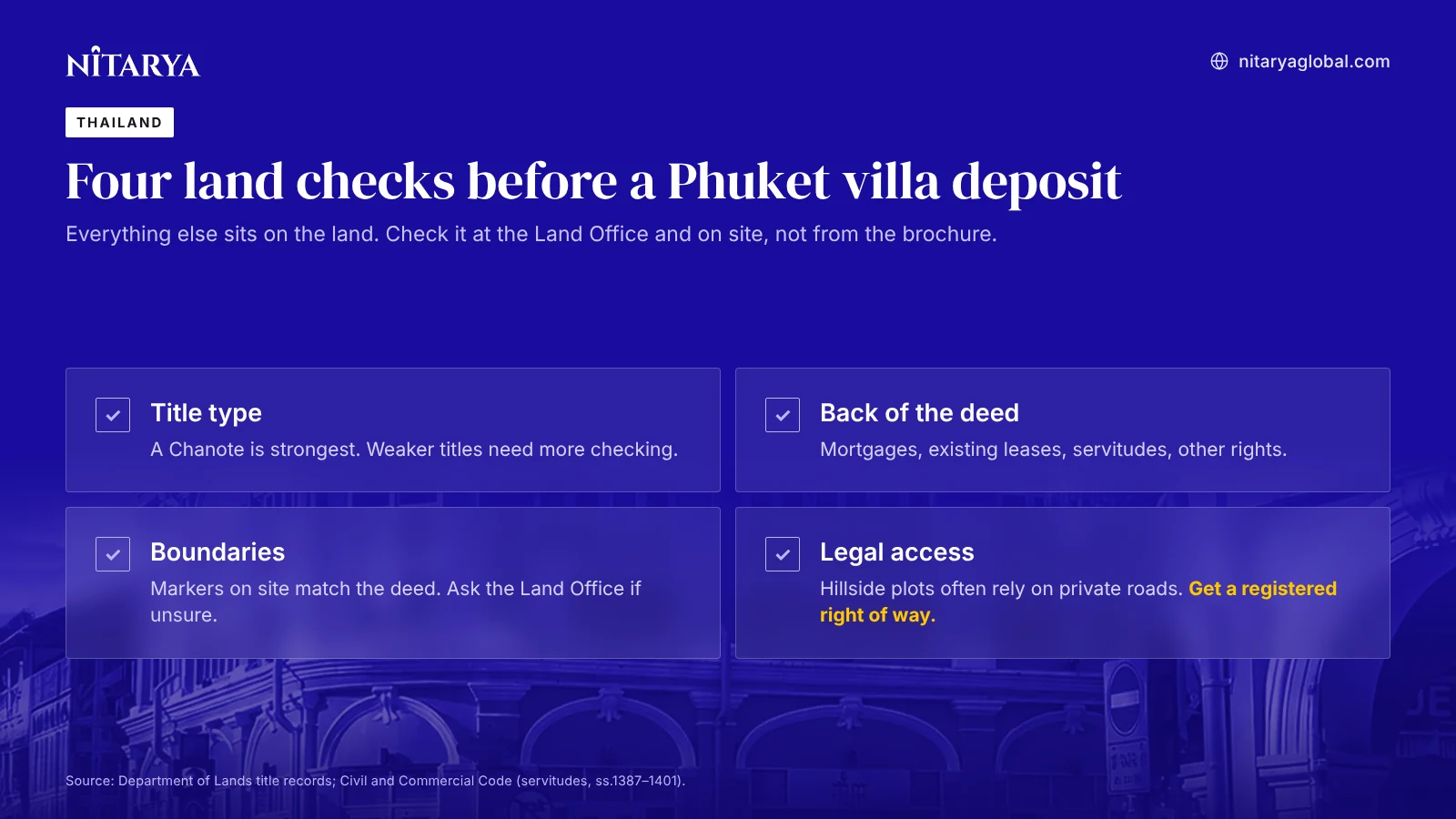
- Title type: a Chanote is the strongest. Weaker titles need more checking, and some can't be leased or built on safely. See our Chanote verification guide.
- The back of the deed: mortgages, existing leases, servitudes and other registered rights.
- Boundaries: whether the markers on site match the deed. If in doubt, ask the Land Office to check.
- Access: whether the road from the public road to your gate is legally yours to use. Hillside plots in Phuket often depend on private roads. Read our guide to right of way in Thailand.
Slope, building permit and planning
Phuket's best views are often on its steepest land, and hillside building is tightly controlled.
For an existing villa, check that the building permit and approved plans match what's actually there, including pools and extra floors added later.
For off-plan villas, check the permit before you pay, and for larger estates, whether an environmental approval was needed.
Our guides to building permit checks, EIA approval and construction contracts go through each step.
What to check in the lease and superficies
- Both are registered at the Land Office and shown on the title, not just signed between you and the landowner.
- The term, start date and rent, including whether it's all paid upfront.
- Whether you can transfer the lease or sublet without the landowner's consent.
- What happens if the landowner dies or sells.
- That any renewal wording is treated as a promise only, and priced that way.
Can you rent a Phuket villa out to holiday guests?
Maybe, but don't take the answer from a sales manager. Stays of under 30 days generally need a hotel licence or a valid exemption, and many estates add rules of their own.
Ask for the licence or exemption that covers this exact villa, and read the estate rules. Until a Thai lawyer confirms your rental plan is lawful, leave the rental income out of your numbers.
Our guide to Airbnb rules in Thailand explains the 30-night rule in more detail.
Before you pay a deposit: Phuket villa checklist
- The land title is checked at the Land Office, including the back of the deed.
- The landowner is a real person or a genuinely Thai-owned company, with no sign of a nominee structure.
- Legal access from the public road is confirmed.
- The building permit and plans match the villa as built.
- The lease and superficies will both be registered, with terms you've read.
- You've priced the villa on the registered 30 years only.
- A Thai lawyer has confirmed whether you can legally rent the villa out the way you plan to. If that's still open, the rental income isn't in your numbers.
- You know the full purchase and running costs.
If any of these are open, ask for the evidence before you pay. Nitarya's Thailand property due diligence service can work through them with you, or you can book a free 15-minute call to talk through the villa you're looking at.
This article is general information only and reflects the position as of November 2026. It is not legal, tax or investment advice. Get advice from appropriately licensed professionals for your own purchase.
Want to compare Phuket areas before you shortlist a villa? Nitarya Property Insights lets you compare locations side by side. Check Nitarya Tools and Insights.
Sources and method
- International buyers in Phuket's high-end villa market: Sotheby's International Realty Thailand, via Thai Examiner.
- Nominee enforcement: Thai Enquirer, Khaosod English and Nation Thailand.
- Superficies: Civil and Commercial Code, Sections 1410 to 1416.
- Hotel Act B.E. 2547 and the 30-night rule: industry summaries checked August 2026.
- Nominee enforcement priorities: Government Public Relations Department announcement, 19 October 2026.
FAQs
Can a foreigner buy land in Phuket?
Not in their own name. Foreigners can lease land for up to 30 years at a time and own the building on it through a registered superficies. Holding land through a company with nominee Thai shareholders is illegal.
Is it safe to buy a villa in Phuket in 2026?
It can be, if the lease and building rights are registered, the landowner is genuine and you value the villa on the registered term only. The riskiest purchases are the ones relying on company structures or renewal promises.
Is buying a villa on Koh Samui any different?
The rules are the same, but enforcement has been especially active there in 2026, with investigations into suspected nominee companies on Koh Samui and Koh Phangan.
Check who owns the land with extra care.
How long does villa due diligence take in Phuket?
Usually one to three weeks, depending on how quickly Land Office, permit and company records can be obtained. Build that time in before you pay a non-refundable deposit.
What happens to my villa lease if the landowner dies?
A registered lease generally binds the landowner's heirs for the rest of its term, but any renewal promise may not. Your contract should also say what happens on the landowner's death or a sale, so check that before you sign.