Superficies in Thailand: How to Own Your Villa on Leased Land
What a right of superficies is, how it differs from a lease and a usufruct, how to register it and what happens to your villa when it ends.


Free Thailand ownership guide Book a free 15-minute call
On this page
- What is a right of superficies in Thailand?
- Superficies vs lease vs usufruct
- Why do villa buyers use a lease and a superficies together?
- How long does a superficies last?
- Can a superficies be ended early?
- What happens when a superficies ends?
- How do you register a superficies?
- Buying a villa that's already built?
- What to check before you rely on a superficies
- Common mistakes with superficies
- Sources and method
- FAQs
TL;DR: A right of superficies lets you own a building on land that belongs to someone else. For foreigners, it's how you own the villa itself while the land stays in a Thai owner's name.
It can run for up to 30 years, or for the lifetime of the landowner or the holder. A fixed-term superficies can be sold and passed to your heirs unless the agreement says otherwise.
It only protects you if it's registered on the title deed at the Land Office.
A land lease and ownership of a house are not the same right. In Thailand you can lease a plot for 30 years and still not own the villa standing on it, unless the paperwork says you do.
Superficies is the right that deals with the building.
The useful question isn't which label sounds stronger. It's whether the rights registered on the title, their terms and your contract support what you plan to do with the house: live in it, let it, sell it or leave it to your family.
What is a right of superficies in Thailand?
It's a real right, under Section 1410 of the Civil and Commercial Code, to own buildings, structures or plantations on or under land that belongs to another person.
The Thai term is สิทธิเหนือพื้นดิน.
In plain terms: the landowner keeps the land, and you own what stands on it. Because it's a real right and not only a contract, a registered superficies stays attached to the land if the landowner sells it.
Don't confuse it with sap-ing-sith. That's a separate right created by its own Act in 2019, with different rules and fees. If an agent uses the two words as if they were the same thing, ask which one will actually be registered.
Superficies vs lease vs usufruct
| Lease | Superficies | Usufruct | |
|---|---|---|---|
| What you get | Use of the land, and the house if it's included | Ownership of the buildings on someone else's land | Use of the property and any income from it |
| Longest term | 30 years per registration | Up to 30 years, or for the lifetime of the landowner or the holder | Up to 30 years, or for the holder's lifetime |
| Can you sell it? | Only if the lease allows it | Yes, unless the agreement says otherwise | Not the right itself |
| Does it pass to heirs? | Only if the lease provides for it | Yes for a fixed term. No if it was granted for your lifetime | No, it ends when the holder dies |
| What happens at the end | You hand the land back | You can remove the building, or the landowner can buy it at market value | The property returns to the owner |
| Registration | Needed for leases over three years | Needed | Needed |
The inheritance row is often the reason families choose a superficies. A usufruct ends with you. A fixed-term superficies can pass to your children for the rest of its term.
Our guide to usufruct in Thailand covers that right in more detail.
Why do villa buyers use a lease and a superficies together?

Because they do different jobs. The lease gives you the right to occupy the whole plot, including the garden, the pool and the access. The superficies makes the building yours.
Whether you need both depends on the existing rights, the building and the deal in front of you.
Have a Thai lawyer check how the two documents work together, and try to keep their terms in step so one doesn't run out years before the other.
Having both also makes the paperwork cleaner when you sell or pass the property on, because the building is clearly yours. Our guide to freehold and leasehold in Thailand explains the lease side.
How long does a superficies last?
Under Section 1412, it can be set for a fixed period of up to 30 years, or for the lifetime of the landowner or the lifetime of the holder.
A fixed term can be renewed, but each renewal is also capped at 30 years, and a clause that promises an automatic renewal may not be enforceable. Treat the registered term as what you hold.
If no term is fixed, Section 1413 lets either side end it on reasonable notice. Where rent is payable, the notice is one year, or one year's rent in its place.
So always fix the term in writing and make sure the registration matches it.
Can a superficies be ended early?
Yes, in two situations under Section 1414:
- you fail to meet an essential condition written into the agreement, or
- rent is payable and you don't pay it for two years running.
Read the conditions before you sign. A condition that sounds minor, such as a restriction on what you can build or how you use the house, can become the landowner's route to ending the right.
What happens when a superficies ends?
Nitarya insight: the house doesn't simply pass to the landowner
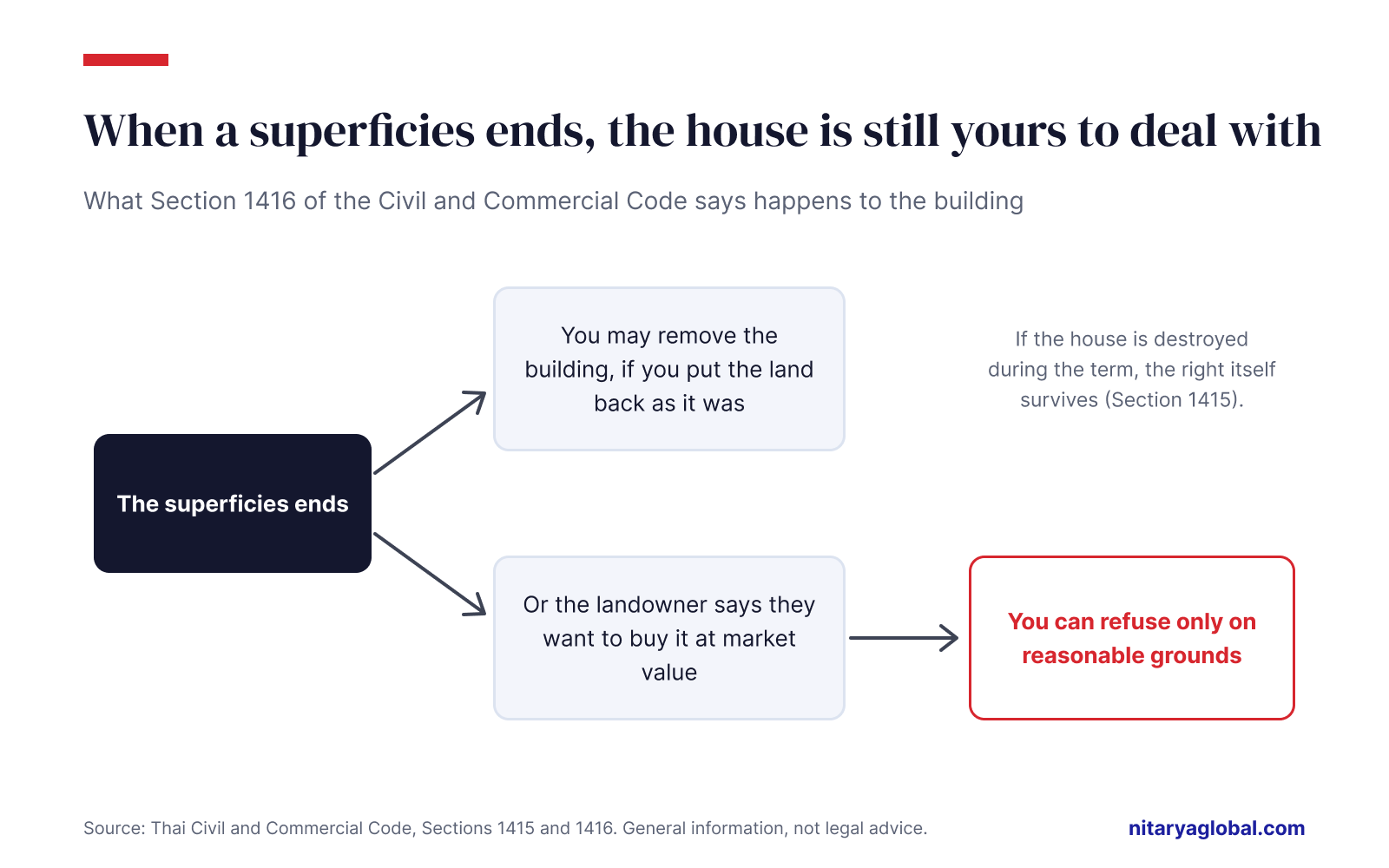
Many buyers assume the villa becomes the landowner's on the last day. The Code says something different.
Under Section 1416, you may remove your building as long as you put the land back as it was. If the landowner tells you they want to buy it at market value instead, you can refuse only on reasonable grounds.
And under Section 1415, the right itself survives even if the house is destroyed during the term.
You can't put a villa on a truck, so in practice the market-value purchase is the outcome that matters.
That's why we suggest agreeing, at the start, who values the house at the end and how, and writing it into the agreement next to the lease. It costs nothing to settle on day one and it is hard to settle in year 29.
How do you register a superficies?
- Check the title. The right has to be noted on the title deed, so the land needs a proper title such as a Chanote. Some land documents, including Sor Por Kor agricultural land, can't carry one.
- Put the agreement in writing. It should set out the term, any rent, what you may build, whether you can transfer it and what happens at the end.
- Go to the Land Office for the area where the land is. Both sides attend, or send someone under a power of attorney. If the landowner is married, expect to be asked for the spouse's consent.
- Pay the fee. Thai law firms put it at about 1.1% of any payment made for the right, stamp duty included, and a small fixed fee per plot where nothing is paid. Confirm the figure with the Land Office first.
- Check the back of the title deed. The officer writes the superficies there. Until it appears, you have a contract and not a registered right.
If you can't be in Thailand to sign, our guide to power of attorney in Thailand covers what the Land Office accepts.
Buying a villa that's already built?
This is the part that catches resale buyers.
Thai legal guides report that a Land Office may refuse to register a superficies over a building that already exists, unless you can show that ownership of the house was transferred to you separately, with its own fees and taxes paid.
Practice also varies between offices. Some are used to registering a lease and a superficies on the same plot for the same people. Others see it rarely and may ask more questions, especially about a lifetime superficies for a foreigner.
So for an existing villa, ask three things before you pay a deposit:
- Who owns the house today, and what document shows it?
- Does the building permit match the building? See our building permit check guide.
- Has the local Land Office confirmed it will register the superficies you've been promised?
What to check before you rely on a superficies
- It's registered on the land title at the Land Office, not only signed between you and the landowner.
- Its term is in step with the land lease.
- The landowner is genuine. If the land sits in a company with nominee Thai shareholders, that's a risk to everything built on it.
- The building permit and house registration book match the building you're buying. See our guide to the Thai house book.
- The agreement says what happens at the end and how the house will be valued.
- You've planned who inherits it, with a will that covers your Thai assets. Our guide to overseas property inheritance planning explains the options.
Common mistakes with superficies
- Relying on a superficies that was promised but never registered.
- Assuming it gives you the land. It doesn't.
- Treating it as a way round the 30-year limit. Like a lease, a fixed term is capped at 30 years.
- Taking a lifetime superficies and expecting your children to inherit it.
- Skipping the conditions, then losing the right over one of them.
- Leaving the end-of-term valuation to be argued about later.
If you plan to sell one day, our guide to selling property in Thailand as a foreigner explains how a lease and a superficies are transferred to a buyer.
Nitarya's Thailand property due diligence service can check the registered rights on a specific plot before you commit.
This article is general information only. It is not legal advice. The section references use an English translation of the Civil and Commercial Code, and the Thai text is the authoritative one.
Get advice from a licensed Thai lawyer before relying on any land right.
Weighing up villa areas before you commit? Nitarya Property Insights lets you compare locations side by side. Check Nitarya Tools and Insights.
Sources and method
- Civil and Commercial Code of Thailand, Sections 1410 to 1416: English translation, Siam Legal library.
- Term, renewal, termination, inheritance and Land Office practice: Thai Law Online, reviewed 2026.
- Registration fee and existing buildings: Samui For Sale legal guide.
- Sap-ing-sith as a separate right: Tilleke & Gibbins.
- Comparison with usufruct and leases: Civil and Commercial Code and published Thai legal guides.
- Checked 14 November 2026.
FAQs
Can a foreigner register a superficies in Thailand?
Yes. A foreigner can hold a registered right of superficies over land owned by a Thai person or company, which lets them own the building on it.
Is a superficies better than a lease?
They do different jobs. A lease gives you use of the land, and a superficies gives you ownership of the building. Many villa buyers hold both.
Ask a Thai lawyer what your transaction needs.
Can a superficies be inherited?
A fixed-term superficies can, unless the agreement says otherwise. Your heirs take over for the rest of the term. One granted for your own lifetime ends when you die, so there is nothing to pass on.
Can a superficies last longer than 30 years?
A fixed term is capped at 30 years. It can be set for the lifetime of the landowner or of the holder instead, which may turn out longer or shorter than 30 years.
How much does it cost to register a superficies?
Thai law firms put the Land Office charge at about 1.1% of any payment made for the right, including stamp duty, and a small fixed fee where no payment is made.
Check the figure with your local Land Office.
Does a superficies survive if the landowner sells the land?
Yes, if it's registered. A registered superficies is a real right attached to the land, so it binds a new owner.
What happens to my house when the superficies ends?
You can remove it if you restore the land, or the landowner can offer to buy it at market value. You can turn that offer down only on reasonable grounds.