Selling Property in Thailand as a Foreigner: Taxes, Proceeds and Resale
How foreigners sell a condo or leasehold villa in Thailand: the steps, the 2027 appraisal reset, what the seller pays and the paperwork to send the money home.

Free Thailand ownership guide Book a free 15-minute call
On this page
- Can a foreigner sell property in Thailand?
- How does a sale work, step by step?
- What taxes and fees does the seller pay?
- Will the 2027 appraisal reset change your costs?
- What documents do you need on transfer day?
- How do you send the sale money out of Thailand?
- Can you sell from abroad?
- Selling a leasehold villa
- Selling property held through a company
- UK tax when you sell
- Common mistakes when selling
- Planning your exit before you buy
- Sources and method
- FAQs
TL;DR: A foreigner can sell a Thai condo to a buyer of any nationality, and the sale completes in one visit to the Land Office.
Expect a 2% transfer fee, either 3.3% specific business tax or 0.5% stamp duty, and withholding tax, all worked out from the official appraised value.
To send the money home, your bank will ask for the Land Office sale agreement, the tax receipts, a copy of the title deed, your passport and the foreign exchange evidence from the day you bought.
Selling a leasehold villa is different, because you're transferring a lease and not the land.
Most buyers think about the exit years after they buy. In Thailand it pays to think about it on the day you buy, because the documents you collect then decide how easily you can sell and get your money home later.
This guide covers the sale step by step, what the seller pays, the paperwork your bank will want and how a leasehold villa sale differs. It's written for foreign owners, including those selling from abroad who can't fly back for every step.
Can a foreigner sell property in Thailand?
Yes. What matters is what you actually hold, because that's what you're selling.
| What you hold | What you sell | Who can buy |
|---|---|---|
| A condo in your own name | The unit, freehold | Anyone. A foreign buyer takes over your place in the 49% foreign quota |
| A villa on leased land | The rest of your registered lease, plus the house if you own it | Anyone, if the lease allows a transfer |
| Property inside a Thai company | The company's shares, or the property out of the company | Depends on the structure. Take legal advice first |
A unit already held in the foreign quota can go to another foreign buyer without new quota, which helps in popular buildings. The buyer still needs their own foreign-currency evidence to register the unit.
Our guide to foreign condo ownership and the 49% quota explains how that works.
How does a sale work, step by step?
- Check your file. Title deed, passport, your original foreign exchange evidence and, for a condo, the house book if you have one.
- Price it against real evidence. Asking prices in your building are a starting point, not proof. Our guide to checking whether a Thai property is overpriced shows the method a careful buyer will use on you.
- Agree terms and sign the sale and purchase agreement. A deposit of about 10% is common. Put the split of taxes and fees in writing here, not at the Land Office counter.
- Collect the building letters. For a condo, the juristic person issues a debt-free letter and, for a foreign buyer, a foreign quota letter. Both are only valid for a short time, so get them close to the transfer date.
- Transfer at the Land Office. Officers check the documents, work out the taxes on the spot, take payment and register the new owner the same day.
- Send the money home. Take the stamped sale agreement and tax receipts to your bank together with your original inbound evidence.
Agents usually charge the seller around 3% by market custom. There's no fixed rate, so agree it before you list.
What taxes and fees does the seller pay?
Everything is paid at the Land Office on transfer day. Who pays what is a matter of contract, although custom puts most of it on the seller.
| Charge | Rate | Worked out on | Who usually pays |
|---|---|---|---|
| Transfer fee | 2% | Official appraised value | Shared, or as agreed |
| Specific business tax | 3.3% (3% plus a 10% local surcharge) | The higher of the sale price and the appraised value | Seller |
| Stamp duty | 0.5% | The higher of the sale price and the appraised value | Seller |
| Withholding tax | Sliding scale for individuals, 1% for companies | Appraised value for individuals | Seller |
You pay specific business tax or stamp duty, never both. The Revenue Department applies specific business tax to a sale within five years of the date you acquired the property, counted to the day.
It doesn't apply if your name has been in the property's house registration for at least a year, or if you inherited the property. In those cases, and after five years, stamp duty applies instead.
One point for sellers of cheaper units. The transfer fee is cut to 0.01% until 30 June 2027, but only when the buyer is a Thai national and both the price and the appraised value are THB 7 million or less.
A foreign buyer still pays the full 2%. If your unit is under that line, a Thai buyer's costs are lower than a foreign buyer's, and that can help your price.
How is withholding tax worked out?
For an individual seller it's a prepayment of income tax, and the Land Office calculates it for you:
- Start with the official appraised value. The sale price doesn't come into it.
- Take off a flat allowance that depends on how long you've owned the property: 92% after one year, falling to 50% for eight years or more.
- Divide what's left by the number of years you've owned it.
- Run that yearly figure through the personal income tax bands.
- Multiply the result by the number of years.
A company seller pays a flat 1%. Our guide to withholding tax on a Thai property sale goes through it line by line.
Nitarya insight: the five-year line is worth less than it looks
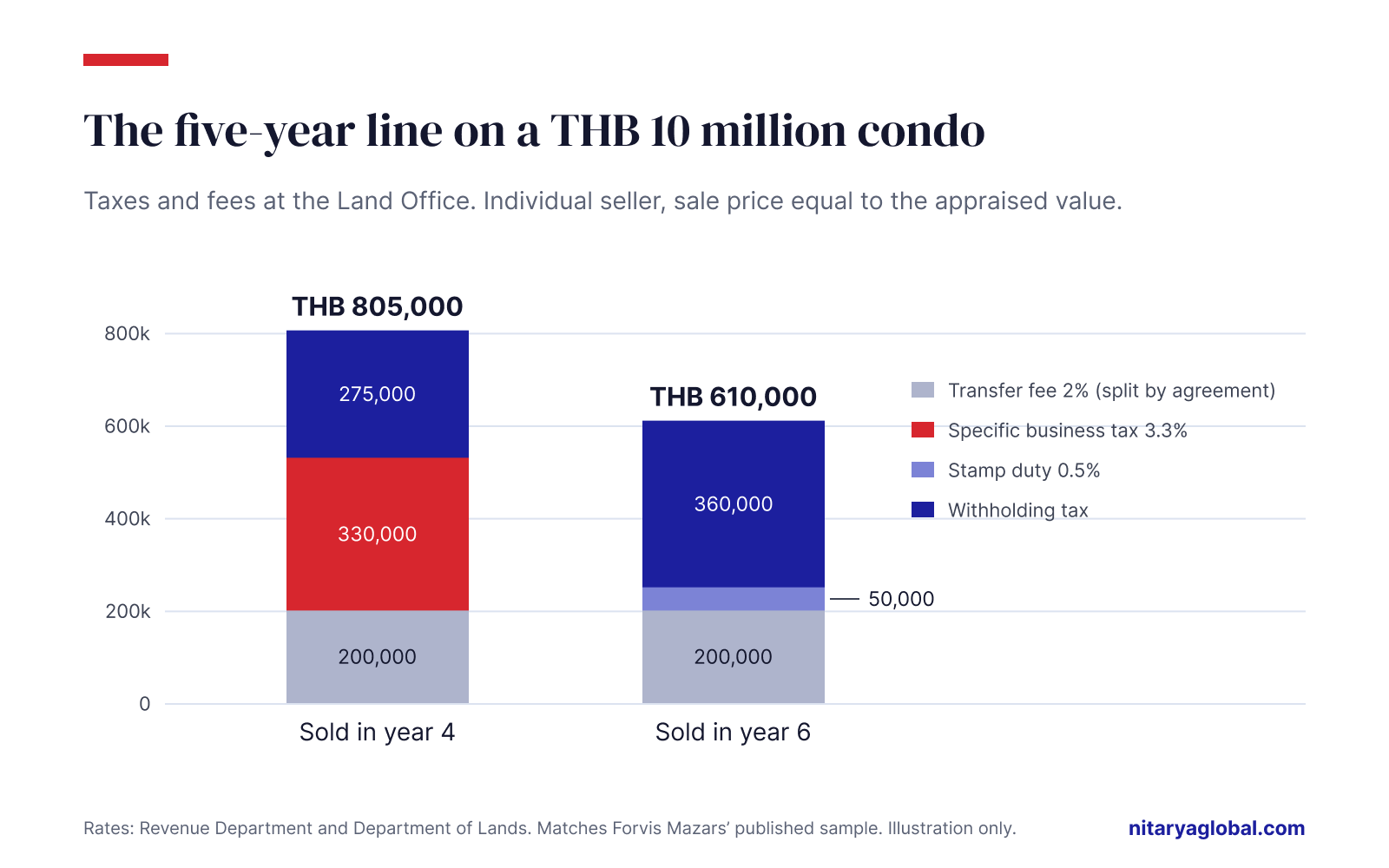
Most guides stop at "wait five years and 3.3% becomes 0.5%". On a THB 10 million condo that swap saves THB 280,000. But withholding tax moves the other way.
In year 4 it comes to THB 275,000. In year 6 it's THB 360,000, because the allowance shrinks the longer you hold.
Put the two together and the total falls from THB 805,000 to THB 610,000. The real saving is THB 195,000, about 2% of the price, not the 2.8% the headline rates suggest.
So don't hold a property you want to sell for an extra year only for the tax. If the market gives you a good buyer in year 4, work out both totals first.
The two taxes also count time differently. Specific business tax counts exact days from the date you acquired the property. Withholding tax counts years of ownership.
Ask the Land Office or your lawyer for an itemised figure for your own dates before you fix a completion day.
Will the 2027 appraisal reset change your costs?
It can. The Treasury Department revises official appraisal values every four years. The current values run to the end of December 2026 and the new round applies from 1 January 2027 to 2030.
Every charge in the table above uses the appraised value somewhere. If the new value for your unit is higher, a transfer registered in January costs more than the same transfer in December.
Reports so far point to modest rises along Bangkok's transit lines, while developers have said they expect a 10% to 20% average rise nationwide.
If you're close to agreeing a sale, ask the Land Office what value applies on your transfer date and plan the completion day around it.
What documents do you need on transfer day?
- The original title deed. For land that's the Chanote.
- Your passport, and the house book if you hold one.
- The signed sale and purchase agreement.
- For a condo: the debt-free letter from the juristic person, and the foreign quota letter if your buyer is foreign.
- A marriage or divorce certificate, if it applies to you.
- A power of attorney on the Land Office's own form, if someone attends for you.
- Mortgage release papers, if the property is mortgaged.
Keep your original foreign exchange evidence separate. The Land Office doesn't need it from the seller, but your bank will.
How do you send the sale money out of Thailand?
Your Thai bank will usually ask for:
- the official Land Office sale agreement
- the Land Office tax receipts
- a copy of the title deed
- your passport
- the original foreign exchange transaction form (FET), or the bank's credit advice, from when you brought the purchase money in
A bank issues an FET form for an inbound transfer of USD 50,000 or more. Below that you'll have a credit advice or bank letter, which does the same job.
This is the document people lose. It shows your money came into Thailand from abroad, which is what lets it go back out. If you can't find yours, contact the branch that received your original transfer before you agree a sale.
That evidence covers what you brought in. If you're sending home more than you brought in because you sold at a profit, ask the bank in advance what else it wants to see.
Each bank has its own checklist for large outward transfers.
Nitarya insight: your exit starts on the day you buy

Keep the purchase documents, registered rights, tax receipts and bank records together. They let your lawyer and your bank trace the sale and the money.
They don't guarantee how long the transfer abroad will take. That depends on your file and the bank's checks.
That's why we put every purchase document into one ownership file from day one. See our Thailand property due diligence checklist for the documents to collect when you buy.
Can you sell from abroad?
Yes. You can appoint someone to attend the Land Office under a power of attorney. The Land Office has its own forms for this, one for land and houses and one for condos.
A power of attorney signed outside Thailand usually has to be notarised and then legalised by a Thai embassy or consulate, so allow a few weeks for it.
Give the power to someone independent of the buyer and the agent. Our guide to power of attorney in Thailand covers the wording that causes delays.
Selling a leasehold villa
You can't sell the land, because you never owned it. What you sell is the rest of your registered lease, plus the building if you own it through a superficies.
- Under the Civil and Commercial Code, a tenant can't transfer a lease without the landowner's consent unless the lease allows it. Check your lease before you market the villa.
- A superficies can be transferred unless the agreement says otherwise. See our guide to superficies in Thailand.
- Buyers will price the years left on the registered term. A renewal clause is a separate promise and not a registered right, so don't expect a buyer to pay for it as if it were. The Supreme Court's Judgment 4655/2566 dealt with prepaid renewal terms built to reach 90 years, and it has made buyers' lawyers more careful. Have a Thai lawyer read your actual wording. Read the case analysis.
Our guide to freehold and leasehold in Thailand explains the 30-year limit in more detail.
Selling property held through a company
If the property sits in a Thai company, a sale usually means selling the company's shares or having the company sell the property.
Both are under closer scrutiny in 2026 because of the nominee crackdown, and a buyer's lawyer will want to see that the Thai shareholders are real. Get legal advice before you start.
UK tax when you sell
If you live in the UK, a gain on overseas property is usually taxable in the UK and has to be reported to HMRC, even if Thai tax has been paid. Keep the Land Office tax receipts, because you may be able to claim credit for the Thai tax.
Take UK tax advice on your own position.
Common mistakes when selling
- Agreeing a price before working out the Land Office total.
- Leaving the tax split to be argued at the counter.
- Looking for the FET form after the buyer has paid.
- Marketing a leasehold villa without checking the lease can be transferred.
- Pricing against asking prices. Foreign buyers took 6,533 condo units in the first half of 2026, 8.8% fewer than a year earlier, and Bangkok has a large stock of unsold new units. Your resale competes with developer discounts.
Planning your exit before you buy
- Keep every FET form and Land Office receipt in one place.
- Choose buildings and locations with real resale demand. In Bangkok, units near transit and in established districts usually sell more easily.
- For a villa, check that the lease can be transferred and how many years will be left when you plan to sell.
- Very high-end villas have a smaller pool of buyers, so expect a longer wait.
Nitarya's Thailand property due diligence service builds your ownership file from the start, so the exit is ready when you are.
This article is general information only. It is not legal, tax or investment advice. Rates and reliefs change, and the figures in the example are an illustration.
Get advice from appropriately licensed professionals in Thailand and the UK before you sell.
Thinking about where to buy next? Nitarya Property Insights lets you compare locations side by side. Check Nitarya Tools and Insights.
Sources and method
- Specific business tax, the five-year rule and exemptions: Thai Revenue Department. Stamp duty: Thai Revenue Department.
- Withholding tax method and the THB 10 million worked figures: Forvis Mazars Thailand property tax guide. We recalculated the year 4 and year 6 figures and they match.
- Transfer fee cut to 30 June 2027 and who qualifies: Tilleke & Gibbins and Forvis Mazars, 2026.
- 2027 appraisal round: Bangkok Post, 21 January 2026, and Nation Thailand.
- Documents for sending sale proceeds abroad and the FET form: Samui For Sale legal guide and CBRE Thailand.
- Foreign condo transfers, first half of 2026: Real Estate Information Center data via Nation Thailand, September 2026.
- Lease and superficies transfers: Thai Civil and Commercial Code.
- Checked 14 November 2026.
FAQs
Can a foreigner sell property in Thailand from abroad?
Yes. You can appoint someone under a power of attorney on the Land Office's form to attend the transfer for you. See our guide to power of attorney in Thailand.
How much tax do I pay when I sell a condo in Thailand?
A 2% transfer fee, usually shared, plus either 3.3% specific business tax or 0.5% stamp duty, plus withholding tax. On a THB 10 million condo the Land Office total is roughly THB 805,000 in year 4 and THB 610,000 in year 6.
Ask for an itemised figure for your own property and dates.
What is the five-year rule when selling property in Thailand?
A sale within five years of the day you acquired the property attracts specific business tax at 3.3%. After that, or if your name has been in the house registration for at least a year, you pay 0.5% stamp duty instead.
What if I've lost my FET form?
Contact the bank branch that received your original transfer. It may be able to issue a replacement or a confirmation letter. Do this before you agree a sale, because the bank will ask for it when you send the money abroad.
Can I sell my Thai condo to another foreigner?
Yes. A unit already in the foreign quota can be sold to another foreigner, who will need to bring in the purchase money from abroad in foreign currency.
Can I sell a leasehold villa in Thailand?
Yes, by transferring the remaining lease, and the building if you own it. Check that your lease allows a transfer without the landowner's consent, and expect buyers to price only the years left on the registered term.
Should I sell before or after 1 January 2027?
New official appraisal values apply from that date, and the transfer fee and taxes are based on them. If the new value for your property is higher, a transfer registered afterwards will cost more.
Ask the Land Office which value applies on your date.