Is Your Thai Property Overpriced? How to Check the Price Before You Pay
How to check whether a Thai condo or villa is fairly priced: price per square metre by zone, official appraisal values, resale evidence and independent valuers.


Free Thailand ownership guide Book a free 15-minute call
On this page
- Why is it hard to know a fair price in Thailand?
- Which four numbers should you keep apart?
- What is the official appraisal value in Thailand?
- How do you compare price per square metre?
- Is a new condo priced higher than a resale?
- How much room is there to negotiate?
- The three-number check
- When should you get an independent valuation?
- Signs a Thai property may be overpriced
- How Nitarya checks a price
- Sources and method
- FAQs
TL;DR: Thailand has no public lookup of sold prices, so an asking price is only a claim until you test it.
Work out the price per square metre, compare it with resales in the same building, look up the official appraisal for free on D-Value, and bring in an independent valuer when the evidence is thin.
In Bangkok the average asking price runs from about THB 71,200 per square metre in the suburbs to THB 236,800 in the central business district, so a city-wide average tells you very little about one unit.
Pricing is one of the hardest things for a foreign buyer to judge in Thailand, especially from thousands of kilometres away. Developers publish list prices, agents publish asking prices, and reliable sold prices are much harder to find.
Foreign buyers also tend to buy at the higher end. In the first half of 2026 they took 11.7% of the condo units transferred in Thailand but 21.7% of the value.
That makes the average foreign purchase nearly twice the size of the average transfer. It doesn't mean foreigners overpay. It does mean more money is at stake, and the price deserves the same checking as the title.
Why is it hard to know a fair price in Thailand?
There's no public, searchable record of what each property sold for, the way a UK buyer can look up price paid data. The Land Office records every transfer, but it doesn't publish them as a database you can search by building.
So most of the numbers you see are asking prices. Portals show what sellers hope for. Developers show list prices before discounts, furniture packages and fee contributions.
The price that was finally paid usually stays between the two parties.
That's why you have to build the comparison yourself, and why it helps to know which number you're looking at.
Which four numbers should you keep apart?
| Number | Who sets it | What it's for |
|---|---|---|
| Asking or list price | The seller or developer | Opening a negotiation |
| Official appraisal value | The Treasury Department | Working out transfer fees and taxes |
| Bank valuation | The lender's valuer | Deciding how much the bank will lend |
| Market valuation | An independent valuer | Estimating what the property would sell for today |
They answer different questions, so don't expect them to match. If you're borrowing, our guide to bank versus market valuation explains what happens when a lender values a property below the price.
What is the official appraisal value in Thailand?
It's the government's value for the land or unit, set by the Treasury Department and used to work out the transfer fee and taxes. You can look it up free of charge through the department's D-Value online service.
It isn't a market price. Appraisals are revised every four years and usually sit below what properties sell for, so a gap between the appraisal and your price is normal and doesn't show the price is wrong.
The current values run to the end of 2026 and a new round applies from 1 January 2027.
Use it for two things: to estimate your transfer costs, and as a sanity check. If a seller's price is several times the appraisal while similar units nearby are not, ask why.
How do you compare price per square metre?
Divide the price by the registered area on the title, not the area in the brochure. Then compare like with like: same building first, then the same street, similar floor, view and age.
Our guide to carpet versus built-up area explains why the area figure matters.
Published research gives a rough frame for where a price sits:
| Market | Price per square metre | Basis |
|---|---|---|
| Bangkok, central business district | About THB 236,800 | Average asking price, Q1 2026 |
| Bangkok, city fringe | About THB 123,500 | Average asking price, Q1 2026 |
| Bangkok, suburbs | About THB 71,200 | Average asking price, Q1 2026 |
| Bangkok, new CBD launches | About THB 192,000 | Average asking price, Q2 2026 |
| Phuket, most areas | THB 125,000 to 160,000 | Average selling price, 2025 |
| Phuket, Bang Tao | About THB 284,000 | Average selling price, 2025 |
These are Knight Frank Thailand figures. Treat them as a frame, not a benchmark for your unit. They mix new and older stock, and most are asking prices.
Nitarya insight: a city average tells you almost nothing
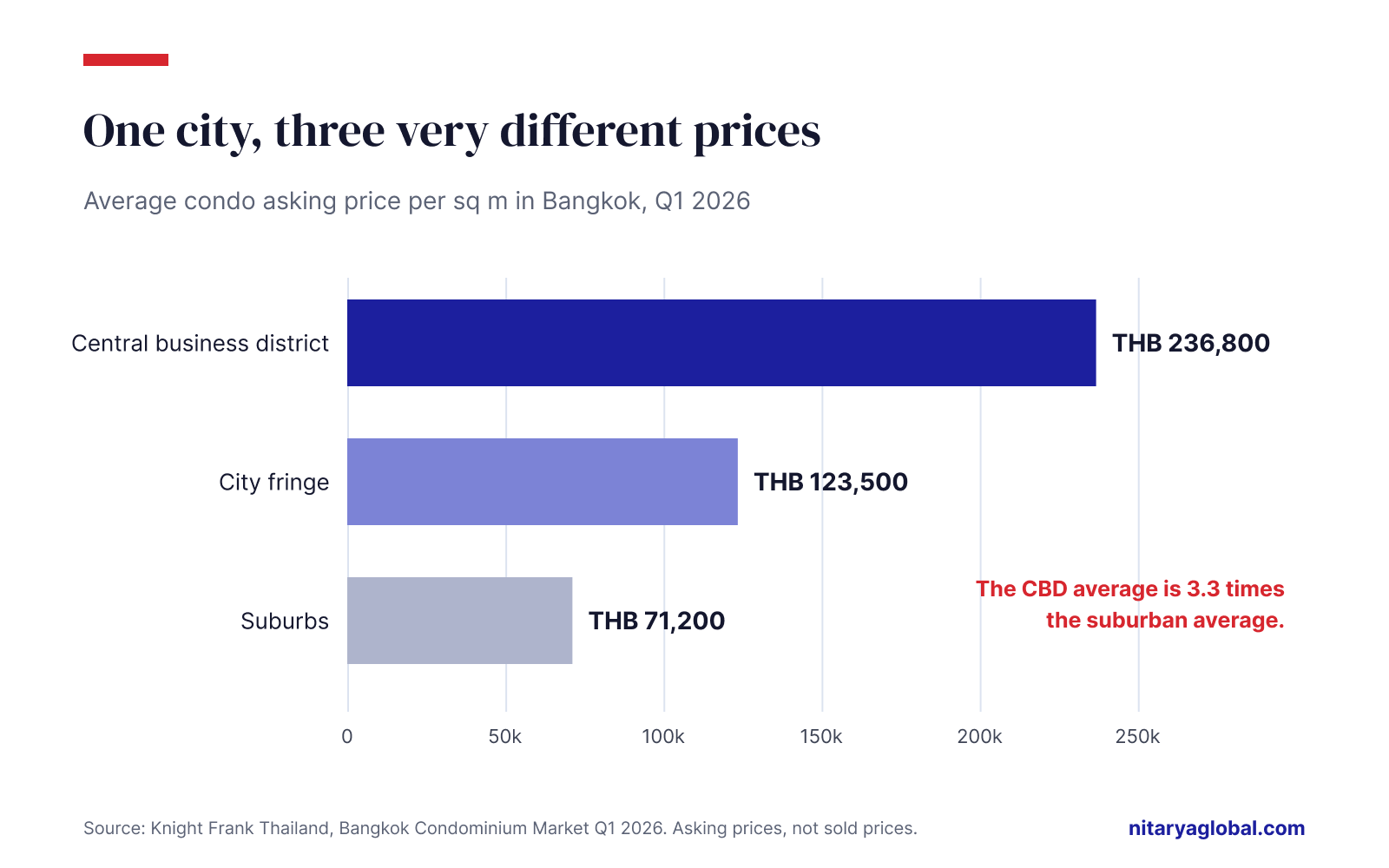
You'll often read that Bangkok condos cost "around THB 125,000 to 150,000 per square metre". The chart shows why that figure is no use for a single purchase.
The central business district average is 3.3 times the suburban average. A unit can look cheap against the city figure and still be expensive for its street.
The same holds in Phuket. In 2025 most of the island sold at THB 125,000 to 160,000 per square metre, while Bang Tao averaged about THB 284,000.
So we never compare a unit with a city. We compare it with its own building, then its immediate neighbours, and only then with the zone.
Is a new condo priced higher than a resale?
Usually, yes. C9 Hotelworks' 2025 Phuket research put non-branded new condos at about THB 139,000 per square metre against THB 100,000 for resales, a 39% premium.
Branded condos averaged THB 181,000, about 28% above non-branded ones.
Part of that premium is real: a new building, a warranty, a brand. Part of it is marketing cost and extras folded into the price. Launch prices often include furniture packages, "free" transfer fees or a rental guarantee.
Strip those out and compare the net price per square metre with completed buildings nearby.
If you're looking at a top-end Bangkok building, our guide to buying a luxury condo in Bangkok covers the same test for that segment. For anything off-plan, read our guide to off-plan property risks as well.
How much room is there to negotiate?
In Bangkok, more than most buyers assume. Knight Frank estimated about 350,000 unsold condo units in the city in early 2026, against roughly 60,000 transfers in a typical year.
That's close to six years of stock at the current pace.
The same report expects buyers to gain bargaining power on price, promotions and payment terms. Discounts often arrive as extras, not as a lower list price, so always bring the offer back to one number: net price per square metre.
Phuket is tighter in the best locations, so don't carry Bangkok's discount expectations across.
The three-number check
We put three numbers side by side on every price: the asking price per square metre, recent resale evidence nearby, and the official appraisal.
Take a hypothetical 80 square metre unit in central Bangkok offered at THB 18 million. That's THB 225,000 per square metre.
- Against the zone: it sits just under the central business district average asking price. That tells you it isn't out of range. It doesn't tell you it's fair.
- Against the building: if two similar units in the same building are listed at THB 190,000 to 200,000, you have a 12% to 18% gap to explain. A higher floor or a better view might cover some of it. If nothing does, that's your negotiating position.
- Against the appraisal: look it up on D-Value. Use it to estimate transfer costs, and question the price only if the gap is far wider than for neighbouring units.
The example is an illustration, not a real property. The method is the point: no single number decides it, and the building comes before the city.
When should you get an independent valuation?
For most villas, for any purchase where the price is well above nearby comparables, and for anything you plan to borrow against.
Villas are hard to compare because no two are the same, so a valuer's view is worth more there than for a standard condo. Use a valuer who isn't connected to the seller or the agent, and ask to see the comparable sales they relied on.
Signs a Thai property may be overpriced
- No resales in the building, or resales listed well below the developer's price.
- A price per square metre above the zone's range without a clear reason.
- An official appraisal much further below the price than for similar units nearby.
- A guarantee or discount that only makes sense if the price was raised first.
- An area figure in the brochure that's bigger than the area on the title.
- Pressure to reserve before you've had time to compare.
How Nitarya checks a price
We set the asking price against resale evidence, the official value and, where it's needed, an independent valuation, and show you the gap in one table.
A qualified valuer gives any valuation opinion. Our job is to gather the evidence and show you where it agrees and where it doesn't. See Nitarya's Thailand property due diligence service.
Planning ahead? The price you pay also shapes what you can sell for. Our guide to selling property in Thailand as a foreigner covers the exit.
This article is general information only. It is not a valuation or investment advice. Market figures are published averages and will not match any single property.
Get a formal valuation from an independent, appropriately qualified valuer for any purchase decision.
Want to compare areas before you look at prices? Nitarya Property Insights lets you compare locations side by side. Check Nitarya Tools and Insights.
Sources and method
- Bangkok asking prices by zone, unsold stock and outlook: Knight Frank Thailand, Bangkok Condominium Market Q1 2026. New CBD launch prices: Knight Frank's mid-year 2026 report, via Siam Real Estate.
- Phuket selling prices: Knight Frank Thailand, Phuket Villa and Condominium Market Year-End 2025.
- New versus resale and branded premiums in Phuket: C9 Hotelworks, Phuket Property Market Update, May 2025.
- Foreign buyers' share of units and value, first half of 2026: Real Estate Information Center data via Nation Thailand, September 2026.
- The 2027 appraisal round: Bangkok Post, 21 January 2026. D-Value service: Treasury Department, as described by Lex Bangkok.
- The "nearly twice" figure is our own arithmetic: 21.7% of value divided by 11.7% of units. The "close to six years" figure is 350,000 units divided by 60,000 a year.
- The THB 18 million example is an illustration, not a specific property.
- Checked 14 November 2026.
FAQs
How do I know if a condo in Thailand is overpriced?
Work out its price per square metre on the registered area and compare it with resales in the same building or nearby. Check the official appraisal, and ask why if the price sits well above both.
For bigger purchases, get an independent valuation.
What is D-Value in Thailand?
It's the Treasury Department's online service for looking up official land and building appraisal values, free of charge. Those values are used for transfer fees and property tax, not as market prices.
Why is the official appraisal lower than the price I'm paying?
Because it's a tax value that is only revised every four years. A gap is normal. It only becomes a warning sign when it's far wider than for similar properties nearby.
What is the average condo price per square metre in Bangkok?
It depends on the zone. In early 2026 the average asking price was about THB 236,800 in the central business district, THB 123,500 in the city fringe and THB 71,200 in the suburbs, according to Knight Frank Thailand.
Can I negotiate the price on a new condo in Thailand?
Often, especially in Bangkok, where there is a large stock of unsold units. Discounts usually come as furniture packages or fee contributions, so compare the net price per square metre after any extras.
Should I get an independent valuation for a Phuket villa?
Yes, in most cases. Villas are hard to compare with each other, so an independent valuer's view adds more than it would for a standard condo.