
Off-Plan Layout Changes in Thailand: Your Rights in 2026
Can a Thai developer change your off-plan layout or shrink the unit? The 5% rule, the one-year deadline and 2025 reservation rules, worked through.

Free Thailand ownership guide Book a free 15-minute call
On this page
- Can a Thai developer change your off-plan layout?
- What counts as "your layout": the three-plan test
- What if the finished unit is smaller or bigger than the contract?
- How long do you have to raise it?
- Which clauses let the plan move, and how do you tighten them?
- Can you change the layout yourself?
- Before transfer: measure and match
- Where NITARYA fits
- FAQ
- Sources
When you buy off-plan, you are paying for drawings. Then the building goes up, and it doesn't always match. A wall moves.
The balcony gets smaller. The unit comes in at 33 square metres when the contract said 35.
Thai law gives you more protection against layout changes on off-plan property than most buyers realise. The catch is that it depends on two documents and one date.
This guide covers what a Thai developer can and can't change, what happens if the finished unit is smaller or bigger, and the deadline that decides whether you can do anything about it.
Can a Thai developer change your off-plan layout?
Not freely. At the reservation stage, the standard contract gives you the right to terminate if the developer changes project details or construction materials without your consent.
At the sale stage, the contract must follow the Interior Ministry's standard form. Terms that depart from it against you are void. What's left is whatever room the contract itself gives the developer.
There are three layers, and each one covers a different moment.
1. The reservation contract (since 31 January 2025). The Consumer Protection Board made condo reservations a controlled business in 2024.
According to Tilleke & Gibbins, the standard reservation contract must:
- state the type and specifications of the materials and equipment in the unit;
- let you terminate if the developer changes project details or construction materials without your consent, or doesn't use the specified materials;
- refund the full reservation fee within 15 days (cash or transfer) or 45 days (credit card) after you terminate;
- not let the developer change the contract or add burdens beyond what was agreed.
A developer that doesn't comply faces up to one year in prison, a fine of up to THB 200,000, or both.
2. The sale and purchase contract. Section 6/2 of the Condominium Act requires every developer's sale contract to follow the form prescribed by the Minister.
Any part that doesn't follow it and isn't in the buyer's favour is invalid (Tilleke & Gibbins). That form, known as Or.Chor.
22, has the developer guarantee construction to government-approved specifications and materials according to plan (Siam Legal).
3. The brochure. Under Section 6/1 of the Condominium Act, advertising, brochures and show-room promises form part of the sale contract.
Where the brochure and the contract conflict, the version more favourable to you prevails (ThaiLawOnline).
So where does the developer's flexibility come from? From clauses buyers sign without reading.
A Phuket developer's published sale agreement, for example, reserves the right to use alternative materials of comparable or better quality, and to amend the specifications or construction plan if law or building regulations require it (developer's sale agreement).
Siam Legal warns buyers about clauses that let the developer modify the floor plan as long as it stays "similar" (Siam Legal). Nobody defines "similar" for you.
What counts as "your layout": the three-plan test
Your layout is not one document. It's three, created at three different times, and you want all three to describe the same unit.
| Plan | When you get it | What it does | What to watch |
|---|---|---|---|
| Brochure, renders, show unit | Before you reserve | Part of the contract under Section 6/1 | Save dated copies. Screenshots of listings and sales messages count too |
| Contract floor plan and spec sheet | Reservation and sale contract | The unit you actually agreed to buy | Must be attached to the contract and referenced by name and revision number, not handed over as a sales sheet |
| Registered unit plan | At completion, on the unit title | The final legal record: location, area and a plan with width, length and height (Condominium Act, s.21) | Measured by the Land Office, which may not use the same method as the contract |
What if the finished unit is smaller or bigger than the contract?
Section 466 of the Civil and Commercial Code draws the line at 5%. If the delivered area is more than 5% off, you can refuse the unit, or accept it and pay a proportionate price.
Within 5%, you have to accept it and pay pro rata. The exception is a gap so serious that you wouldn't have bought had you known (ThaiLawOnline, s.466).
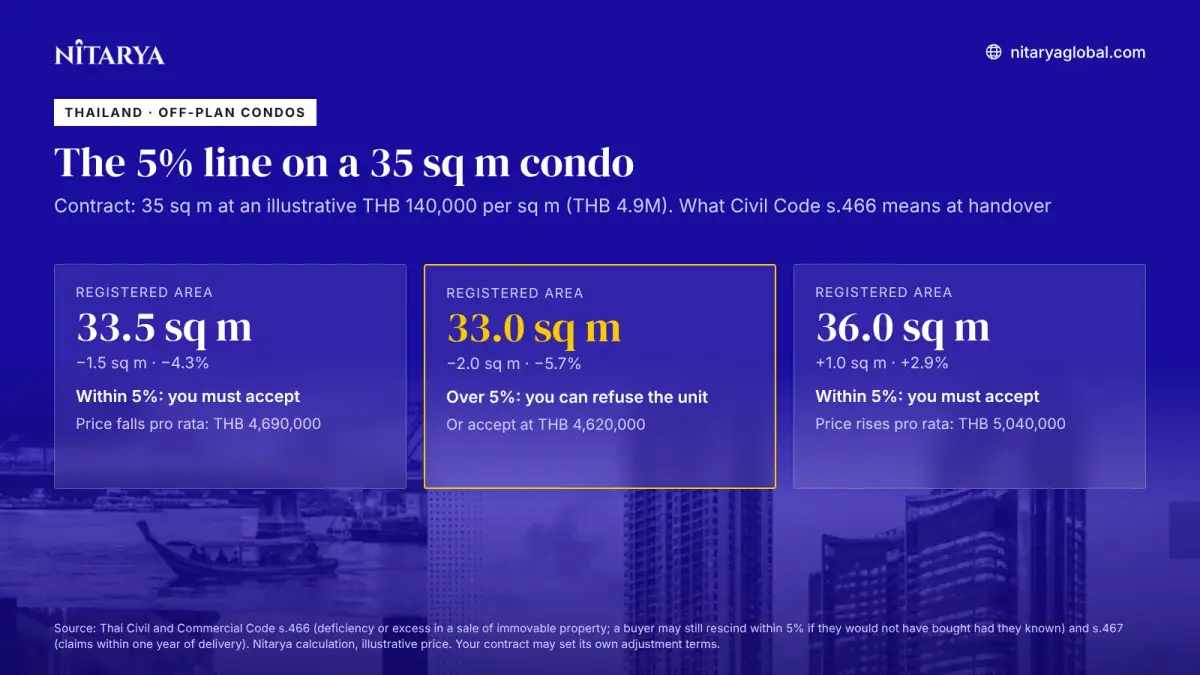
Here is what that means in money. The figures are illustrative: a 35 sq m unit at THB 140,000 per sq m, so THB 4.9 million. On this unit, the 5% band is 1.75 sq m, or THB 245,000.
| Registered area | Difference | Your position under s.466 | Price |
|---|---|---|---|
| 33.5 sq m | −1.5 sq m (−4.3%) | Must accept. Price falls pro rata | THB 4,690,000 (THB 210,000 less) |
| 33.0 sq m | −2.0 sq m (−5.7%) | May refuse the unit, or accept at the pro rata price | THB 4,620,000 if you accept |
| 36.0 sq m | +1.0 sq m (+2.9%) | Must accept. Price rises pro rata | THB 5,040,000 (THB 140,000 more) |
Section 466 is the default rule. Your contract may set its own adjustment terms.
Watch for clauses that force you to accept any size difference at the original price (ThaiLawOnline), and ask a Thai lawyer whether the contract's terms are less favourable than the standard form.
Under Section 6/2, those parts are void.
How long do you have to raise it?
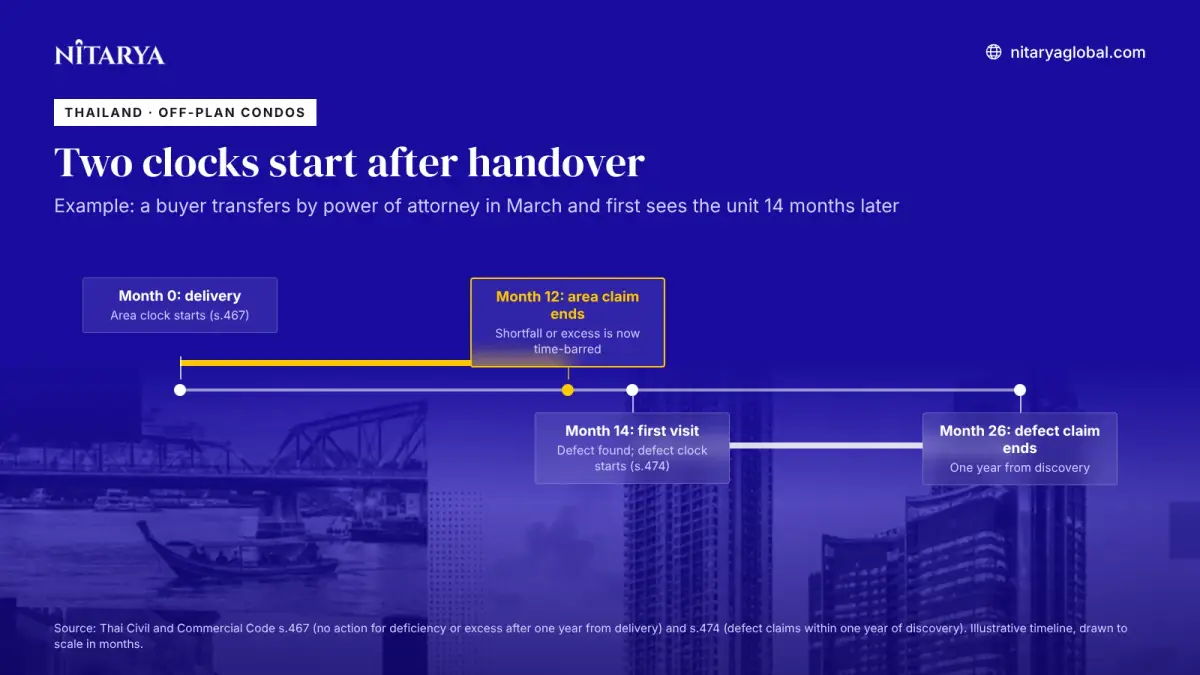
One year from delivery. Section 467 says no action for a shortfall or excess in area can be brought later than one year after delivery (ThaiLawOnline, s.467).
Defects are a separate clock: you must sue within one year of discovering the defect (ThaiLawOnline).
Which clauses let the plan move, and how do you tighten them?
These are the clauses to find before you sign, and what to ask for instead.
| Clause you'll see | Why it matters | What to ask for |
|---|---|---|
| "The seller may modify the plan, provided it remains similar" | "Similar" is decided by the developer | A list of changes that always need your written consent: number of rooms, room positions, structural walls, orientation, balcony size |
| "Materials of comparable or better quality" | Quality is judged by the party saving money | Tie substitutes to the spec sheet by brand and model, and give yourself the right to see a substitute before it goes in |
| "Changes required by law or the authorities" | Can be genuine, for example a permit or EIA condition | Written notice with the approval attached, and the effect on area, price and completion date |
| Price adjusts only if the area grows, or never | Conflicts with the 5% rule and the standard form | Adjustment both ways at the contract rate, and a right to refuse above 5% |
| Floor plan marked "indicative" or "for illustration" | Weak evidence of what you bought | A signed plan attached to the contract, with a revision number |
A genuine regulatory change still has to go through the system.
Under the Building Control Act, altering a building needs either a notification to the authority or an alteration permit, unless the change is on the exempt list (Tilleke & Gibbins).
For larger projects, check whether the change touches what the EIA approved: see our EIA approval guide and our building permit check.
Can you change the layout yourself?
Yes, if the developer agrees in writing. Changes to structure, engineering or the facade are usually off the table.
One Phuket developer's agreement bars any alteration affecting structure, engineering stability or architectural appearance without its prior written consent, and the buyer pays the consent fees (developer's sale agreement).
Treat any change as a variation order:
- Put the request in writing with a marked-up drawing.
- Get the price and the effect on the completion date in writing.
- Agree who applies for any notification or alteration permit, and by when.
- Check the effect on the registered area. If the area changes, the price clause and the 5% rule apply to it.
- Sign the variation and attach it to the contract. A sales agent's verbal OK is not evidence.
For a house or villa built under a construction contract, the rules are clearer. Since 2017, residential construction contracts must give you the right to amend the plan, with a revised price.
The builder can't change the plan, price or conditions in a way that adds to your burden without your written consent (Tilleke & Gibbins). Our construction contract guide covers the rest.
Before transfer: measure and match
Do this before you sign anything at the Land Office.
- Ask the developer for the unit plan that will go on the title, a week before transfer.
- Measure every room against the contract floor plan, and photograph the tape measure in place.
- Check finishes, brands and fittings against the spec sheet.
- Work out the area difference as a percentage of the contract area. Above 5%, decide whether to refuse or accept before transfer day.
- Send the developer a written list of every difference, and keep proof that they received it.
- Put the one-year date from delivery in your calendar.
Our Thai condo title search guide explains how to read the title itself. If you're a foreign buyer, check the 49% foreign quota too. A unit bought freehold has to fit inside it.
Where NITARYA fits
We work for the buyer only and don't sell projects. Before your deposit, we read the reservation contract and sale contract against the standard forms.
We check that the floor plan and spec sheet are attached, check the project's permits and EIA status, and flag every clause that lets the plan move. In the full check, an independent Thai lawyer writes the legal opinion.
Start with a US$349 evaluation. Full due diligence costs from US$2,500 plus the lawyer's fee. The Thailand due diligence checklist and our guide to off-plan property risks show how the layout check fits into the wider review.
FAQ
Can a Thai developer change my condo layout without asking me?
Not at the reservation stage. If the developer changes project details or materials without your consent, you can terminate and get your reservation fee back within 15 days (cash or transfer) or 45 days (card).
In the sale contract, any term that departs from the standard form against you is void.
What happens if my condo is smaller than the contract says?
If it's more than 5% smaller, you can refuse the unit, or accept it and pay a proportionate price (Civil Code Section 466).
Within 5%, you have to accept it, but the price drops pro rata, unless the gap is so serious you wouldn't have bought had you known.
How long do I have to claim for a smaller unit?
One year from delivery under Section 467. Defects run on a separate clock: one year from when you discover them.
Is the brochure part of my contract in Thailand?
Yes, for condominiums. Section 6/1 of the Condominium Act makes advertising and brochures part of the sale contract, and a conflict is read in your favour.
Keep dated copies of everything you were shown.
Can I change the layout of an off-plan unit before completion?
Usually, with the developer's written consent and a priced variation. Structural and facade changes are normally barred. Check whether the change needs a notification or alteration permit, and what it does to the registered area.
Do I pay more if the unit is bigger than the contract?
Within 5%, yes, pro rata. On a 35 sq m unit at THB 140,000 per sq m, one extra square metre adds THB 140,000.
Sources
- Tilleke & Gibbins, Thailand Specifies Form of Reservation Contract for Sale of Condo Units (15 October 2024)
- Tilleke & Gibbins, Standard Purchase Agreements Protecting Condo Buyers (Condominium Act s.6/2)
- Siam Legal, Buying Off-Plan: The Sales and Purchase Agreement (Or.Chor. 22)
- Siam Legal, Buying Off-Plan Properties
- ThaiLawOnline, Civil and Commercial Code Section 466 and Section 467
- ThaiLawOnline, Off-Plan Condos in Thailand: Delays, Defects and Your Refund Rights (Condominium Act s.6/1; CCC s.474)
- WSR Law Group, Condominium Act text (s.21)
- SamuiForSale, Contract price and final floor area of an off-plan condominium
- Aster of Asia, Condominium price per usable area and price adjustment on final measurement
- Tilleke & Gibbins, Residential building construction contract controls (2016 Notification, in force 1 January 2017)
- Tilleke & Gibbins, Building Control Act alteration permits
- Example developer agreement: Essence Residences, Phuket, freehold sale agreement
Last updated: 26 November 2026. This guide is general information, not legal advice. Your rights depend on the wording of your contract.
Have a Thai-qualified lawyer review it before you pay a deposit.