
Thailand Property Agents: Who Pays the Commission and What They Don't Check
Thai property agents earn 3-5%, usually from the seller, and only if you buy. What Thai law says about brokers and what to verify before a deposit.


Free Thailand ownership guide Book a free 15-minute call
On this page
- Who pays the estate agent in Thailand?
- Do real estate agents in Thailand need a licence?
- What does Thai law say about brokers?
- What does an agent usually not check for you?
- Agent, lawyer or independent adviser: who does what?
- What should you ask an agent before a viewing?
- When is an agent enough on their own?
- How Nitarya helps
- Sources
- FAQs
TL;DR: In Thailand the seller or developer usually pays the agent 3 to 5% of the price, and only when the sale completes. There's no licensing regime for property agents, and Thai law presumes a broker has no authority to take your money.
Use an agent to find property. Get the title, quota, contract and money route checked by someone you pay, on terms that don't depend on the sale.
Most foreign buyers in Thailand find their property through an agent, and a good agent makes the search far easier. The problem isn't the people. It's the structure.
The agent is paid by the other side, and only if the deal closes.
This page sets out who pays whom, what Thai law says about brokers, and which checks to keep out of the agent's hands.
If you've already found a unit and want it checked before you pay, our Thailand property due diligence service does exactly that.
Who pays the estate agent in Thailand?
Usually the seller, or the developer on a new project. Global Property Guide puts the typical agent fee at 3 to 5% of the price, paid by the seller.
The commission is normally due only when the sale completes, so if you walk away, the agent earns nothing. On a THB 4.3 million condo, that's THB 129,000 to THB 215,000 if you buy.
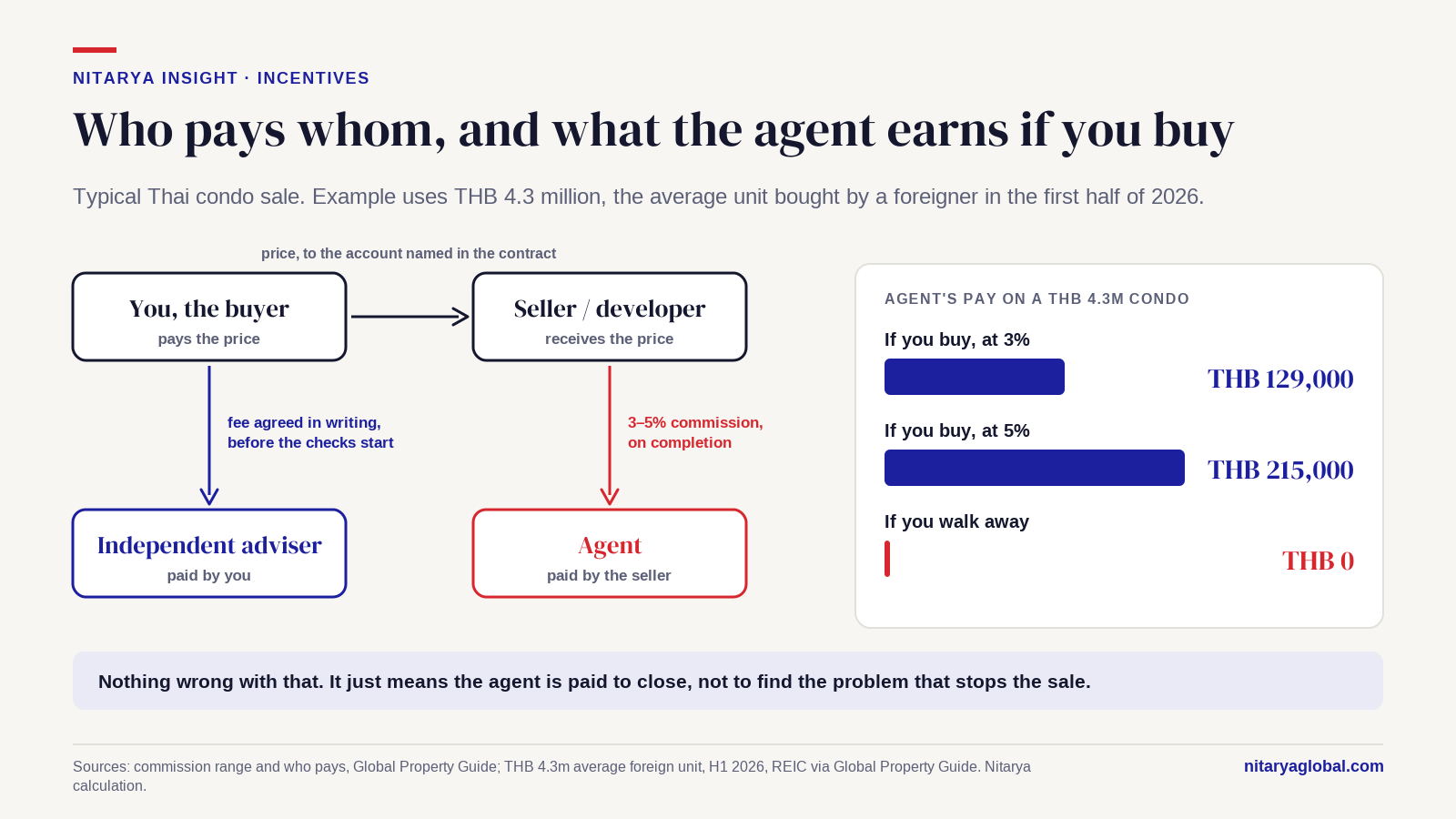
THB 4.3 million is the average condo a foreigner bought in the first half of 2026, according to REIC data. Commission rates aren't fixed by law, and on new projects the developer sets them.
One more pattern to know. In Phuket, hotel and property consultancy C9 Hotelworks has noted that agency splits aren't widely used because both sides frequently use the same agent.
When one agent represents the seller and talks to you, ask plainly whose interests they act for.
Do real estate agents in Thailand need a licence?
No. Thailand has no licensing regime for property agents, and no statute gives an agent a duty of care to the buyer. Anyone can call themselves an agent.
That doesn't make agents untrustworthy. It means you can't rely on a licence number, a regulator or a complaints scheme the way you might at home.
What does Thai law say about brokers?
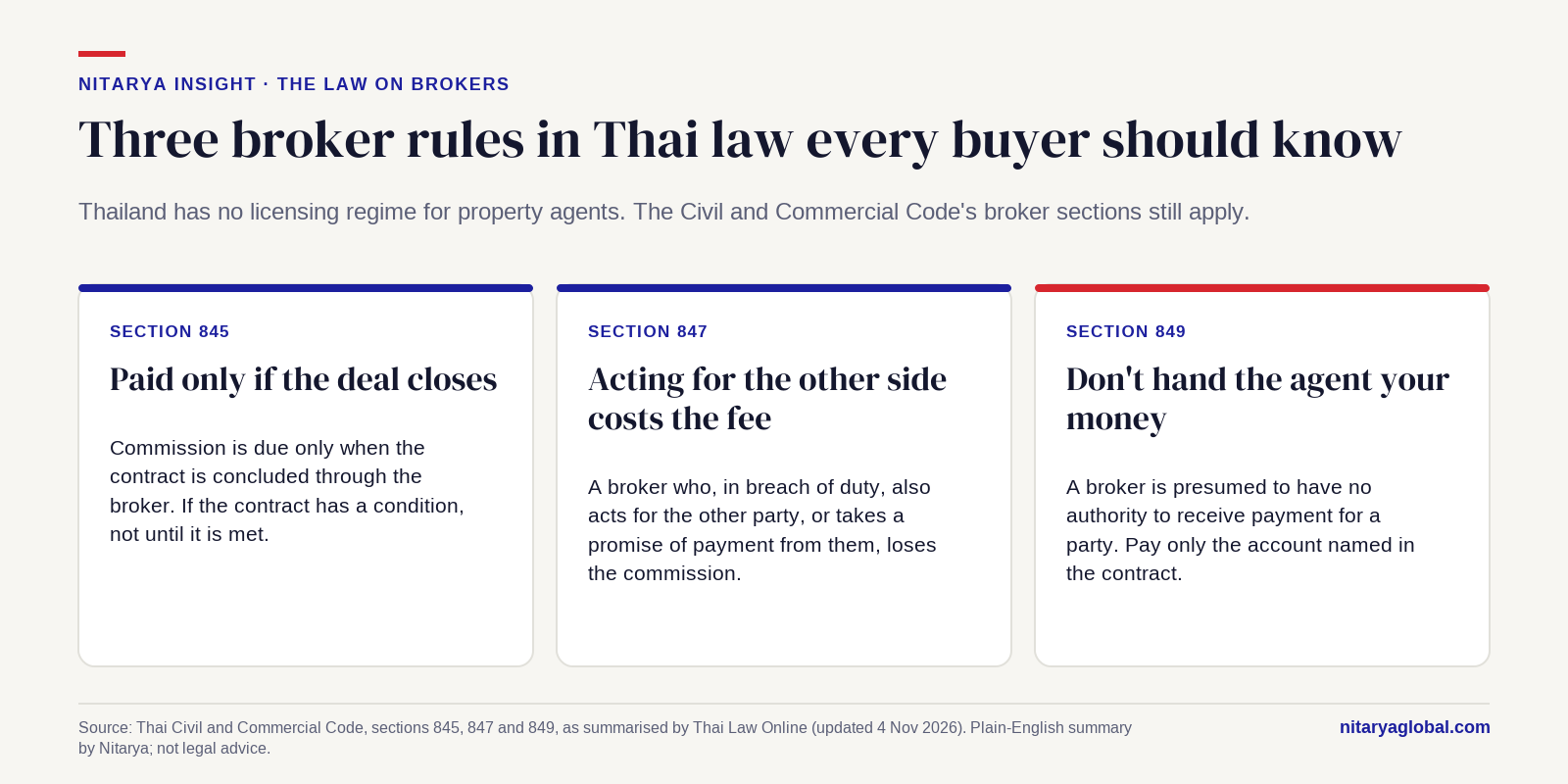
The Civil and Commercial Code has a short section on brokers, and three rules matter to a buyer. Commission is earned only when the contract is concluded.
A broker who acts for the other side in breach of duty loses it. And a broker is presumed to have no authority to receive payment for either party.
In practice:
- Section 845 explains the incentive. If the contract has a condition, the commission isn't due until it's met, which is one more reason to make your deposit conditional on the checks.
- Section 847 is why you should ask who the agent acts for, and whether the developer pays anything beyond the standard commission.
- Section 849 is the one to remember on deposit day. Pay only the seller's or developer's account named in the contract. Never an agent's account, and never a personal account.
About to pay a deposit? Our Explore & Decide evaluation compares up to five projects against your budget, and our Acquire & Own service adds an independent Thai lawyer's written opinion on the unit you choose.
Or book a free 15-minute call first.
What does an agent usually not check for you?
Anything that could stop the sale. In practice that means the certified title and its back page, the registered owner, the quota on the Land Office record, the building's debts, court records and the FET.
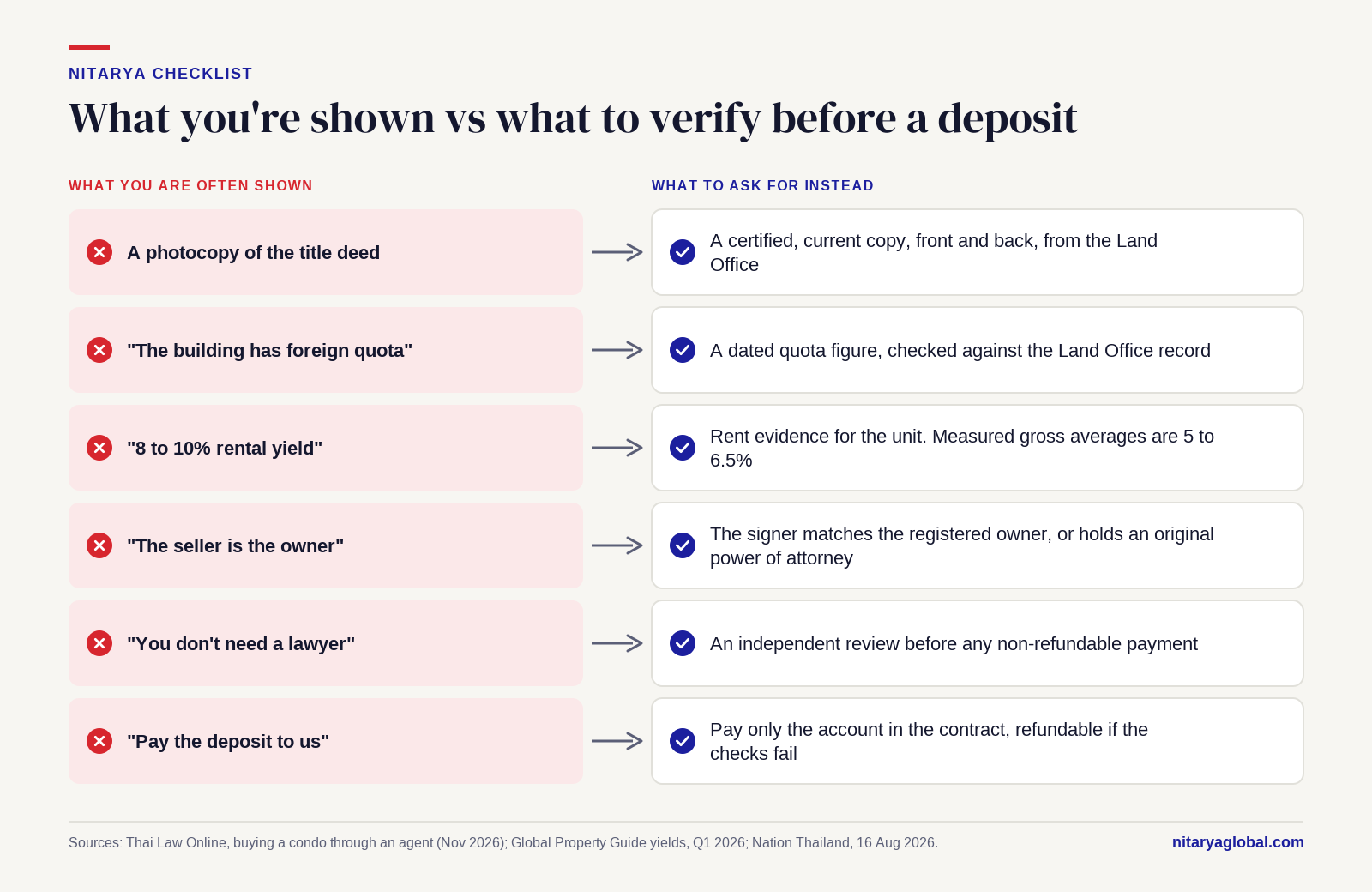
None of these is the agent's job, and an agent showing you a photocopy of the deed hasn't checked it.

What to do about each:
- Title. Ask for a certified, current copy of the title deed, front and back. The back page records mortgages, leases and other rights. Our Thai condo title search guide explains what to look for.
- Quota. "The building has quota" isn't evidence. Get a dated quota figure and check it against the Land Office record. See our guide to the 49% foreign condo quota.
- Owner. The person signing must match the registered owner, or hold an original power of attorney that a lawyer has read.
- Debts. A debt-free letter for the unit, recently dated, with any special assessments shown.
- Money. How the money will arrive so the FET works. Our guide to buying property in Thailand remotely covers the money route.
- Tax split. Who pays which Land Office charge, in writing. A "50:50" offer usually covers only the transfer fee. Our stamp duty estimate lists each charge.
Nitarya insight: the yield claim is the most expensive line in the pitch
Property operators quoted rental yields of 8 to 10% for Phuket and 8 to 9% for Pattaya in August 2026. Global Property Guide measured gross averages of 5.05% for Phuket, 5.51% for Chon Buri and 6.49% nationally in Q1 2026.
On a THB 4.3 million condo, the gap between a quoted 8% and a measured 5% is THB 129,000 a year. That's the same as a 3% commission, every year you own the unit.
If a yield is part of why you're buying, ask for rent evidence for that building, then compare it with our guide to where to buy property in Thailand, which sets the quoted and measured figures side by side.
Agent, lawyer or independent adviser: who does what?
Use each for what they're paid to do. An agent finds options and organises viewings. A lawyer acting for you checks the title, contract and power of attorney.
An independent adviser compares options against your goal and checks the evidence. The question in every case is the same: who pays them, and when.
| Role | Who pays | When they're paid | Who they act for | Best used for |
|---|---|---|---|---|
| Agent | Seller or developer, usually 3 to 5% | On completion | The seller, unless agreed otherwise | Finding options, viewings, logistics |
| Seller's or developer's lawyer | Seller or developer | Per transaction | Their client | Their side of the paperwork |
| Your own Thai lawyer | You | Fixed or hourly fee | You | Title, contract, power of attorney, Land Office |
| Independent adviser | You | Mostly before you decide | You, under a written engagement | Comparing options and checking evidence |
In fairness, our own fees aren't completely separate from the outcome either, so here's how they work. Explore & Decide costs a fixed US$89.
On Acquire & Own, 60% of the fee pays for the property check and is due whether or not you buy; the other 40% is purchase support, payable only if you buy a property that passes the check.
Some developers or brokers may pay us a referral fee; you don't. We set the ranking rules before we build a shortlist, and no project is promoted.
What should you ask an agent before a viewing?
- Who pays you, how much, and when?
- Do you act for the seller or developer as well as for me?
- Do you receive anything from the developer beyond the standard commission?
- Will the reservation deposit be refundable, in writing, if the title, quota or debt-free letter fails?
- Which account does the deposit go to? It should be the seller's or developer's account named in the contract.
- Can I see a certified title copy, front and back, before I reserve?
- What rent evidence sits behind the yield you've quoted?
A good agent will answer all seven without hesitation. If the answers are vague, slow down.
When is an agent enough on their own?
When you're browsing, renting before you buy, or looking for resale units that aren't advertised. An agent's local knowledge is useful at every one of those stages.
It stops being enough at the point money is about to leave your account, because that's where the agent's incentive and yours part ways.
How Nitarya helps
We work on the buyer's side. We check the title and Land Office record, the quota and debt-free letters, the contract and the money route, and we show you what's verified, what's pending and what's missing.
Legal opinions come from an independent, licensed Thai lawyer.
- Still choosing? Start with Explore & Decide. Evaluations start at US$89.
- Found the unit? Our Thailand property due diligence service covers the checks end to end.
- Want to compare areas first? Nitarya Property Insights lets you compare locations side by side. Check Nitarya Tools and Insights.
This article is general information as of November 2026. It isn't legal, tax or investment advice. Get advice from licensed professionals for your own purchase.
Sources
- Agent fees and who pays: Global Property Guide, buying guide for Thailand.
- No licensing regime, no statutory duty of care, and Civil and Commercial Code sections 845, 847 and 849: Thai Law Online, buying a condo through an agent, updated 4 November 2026.
- Agency splits in Phuket: C9 Hotelworks.
- Average foreign condo, H1 2026: REIC via Global Property Guide.
- Quoted yields: Nation Thailand, 16 August 2026. Measured yields: Global Property Guide, Q1 2026.
- Nitarya fees and referral-fee disclosure: Explore & Decide and Acquire & Own.
- Commission and yield-gap examples are Nitarya calculations from the figures above.
FAQs
Who pays the real estate agent commission in Thailand?
Usually the seller, or the developer on a new project. The buyer normally pays no commission unless they've signed a separate agreement with a buyer's agent.
The commission is typically paid when the sale completes.
How much commission do property agents charge in Thailand?
Typically 3 to 5% of the sale price. No law fixes the rate, and developers set their own on new projects. On a THB 4.3 million condo, that's about THB 129,000 to THB 215,000.
Are real estate agents licensed in Thailand?
No. Thailand has no licensing regime for property agents, and no statute gives an agent a duty of care to the buyer. The Civil and Commercial Code's broker sections still apply to how commission is earned and who can receive money.
Should I pay my deposit to the agent?
No. Under section 849 of the Civil and Commercial Code, a broker is presumed to have no authority to receive payment for a party.
Pay only the seller's or developer's account named in the contract, and make the deposit refundable if the checks fail.
Do I need a lawyer if I use an agent in Thailand?
The agent isn't checking the title, quota, debts or contract for you, and is paid only if you buy. A Thai lawyer acting for you, or an independent due diligence service, should review those before any non-refundable payment.
Do I need a buyer's agent in Thailand?
Not always. Buyer's agents are uncommon in Thailand and may still be paid from the seller's commission. What you need is someone who checks the evidence for you, on terms that don't depend on whether you buy.