Buying Property in Thailand Remotely: What You Can Do From Abroad in 2026
Buying a Thai condo without flying in? What you can do from abroad, the POA rules before and after the 2027 apostille change, FET limits and timelines.


Free Thailand ownership guide Book a free 15-minute call
On this page
- Can you buy property in Thailand without visiting?
- How do you buy a Thai condo from abroad, step by step?
- How do you sign a Thai power of attorney from abroad in 2026?
- How do you send money for a Thai condo from abroad?
- How long does a remote purchase take?
- What can't you check from a screen?
- How Nitarya helps remote buyers
- Sources
- FAQs
TL;DR: You can buy a Thai condo, or take a registered lease on a villa, without visiting. Checks, contract, payment and power of attorney can all be done from abroad.
One step needs a person in Thailand: your attorney at the Land Office. Until 28 February 2027 your power of attorney still needs Thai embassy legalisation.
Payments of US$200,000 or more now come with document checks.
Plenty of overseas buyers never stand in the unit before it's registered in their name. Thai law allows it: you don't have to attend the Land Office yourself if you appoint an attorney to act for you.
What it doesn't allow is shortcuts on the paperwork.
Two things changed recently for remote buyers. Thailand has joined the Apostille Convention, but it only applies from 28 February 2027. And the Bank of Thailand has tightened checks on large foreign currency inflows.
This guide covers both, step by step.
If you already have a unit in mind and want it checked from abroad, that's what our Thailand property due diligence service is for.
Can you buy property in Thailand without visiting?
Yes. You can review, sign and pay from abroad, then sign a power of attorney so someone registers the transfer for you.
What you can't do remotely is stand in the Land Office yourself, so the person you appoint, usually a Thai lawyer, carries the risk on the day. Choose them carefully and keep their authority narrow.
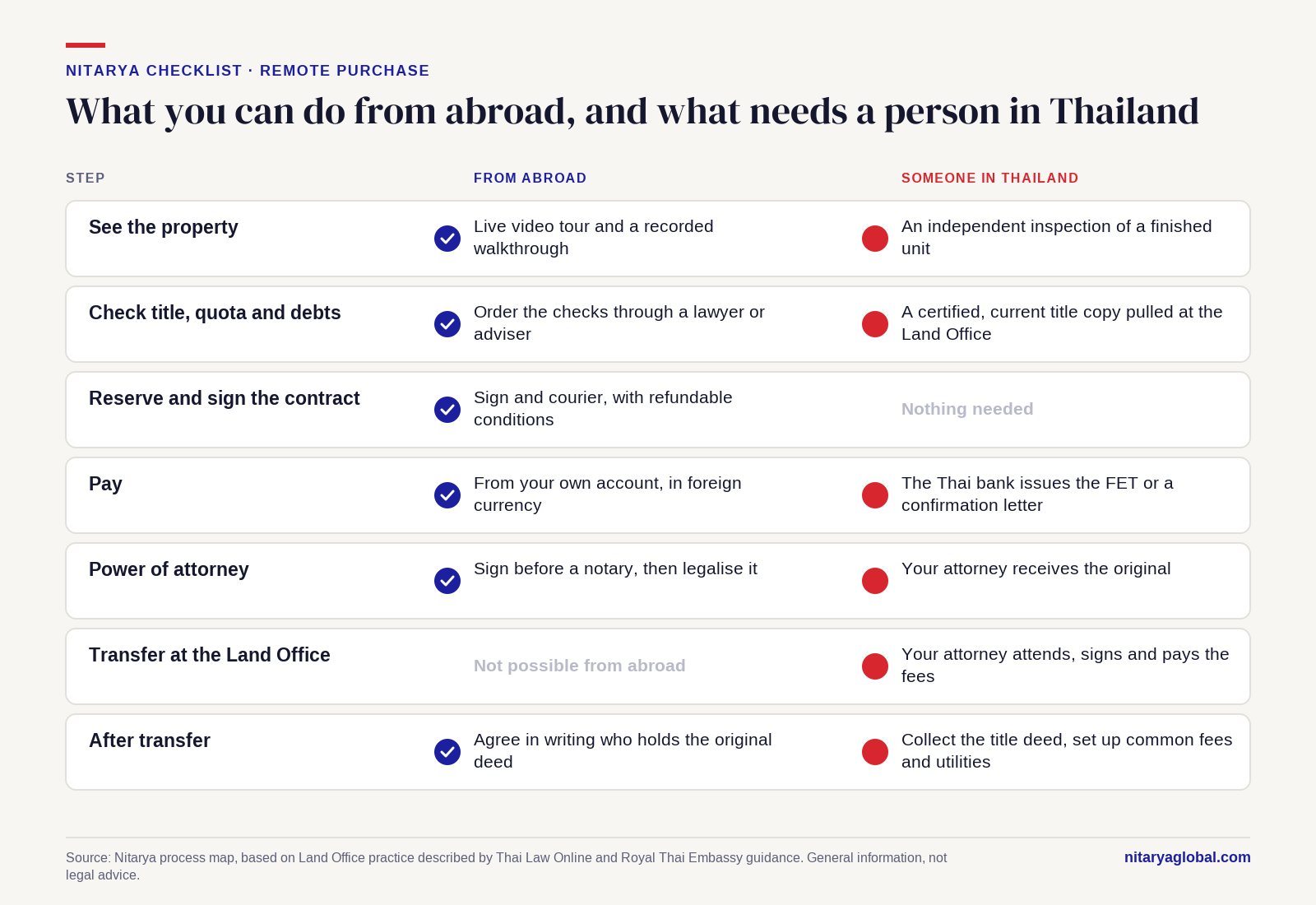
What you're buying decides the paperwork:
- A condo, freehold. You can own the unit in your own name if the building's foreign quota has room and the money arrives from abroad in foreign currency. See our guide to the 49% foreign condo quota.
- A villa or house, leasehold. Foreigners can't own the land. You register a lease of up to 30 years at a time, usually with a superficies so you own the building. No FET form is needed, but the lease must be registered at the Land Office. Our guide to leasehold vs freehold in Thailand explains both.

How do you buy a Thai condo from abroad, step by step?
- Fix your ownership route. Freehold condo within the quota, or a registered lease. Everything else follows from this.
- Get the unit checked before you reserve. A certified, current copy of the title, front and back, a dated quota letter, a debt-free letter, and a check on the seller or developer. Our Thai condo title search guide shows what each proves.
- Reserve with conditions. Reservation deposits are typically 1 to 2% of the price. Ask for it to be refundable if the title, quota or debt-free letter fails.
- Review and sign the contract. Sign, scan and courier the originals. Our guide to SPA contract review lists the clauses to check.
- Send the money the right way. From your own account, in foreign currency, with the purpose stated. Details below.
- Sign the right power of attorney and legalise it. The slowest step, so start it as soon as the unit is confirmed.
- Your attorney completes the transfer at the Land Office. They sign, pay the fees and register the unit or lease in your name. Foreign buyers pay the full 2% transfer fee on their share.
- Get the originals back. Agree in writing who holds the title deed and how it reaches you.
Buying from abroad and want one team to run steps 2 to 7? Our Acquire & Own service includes an independent Thai lawyer's review with a written opinion, one local representative visit and a closing checklist.
Not ready yet? Book a free 15-minute call.
How do you sign a Thai power of attorney from abroad in 2026?
Use the Land Department's own form, sign it before a notary, then have it legalised: first by your own foreign ministry, then by the Thai embassy or consulate.
The Royal Thai Embassy in London, for example, charges £10 per document and takes three working days, plus delivery. From 28 February 2027, an apostille should replace the embassy step for many countries.
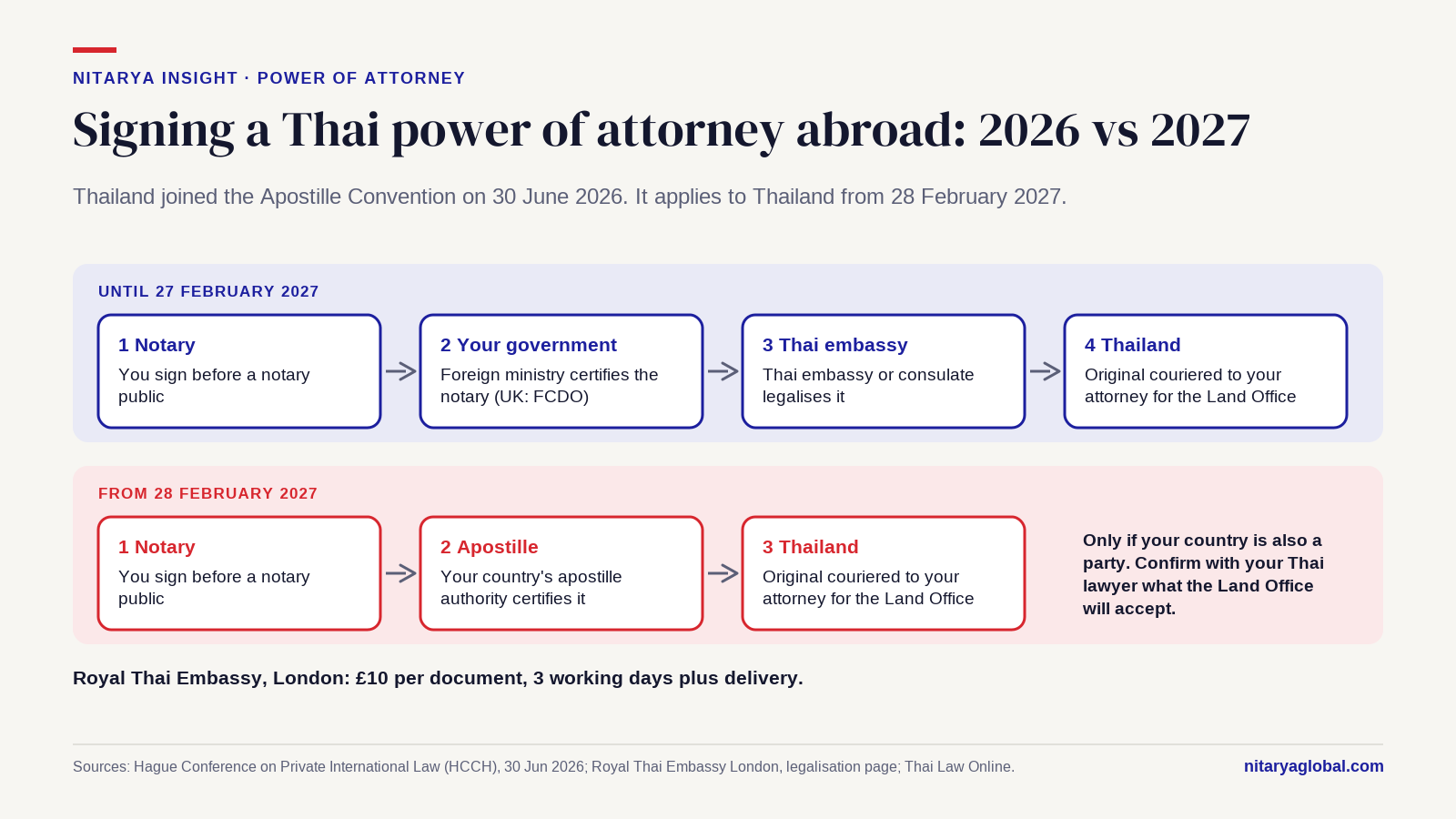
Nitarya insight: the 2027 apostille change, and why "just apostille it" is early
Thailand deposited its accession to the 1961 Apostille Convention on 30 June 2026. The Convention enters into force for Thailand on 28 February 2027.
Until then, every foreign document used in Thailand still goes through the traditional legalisation chain.
That matters because several 2026 buyer guides already tell foreigners to "notarise and apostille" a power of attorney. For a document going to a Thai Land Office before 28 February 2027, an apostille alone isn't the full chain.
The Thai embassy in Brussels, for example, still lists a step to legalise documents that already carry a Belgian apostille.
From 28 February 2027, a power of attorney from a country that is also a party should only need an apostille. Two cautions.
Land Offices may take time to apply the change in practice, and your Thai lawyer will still want the right form, a Thai translation where needed and a certified passport copy.
If your transfer date falls close to the switch, ask your lawyer in writing which route their Land Office will accept.
Which power of attorney form do you need?
- Or.Chor.21 for a condominium unit.
- Tor.Dor.21 for land transactions.
Both are Land Department forms, and Thai embassies publish them. Two more rules save weeks:
- One power of attorney, one authority. The Thai embassy in Brussels notes that each power of attorney can be presented to only one authority. A Land Office power of attorney won't also cover your bank.
- Keep it narrow. Name the unit or title deed number, the exact acts, the attorney and an expiry date. A broad "all property matters" document is a risk if anything goes wrong.
Our guide to power of attorney in Thailand covers the common reasons one gets rejected.

How do you send money for a Thai condo from abroad?
From your own account, in foreign currency, with the purpose written on the transfer. The Thai bank converts it to baht.
For each transfer of US$50,000 or more, it issues a Foreign Exchange Transaction (FET) form; below that, ask for a bank confirmation letter. The Land Office won't register a foreign freehold condo without this evidence.
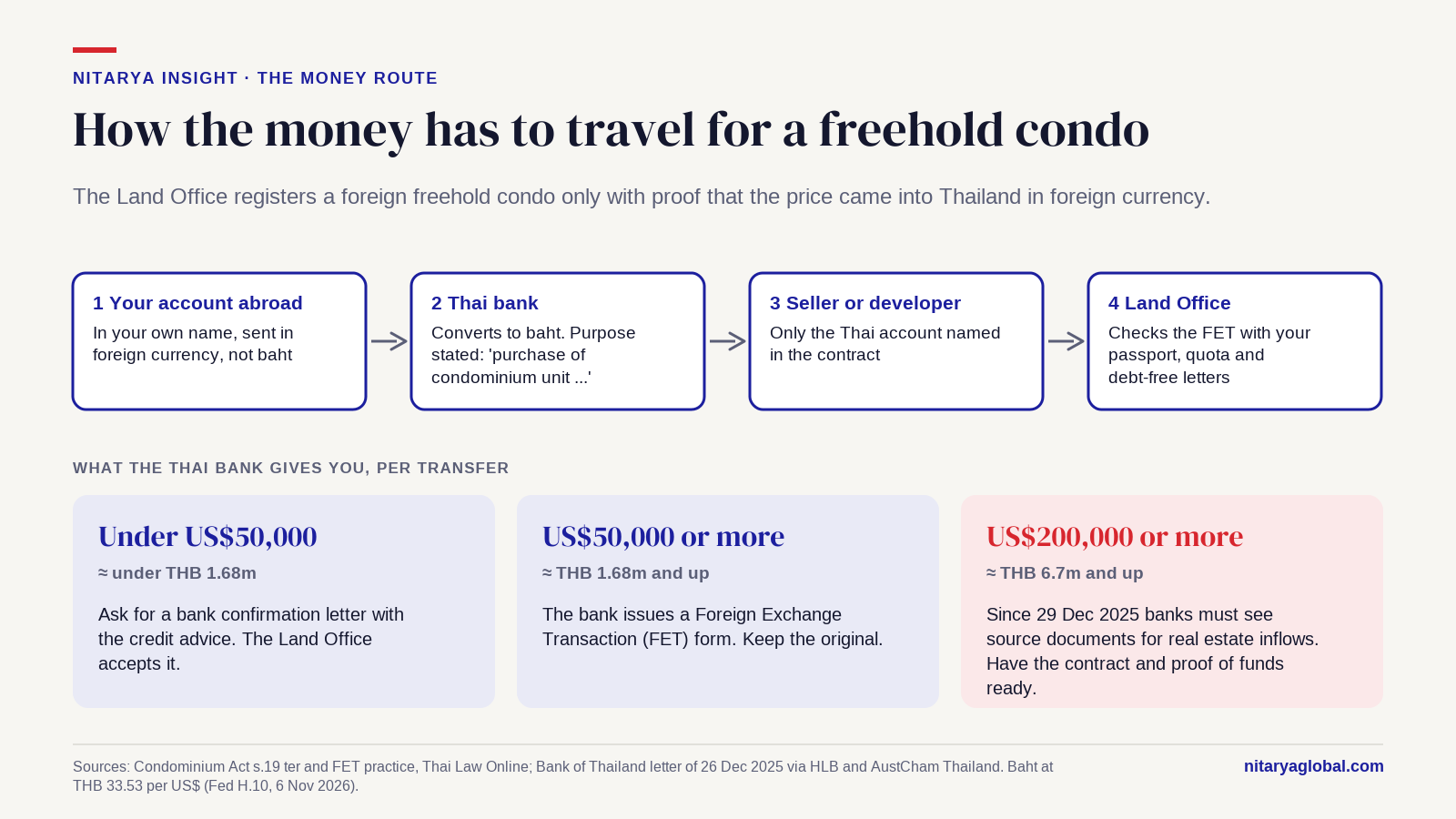
The rule comes from section 19 ter of the Condominium Act: a foreign buyer must show that at least the purchase price came into Thailand in foreign currency.
The usual mistakes are sending baht that was converted before it left your country, paying from a company account, and paying an agent's personal account.
You don't need a Thai bank account to buy, as long as the bank record names you. See our guide to proof of funds for a property purchase.
Nitarya insight: the US$200,000 line
Since 29 December 2025, the Bank of Thailand has required Thai banks to check supporting documents when customers receive US$200,000 or more in foreign currency from abroad.
Where the purpose is investment in Thai real estate, the bank can't skip this using its usual Know Your Business process. At THB 33.53 to the dollar, US$200,000 is about THB 6.7 million.
The average foreign condo in 2025 cost THB 4.09 million, so a typical purchase stays under the line. A buyer paying for a Phuket villa lease or a Bangkok CBD unit in one transfer often won't.
Don't split a payment just to avoid the check. Send your bank and the seller a short pack in advance instead: the contract, your passport and a note on where the money came from.
That gives the bank what it needs before your Land Office date.
How long does a remote purchase take?
For a completed resale condo, plan on roughly six to ten weeks from first checks to transfer, if nothing goes wrong.
The power of attorney is usually the slowest part, because the notary, foreign ministry and embassy steps run one after another. Off-plan units register at completion, so sign the power of attorney closer to handover.
| Stage | Planning estimate | Can it overlap? |
|---|---|---|
| Checks on title, quota, debts and seller | 1 to 2 weeks | Start first |
| Reservation and contract review | 1 to 2 weeks | Yes, with the checks |
| Power of attorney: notary, foreign ministry, Thai embassy, courier | 2 to 4 weeks | Yes, once the unit is confirmed |
| Money transfer and FET | 1 to 2 weeks | Yes |
| Land Office transfer | 1 day | Last |
These are Nitarya planning estimates, not official times.
What can't you check from a screen?
- The unit's condition. Damp, cracks and poor finishes rarely show on a video call.
- Boundaries and access for a villa. Whether the markers on site match the deed, and whether the road to your gate is legally yours to use.
- The building's day-to-day running. Lifts, security and how the juristic person handles repairs.
- The neighbourhood at night. Noise, traffic and construction next door.
A local visit closes most of these. Our Acquire & Own service includes one local representative visit to a completed or under-construction property.
If you're still deciding where to buy, our guide to where to buy property in Thailand compares markets on 2026 data. If an agent is handling the purchase for you, read who pays Thai property agents, and what they don't check.
Living in the Gulf? See how to buy property in Thailand from the UAE.
How Nitarya helps remote buyers
We work on the buyer's side only, and the service is built for people who live abroad.
We check the title and Land Office record, the quota and debt-free letters, the contract and the money route, and we show you what's verified, what's pending and what's missing.
Legal opinions come from an independent, licensed Thai lawyer.
- Still choosing? Start with Explore & Decide. Evaluations start at US$89.
- Found the unit? Our Thailand property due diligence service covers the checks end to end.
- Prefer to talk first? Book a free 15-minute call.
This article is general information as of November 2026. It isn't legal, tax or investment advice. Embassy fees and Land Office practice change.
Get advice from licensed professionals for your own purchase.
Sources
- Buying without attending the Land Office: The Thaiger, Thai property services FAQ.
- Apostille Convention, accession and entry into force: Hague Conference on Private International Law; legalisation until then: Thai Law Online; Cabinet approval: Thai Ministry of Foreign Affairs.
- Legalisation steps, fee and timing: Royal Thai Embassy, London. One authority per power of attorney, Or.Chor.21 and apostille legalisation: Royal Thai Embassy, Brussels and certifying signatures.
- FET form, threshold and section 19 ter: Thai Law Online; reservation deposits and remittance mechanics: The Thaiger.
- US$200,000 document checks: Bank of Thailand letter, 26 December 2025, summarised by AustCham Thailand.
- Average foreign condo value 2025: REIC via Khaosod English. Exchange rate: US Federal Reserve H.10, 6 November 2026.
FAQs
Can a foreigner buy property in Thailand without visiting?
Yes. You can complete checks, sign the contract and pay from abroad, then appoint an attorney by power of attorney to register the transfer at the Land Office.
The one thing you can't do remotely is attend the Land Office yourself.
Do I need a Thai bank account to buy a condo remotely?
No. The money can go straight to the seller's or developer's Thai account named in the contract. What matters is that it arrives in foreign currency, the bank record names you, and you get the FET form or a bank confirmation letter.
Can I use an apostille for a Thai power of attorney?
Not on its own before 28 February 2027, when the Apostille Convention takes effect for Thailand. Until then, the document is notarised, certified by your foreign ministry and legalised by a Thai embassy or consulate.
After that date an apostille should be enough if your country is also a party.
Which power of attorney form do I need for a Thai condo?
Form Or.Chor.21 for a condominium unit, and Tor.Dor.21 for land transactions. Each power of attorney can be presented to only one authority, so a Land Office power of attorney won't also cover your bank.
When do I get an FET form?
The Thai bank issues one for each inward transfer of US$50,000 or more, converted to baht for a stated purpose. Below that, collect the credit advice and ask for a confirmation letter, which the Land Office accepts instead.
How long does it take to buy a Thai condo remotely?
For a completed resale unit, plan on about six to ten weeks if the checks are clean. Legalising the power of attorney usually takes the longest. Off-plan units register at completion, which can be months or years later.
Is it safe to buy property in Thailand remotely?
It can be, if the title, quota, debts and seller are checked before you pay a non-refundable deposit, the money route produces an FET, and your power of attorney is narrow.
Most remote-buying problems start with paying first and checking later.