
Thailand Property Law Updates 2026: What Foreigners Should Know
Thailand property law updates for 2026: the lease ruling, the nominee crackdown, new condo deposit rules, 2027 appraisals, and what's still only a proposal.


Free Thailand ownership guide Book a free 15-minute call
On this page
- Thailand property law changes at a glance (November 2026)
- Are 30+30+30 leases still valid in Thailand?
- Has Thailand passed the 99-year lease law?
- Can foreigners own 75% of a condo building in Thailand?
- New condo reservation rules for off-plan buyers
- Thailand's nominee crackdown in 2026
- Land appraisal 2027: why buying costs could rise
- Do foreigners get Thailand's 0.01% transfer fee?
- Thailand's remittance tax: does it affect buying property?
- What hasn't changed
- Before you buy in Thailand: a short checklist
- Sources and method
- FAQs
TL;DR: Separate a court decision, an enforcement announcement and a proposed reform before using property-law news in a purchase decision. The October 2026 nominee operation is confirmed by the government.
Other time-sensitive items below remain draft research pending the official instrument and qualified review; they are not a current-law clearance.
A headline about longer leases or a higher foreign quota is not evidence that a particular transfer can be registered under it. Ask for the enacted instrument, effective date, eligibility conditions and Land Office requirements.
What has happened gets far less attention. Leases sold as "90 years" now have a Supreme Court ruling against them. Off-plan condo deposits are better protected than they were.
And the government is checking company structures in exactly the places foreigners like to buy.
This guide covers where each change stands as of November 2026 and what it means if you're a foreigner looking at property in Thailand. Things move quickly here, so treat it as your starting point and check again before you sign anything.
Already have a property in mind? Our Thailand property due diligence checklist turns these updates into the checks to make before you pay a deposit.
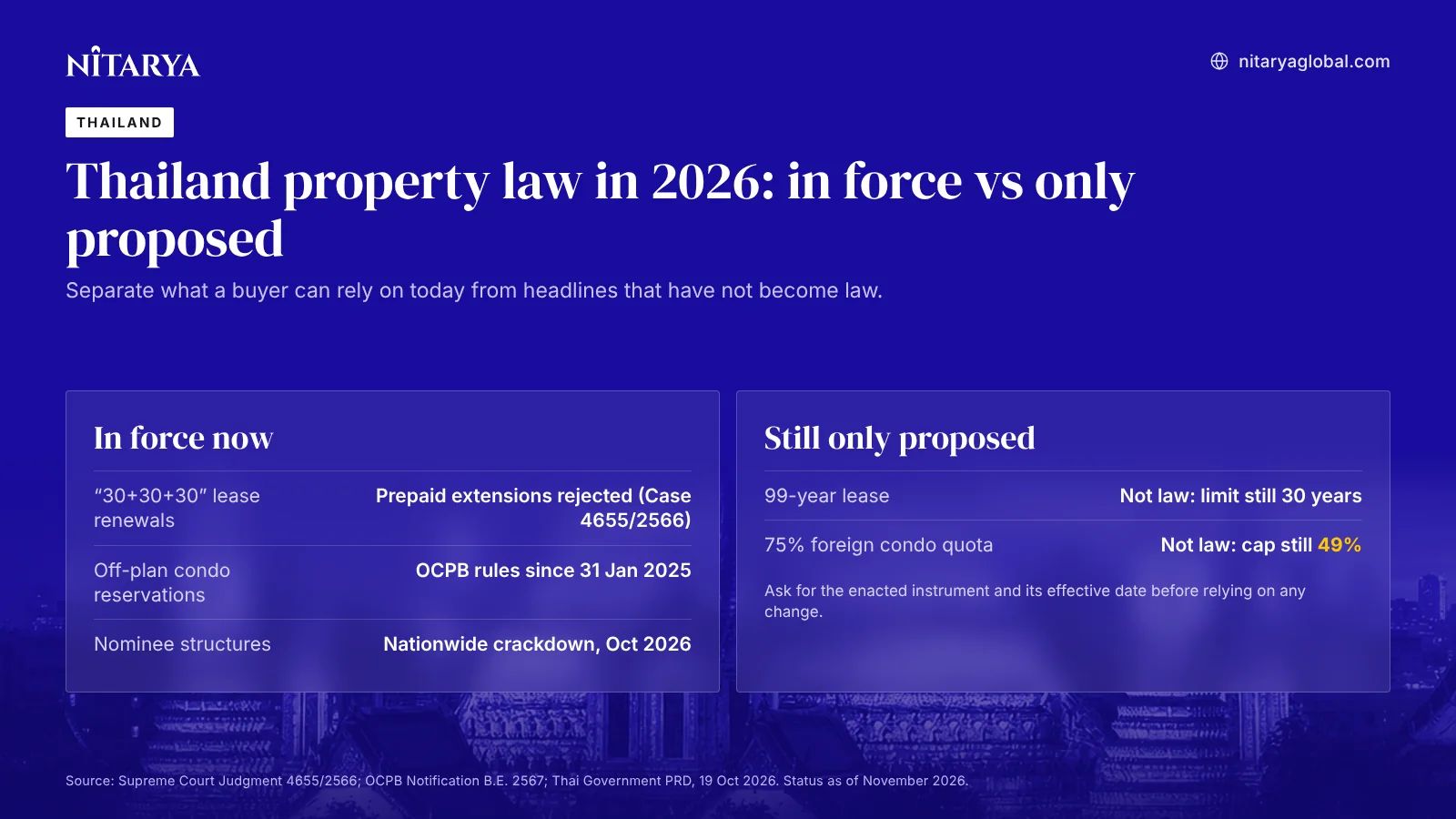
Thailand property law changes at a glance (November 2026)
| Change | Where it stands | What it means for a foreign buyer |
|---|---|---|
| "30+30+30" lease renewals | Case 4655/2566: prepaid automatic extensions rejected; decided 2023, analysed 2025 | Registered term and future renewal are different rights; review the actual instrument |
| Off-plan condo reservations | New consumer rules in force since 31 January 2025 | Standard Thai contract, banned unfair clauses, refund deadlines |
| Nominee company structures | Always illegal; nationwide crackdown announced October 2026 | Land held through "Thai partners" is under active scrutiny |
| Official land appraisal values | New round due 1 January 2027 | Check the enacted timetable and property-specific value; do not assume a rise |
| 0.01% transfer fee relief | Extended to 30 June 2027, Thai nationals only | Foreigners still pay the standard 2% |
| Tax on money remitted into Thailand | In force since 2024; proposed two-year exemption not passed | Matters only if you're a Thai tax resident |
| 99-year lease | Proposed, not law | The limit is still 30 years per registration |
| 75% foreign condo quota | Under study, not law | The cap is still 49% |
Are 30+30+30 leases still valid in Thailand?
Judgment 4655/2566 concerned prepaid future terms designed to create a 90-year arrangement from the outset. It does not establish that every possible renewal clause is void.
Treat the registered term and any future renewal as different rights, and have a Thai lawyer review the actual wording. Read the case analysis. The analysis was published on 10 March 2025 and says the case was decided in 2023.
Do not label 18 March 2025 as the judgment date without the court record.
For years, villas and houses were sold to foreigners on a 30-year lease with two more 30-year renewals signed at the same time, and marketed as 90 years of security.
The case that ended this started in Phuket.
The Court looked at the whole arrangement, including renewal periods priced below the original rent, and treated it as a way round the 30-year limit in Section 540 of the Civil and Commercial Code.
The case does not establish the outcome of every differently drafted option. The current owner, future owner, heirs and the proposed registration each need to be considered in the actual legal review.
For a leasehold purchase, distinguish the remaining registered term from an option for a future term. Do not tell an existing holder that the first term is fine without reviewing the actual registration and contract.
Get advice on the particular instrument before pricing the exit or renewal.
Has Thailand passed the 99-year lease law?
No. In 2025 the government proposed changing the Rights over Leasehold Assets Act so registered leases on non-agricultural land could run for up to 99 years.
The draft went out for public consultation in July 2025. As of November 2026, it still hasn't been passed.
Until it is, the Land Office will register a lease for up to 30 years, and that's the term you can rely on.
If a developer is selling "90-year" or "99-year" terms today, ask which law those extra years rest on. Usually the answer is a clause in the contract, and since the 2025 ruling that's about the weakest protection you can have.
Can foreigners own 75% of a condo building in Thailand?
Not yet. Raising the foreign condo quota from 49% to as much as 75%, sometimes only in certain areas or price bands, has been discussed since 2024 and approved for study.
It isn't law.
Foreign buyers can still own no more than 49% of a building's total saleable floor area between them. Freehold still depends on the purchase money coming in from abroad in foreign currency, with the right bank paperwork to prove it.
In the buildings foreigners like most, the quota is still the thing that runs out first. Our guide to foreign condo ownership and the 49% quota shows how to check it before you commit.
New condo reservation rules for off-plan buyers
The OCPB lists a notification designating condominium sales with reservations as a contract-controlled business. Confirm the prescribed form, commencement and exact scope before applying it to a developer reservation.
This is a separate check from the later sale agreement. OCPB notification listing.
This came from the Office of the Consumer Protection Board (OCPB), which made selling condo units through reservations a "contract-controlled business".
The notification was published on 3 October 2024.
Secondary summaries report restrictions on unilateral changes and liability limits, with different refund periods by payment method.
Those details need to be checked against the OCPB notification and the event triggering repayment before they are stated as a rule for this purchase.
Two limits are worth knowing. The rules cover reservation agreements signed on or after 31 January 2025, and they only cover the reservation stage.
Your sale and purchase agreement still needs a proper review, particularly the handover date, area tolerance and defects. For the wider risks, read our guide to off-plan property risks.
Thailand's nominee crackdown in 2026
Using Thai nominee shareholders to hold land or run a restricted business for a foreigner has always been illegal. What's changed is how hard the rule is being enforced.
In January 2026, the Department of Business Development (DBD) said it would look into 21,459 suspected cases of foreigners using Thai nominees to hold land and real estate during the year.
In May, the Department of Special Investigation (DSI) opened investigations into 34 companies on Koh Samui and Koh Phangan.
A new DBD registration order took effect on 1 August 2026, adding checks when certain companies with Thai and foreign shareholders are set up.
Then on 19 October 2026, Prime Minister Anutin Charnvirakul announced a nationwide operation against illegal nominees and landholdings.
Nitarya insight: the checks are happening where foreigners buy
The DBD named six areas for its 2026 inspections: Phuket, Pattaya, Chiang Mai, Surat Thani, Prachuap Khiri Khan and Greater Bangkok. They match the six provinces where foreigners registered the most condos in 2025.
On REIC's figures, those provinces accounted for 13,934 of the 14,899 units registered to foreign buyers, or 93.5%.
To be clear, the crackdown isn't aimed at someone who owns a condo in their own name within the quota. It's aimed at companies that hold land or run restricted businesses for foreigners through Thai shareholders who aren't real investors.
But if someone offers you land "through a company with Thai partners", especially in Phuket, Pattaya or the islands, that's exactly the structure being looked for.
Walk away and get independent legal advice. You can see the full province breakdown in our Thailand property due diligence checklist.
Land appraisal 2027: why buying costs could rise
Thailand's official land and property values are due to be reset on 1 January 2027, for the 2027 to 2030 period.
Transfer fees and the annual land and buildings tax are worked out from these values, so your costs can go up even if no tax rate changes.
An appraisal reset can change the base used for a charge without changing its rate. But a broad reported gap between official and market values cannot establish the new assessment of one property.
Confirm the official value applicable on the registration date and whether any announced timetable has taken effect.
Nitarya insight: what the reset could mean on an average condo
Use a clearly hypothetical calculation rather than applying a national appraisal gap to an average condo: if an assessment changed from THB 3 million to THB 4 million while a 2% fee stayed the same, that fee would change from THB 60,000 to THB 80,000 before allocating it between the parties.
These are invented arithmetic inputs, not a valuation or forecast.
The example shows the mechanism only. It does not predict a particular assessment increase or establish a market value.
One timing detail catches people out. The value that counts is the one in force on the day you register the transfer at the Land Office, not the day you signed the contract.
Our guide to Thailand property taxes for UK buyers covers the annual tax side.
Do foreigners get Thailand's 0.01% transfer fee?
No. Thailand has cut the transfer and mortgage registration fees to 0.01% for qualifying purchases and extended the cut to 30 June 2027, but it only applies to Thai nationals buying property worth no more than THB 7 million.
Foreign buyers pay the standard 2% transfer fee on the official value. It's usually split with the seller by agreement, so write the split into your contract.
For the seller's side of the sale, see withholding tax on a Thai property sale.
Thailand's remittance tax: does it affect buying property?
Do not decide the tax treatment from the purpose of the transfer alone. The source of the money, when income arose, the person's residence in the relevant period, applicable exemptions and treaty relief need individual analysis.
This draft does not establish the current treatment of a particular remittance.
In 2025 the Revenue Department proposed exempting foreign income brought in during the year it was earned or the year after. As of autumn 2026, that exemption hasn't been passed.
If you live in the UK and buy as a non-resident, this rule is unlikely to touch your purchase.
If you live in Thailand or plan to, get tax advice before you move money to buy, because where the funds came from and when they were earned can matter.
Don't forget the UK side if you plan to let the property: see UK tax on foreign rental income.
What hasn't changed
With so much in the news, it's easy to lose sight of the basics. These are the same as they were:
- Foreign land ownership is generally restricted. Read that rule alongside the narrow statutory exceptions and required approvals, not as an absolute prohibition.
- A foreigner can own a condo unit freehold within the 49% quota, paid for with money brought in from abroad in foreign currency.
- A lease of land or a house can be registered for up to 30 years at a time.
- The Land Code already lets a foreigner who invests at least THB 40 million apply to buy up to one rai of land for a home, with ministerial approval. It's rarely used, and talk of changing it hasn't turned into law.
- Thai law doesn't make you use a lawyer, but your own licensed Thai lawyer is still the only person at the Land Office who's acting for you.
Before you buy in Thailand: a short checklist
Put together, these changes all point the same way. Registered, transparent, in your own name: that's what holds up. The arrangements losing protection are the ones that relied on renewal promises, nominees or loosely drafted deposits.
Before you commit to a Thai property in 2026 or 2027:
- Value any leasehold on its registered 30-year term only.
- Ignore "99-year" and "75% quota" sales talk until the law actually changes.
- If you're buying off-plan, check your reservation agreement follows the OCPB standard form.
- Stay away from any company or nominee structure for land.
- Find out which official values will apply on your transfer date, and budget the full 2% transfer fee.
- If you live in Thailand, take tax advice on the money you bring in.
Our Thailand property due diligence checklist goes through every check in detail. If you'd like a second pair of eyes on a specific property, Nitarya's Thailand property due diligence service can review it for you.
This article is general information only and reflects the position as of November 2026. It is not legal, tax, investment or valuation advice.
Thai law and policy change often, so get advice from appropriately licensed professionals for your own purchase.
Comparing Thai locations before you shortlist? Nitarya Property Insights lets you compare areas side by side. Check Nitarya Tools and Insights.
Sources and method
- Supreme Court Judgment No. 4655/2566 (18 March 2025): summaries by Thai law firms including Formichella & Sritawat and Lawyers for Expats Thailand.
- Status of the 99-year lease and 75% quota: Crown Continental, citing Bangkok Post and Nation Thailand, as at October 2026.
- OCPB condo reservation rules: Notification B.E. 2567, published 3 October 2024 and in force from 31 January 2025, as summarised by WSR Law Group.
- Nominee enforcement: Thai Enquirer (January 2026), Khaosod English (May 2026) and Lexology (October 2026).
- 2027 land appraisal round: Bangkok Post and Nation Thailand.
- Foreign income remittance rule: Forvis Mazars and Thai Law Online, checked September 2026.
- Province share of foreign condo registrations and the transfer fee example: our own calculations from REIC's full-year 2025 data and the Treasury Department's stated appraisal gap.
FAQs
What are the main property law changes in Thailand for foreigners in 2026?
This draft covers the lease-renewal case, reservation-contract rules, nominee enforcement and proposed appraisal or ownership reforms.
Only rely on a change after checking the authoritative instrument, its effective date and its application to the transaction.
Can a foreigner own land in Thailand in 2026?
Foreign land ownership is generally restricted, but narrow statutory routes exist with conditions and approvals. A foreign-eligible condo, a land lease and separate building rights are different assets.
Confirm the buyer's category and proposed registration with a Thai lawyer.
Is it still safe to buy a leasehold villa in Thailand?
No holding structure makes a villa safe by itself. Check the registered term, landowner, building rights, access, permissions, contract and exit.
Judgment 4655/2566 concerned prepaid future terms designed to create a 90-year arrangement from the outset. It does not establish that every possible renewal clause is void.
Treat the registered term and any future renewal as different rights, and have a Thai lawyer review the actual wording. Read the case analysis.
Does the nominee crackdown affect foreigners who own a condo?
Not if the condo is in your own name, within the foreign quota and paid for with properly documented foreign currency.
The crackdown is aimed at companies that use Thai shareholders who aren't real investors to hold land or run restricted businesses for foreigners.
Will buying property in Thailand cost more in 2027?
Possibly. New official land values are due to apply from 1 January 2027, and transfer fees and the annual land and buildings tax are based on them.
Developers have asked for a delay, so check the latest position before you fix a transfer date.
Are off-plan condo deposits refundable in Thailand?
Refund rights depend on the applicable reservation rules, the agreement and the reason for cancellation. Do not treat the 15/45-day periods reported in secondary summaries as a universal right to cancel and recover every deposit.
Confirm the current notification and its conditions with a Thai lawyer.
Do I pay Thai tax on money I bring in to buy property?
A transfer for a property purchase is not enough information to decide tax. Have a Thai tax adviser trace the funds and check relevant-year residence, income timing, exemptions and treaty relief before relying on an answer.