
10 Checks Before Buying You Must Check Before Buying a Property in India [2027]
What property due diligence is, why it matters, and the 10 checks to run before you pay a token, booking amount or deposit, with the documents to ask for in India, Dubai and Thailand.
By [Author name, role and credentials] | Legally reviewed by [Advocate name, Bar Council enrolment no.] | Last updated: 10 November 2026 | 12-minute read
Property due diligence is the process of verifying a property's title, ownership, approvals, loans and dues, physical area, price and sale agreement before you pay any money. It confirms that the seller has the legal right to sell, that nothing blocks the transfer, and that the price and terms are fair.
In 2019, a Dubai court heard how a group of nine people used forged documents to sell two Palm Jumeirah plots they did not own. The buyer, an Indian businessman, paid Dh27 million by cheque. He only discovered the fraud when a security guard told him his name was not on the owners' list. Every check in this guide exists to stop that from happening to you.
Key takeaways
- Do due diligence before you pay a token, booking amount or deposit - not after.
- Verify on official portals and registries yourself. A photo, PDF or WhatsApp forward is a claim, not proof.
- If the title, ownership, loans or approvals fail, walk away. A lower price does not fix a defective title.
- Budget for costs your loan will not cover: taxes, fees, deposits and any gap between the bank's valuation and your price.
In this guide
- What is property due diligence?
- Why property due diligence matters
- The 10 property due diligence checks
- When to do each check
- The numbers: 4 formulas to calculate before you buy
- Documents you will need (India, Dubai, Thailand)
- Red flags: when to walk away
- Should you do it yourself or hire a professional?
- Property due diligence checklist
- FAQs
What Is Property Due Diligence?
Property due diligence is evidence-based verification. Instead of relying on what a seller, broker or brochure says, you check three things: the documents (deeds, approvals and the agreement), the official records (land registries, regulator portals and court databases) and the property itself (its area, condition and boundaries).
Good due diligence is staged. You verify the basics before paying a token or booking amount, complete the full checks before signing the sale agreement, and run a final check just before registration. You do not release the next payment until the previous stage is clear.
What property due diligence is not. A site visit shows you the property, not who legally owns it. A brochure or a PDF sent on WhatsApp is a claim, not proof. And a home loan approval is not a clean chit: the bank is checking whether the property is acceptable security for its loan, not whether every risk to you as the owner has been removed.
The checks also vary by property type. A family flat and an office or retail unit carry different risks, so see our guides to residential property due diligence and commercial property due diligence for the specifics.
Why Property Due Diligence Matters
1. Fake sellers and forged documents
The Palm Jumeirah case was not a one-off. In another Dubai case the same year, three men were tried for using forged power-of-attorney documents to sell a Palm Jumeirah villa worth Dh17 million for roughly half its value. In both cases the paperwork looked genuine. What would have exposed it was independent verification: checking the title with the land registry and confirming the power of attorney directly with the owner and the authority that issued it.
2. Loans that follow the property
A mortgage, lien or court attachment can survive a sale. If the seller's loan is not cleared, the lender may still have a claim on the property after you have paid.
Escrow rules exist to stop project money leaking out. Dubai's Court of Cassation recently held that a bank's AED 246 million mortgage over an off-plan project was enforceable only up to the AED 93 million actually deposited into the project's escrow account; the rest had been diverted to the developer's own account. For buyers the lesson is simple: pay only into the project account named in your registered agreement (the escrow account in Dubai, the designated RERA project account in India), never into a personal account.
3. Delays and harsh exit clauses
Off-plan purchases can go wrong on both sides. In February 2026, a Dubai real estate court cut a developer's retention from the full 40% permitted by law to 10% of the unit's value. It found that years of construction delays made keeping the maximum unfair, and ordered a Dh185,000 refund plus 5% legal interest. Buyers who understand the default and termination clauses before signing are far better placed to negotiate, or to challenge, when things go wrong.
4. Costs you did not plan for
The agreement value is rarely the full price. Stamp duty or transfer fees, registration, GST or VAT, brokerage and deposits add several percent; in our India example below they add more than 13%. If the bank values the property below your price, you fund the difference in cash. And once you own it, service charges, management fees and vacant months can turn a 7% gross rental yield into roughly 4.3% net.
The depth of checking also depends on where you are in the transaction. Our guides to property checks before buying, during the buying process and after purchasing a property cover each stage in detail.
The 10 Property Due Diligence Checks
These ten checks apply in almost every market. The portals and document names change from country to country, but the questions stay the same.
| # | Check | What you are confirming | Walk-away red flag |
|---|---|---|---|
| 1 | Title chain | An unbroken ownership history | A missing link with no court order, probate or succession document |
| 2 | Ownership and land records | The seller is the registered owner | Name mismatch, or a seller acting on an unverified power of attorney |
| 3 | Encumbrances | No mortgage, lien or attachment | A loan with no lender NOC and no written outstanding amount |
| 4 | Approvals and project registration | The project is legally approved and registered | Project not on the regulator's portal |
| 5 | Developer or seller track record | They have delivered before | A pattern of delays or unresolved complaints |
| 6 | Physical inspection and area | You get the area and condition you pay for | Usable area more than 3% short, or encroachments |
| 7 | Valuation and location | The price is fair and the loan covers what you expect | Valuation far below price with no cash to cover the gap |
| 8 | Taxes, dues and service charges | You know the full cost and no arrears pass to you | Arrears with no written settlement |
| 9 | Litigation | No dispute affects the property | A pending case on the property itself |
| 10 | Sale agreement | The terms protect you | No delay compensation, a one-sided exit clause, or payments to a personal account |
Check 1: Title chain
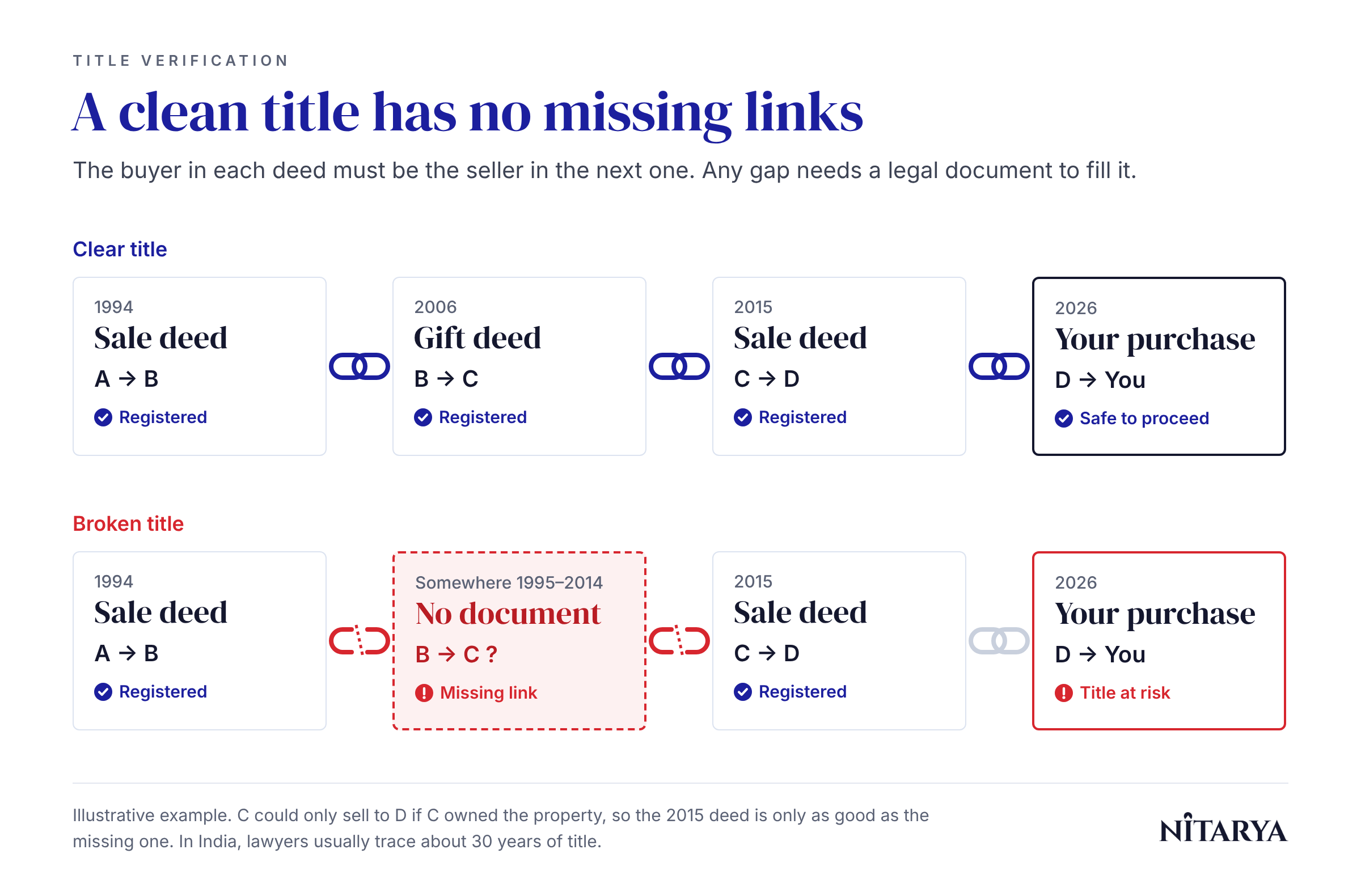
Ask for the root (mother) deed, every link deed and the latest registered deed. Lay them out in date order: the buyer in each deed must be the seller in the next one. Any gap caused by a death, gift or partition must be covered by a registered document or a court order, probate or succession certificate; an affidavit alone is not enough.
In India, lawyers typically trace around 30 years of title; our guide to property title search in India shows how this works step by step. In Dubai, title is centrally registered, so you can check a title deed's current status on the Dubai Land Department's Dubai REST app.
Red flag: the seller cannot produce a link document and offers a discount instead.
Check 2: Ownership and land records
Match the owner's name across the deed, their government ID and the official land record, including the mutation entry where your country uses one. If the names differ, ask for the document that explains why, such as a name-change deed or succession certificate. If someone is selling under a power of attorney, verify the power of attorney itself and contact the owner directly.
Our guide on how to verify property ownership walks through the official portals. In Thailand, check the title (ideally a Chanote) at the Land Department, and remember that foreigners can generally own condominium units only within the building's 49% foreign-ownership quota.
Red flag: the seller refuses to let you contact the owner named on the deed.
Check 3: Encumbrances (loans, liens and charges)
Get the record of every charge registered against the property. In India that is the encumbrance certificate from the sub-registrar, usually covering 13 to 30 years; our step-by-step guide to encumbrance certificate verification explains how to read one. In Dubai, the title status shows whether the property is mortgaged.
If there is a loan, get the lender's NOC and the outstanding amount in writing. Make sure the loan is paid off directly to the lender at transfer, ideally under a tripartite agreement, rather than paying the seller and trusting them to clear it.
Red flag: a mortgage shows up and the seller asks you to "just pay me and I'll close the loan".
Check 4: Approvals and project registration
Copy the project registration number from the brochure and check it yourself on the regulator's portal. In India, projects on more than 500 square metres of land or with more than eight apartments must be registered with the state RERA. The portal shows approvals, the declared completion date and progress updates, and a developer cannot take more than 10% of the price as an advance before a registered agreement for sale.
Our guide to RERA registration verification shows exactly where to look. For ready properties, ask for the occupancy or completion certificate. In Dubai, off-plan sales must be recorded in the interim register (Oqood), and payments must go to the project's escrow account.
Red flag: the project number is not on the portal, or the portal details do not match the brochure.
Check 5: Developer or seller track record
For new projects, ask for three past projects and compare their promised and actual completion dates. Search the developer's name on the regulator's complaint portal and consumer commission records. For resale property, ask how long the seller has owned it and why they are selling. Our guide to developer background checks lists the sources to search.
Red flag: repeated delays or complaints on earlier towers of the same project.
Check 6: Physical inspection and area
Measure the usable (carpet) area with a laser meter and compare it with the agreement. Usable area excludes external walls, shared lobbies and common areas, which is why it differs from built-up and super built-up area; see our explainer on carpet area vs built-up area. If the difference is more than 3%, ask for a written price correction.
Inspect for leaks, cracks and unauthorised changes, and confirm the boundaries and access road match the approved plan or survey map.
Red flag: you are not allowed to measure, or the agreement quotes only "super area".
Check 7: Valuation and location
Three different numbers each have a different job. The government or registry value (the circle rate in India) is the base for stamp duty or transfer fees. The bank's valuation decides how much it will lend. The market price is what you negotiate.
If the bank values the property 10-15% below your price, you need extra cash to cover the gap; our guide to Dubai property valuation methods explains why these numbers differ. For location, check the supply pipeline in your specific district or micro-market rather than the city average, along with infrastructure timelines, flood risk and zoning changes.
Red flag: thousands of similar units are due nearby in the next two years and your rental assumptions ignore it.
Check 8: Taxes, dues and service charges
Get every cost in writing: stamp duty or transfer fee, registration, GST or VAT, brokerage and any withholding tax. In India, a buyer must deduct 1% TDS when buying property worth ₹50 lakh or more from a resident seller and deposit it with the tax department; our guide to TDS on property purchases in India covers the filing.
Then ask for the annual maintenance or service charge and an arrears statement. In Dubai, service charges must be approved through the Dubai Land Department's Mollak system, so check the approved figure for your building rather than a community average.
Red flag: unpaid dues that the seller wants you to "settle later".
Check 9: Litigation
Search the seller's name, the property address or survey number, the project and the developer on court portals (such as eCourts in India), the regulator's complaint portal and consumer commission records. Our guide to legal due diligence in Indian real estate shows how lawyers run these searches.
Red flag: a pending case or attachment order on the property itself. Do not proceed without legal advice.
Check 10: Sale agreement
The sale agreement only promises a transfer; the registered sale deed actually transfers ownership. Our explainer on sale deed vs sale agreement covers the difference. Before signing, read the payment schedule (ideally linked to construction milestones), the possession date and grace period, compensation for delay, defect liability, and what happens if either side defaults.
In India, RERA makes the developer liable to fix structural defects reported within five years of possession. In Dubai, Article 11 of Law No. 13 of 2008 (as amended) caps what a developer can keep if an off-plan buyer defaults: nothing if construction never started for reasons beyond the developer's control, up to 25% below 60% completion, and up to 40% from 60% onwards. The developer must first go through a Dubai Land Department notice giving the buyer 30 days to pay.
Red flag: no delay penalty for the developer, but a heavy forfeiture for you.
When to Do Each Check
Run the checks in four stages, and do not move money to the next stage until the current one is clear.
- Before paying a token or booking amount: verify the deed or registration number on the official portal and run checks 1-4. If any of these fail, stop.
- Before signing the sale agreement: complete checks 5-10, including the measurement, valuation, cost calculation and agreement review.
- Before registration or the final payment: re-run the title status and encumbrance check, confirm every NOC and the dues clearance, and do a final measurement.
- After purchase: update the land records or registry in your name, transfer utilities and society or owners' association membership, and store the originals safely.
The Numbers: 4 Formulas to Calculate Before You Buy
Formula 1: Gross rental yield
Gross yield (%) = Annual rent / Purchase price x 100
Example: 70,000 / 1,000,000 x 100 = 7.0%.
Formula 2: Net rental yield (the one that matters)
Net yield (%) = (Rent - Service charges - Management - Vacancy) / (Purchase price + Purchase costs) x 100
| Item | Amount |
|---|---|
| Annual rent | 70,000 |
| Less service charges | -14,400 |
| Less management fee (6% of rent) | -4,200 |
| Less vacancy (1 month) | -5,833 |
| Net annual income | 45,567 |
| Total investment (price 1,000,000 + 7% purchase costs) | 1,070,000 |
| Net yield | 4.26% (vs 7.0% gross) |
Together, these costs cut the yield by about 39%. Use the approved service charge for your exact building, not an area average. You can model this with our India rental yield calculator, or the Dubai rental yield calculator for overseas purchases.
Formula 3: Total cost of purchase (India example)
Total cost = Agreement value + GST + Stamp duty + Registration + Deposits
Illustrative example: an under-construction flat with an agreement value of ₹80,00,000. Rates vary by state, buyer category and property type, so replace them with your own.
| Item | Amount |
|---|---|
| Agreement value | ₹80,00,000 |
| GST at 5% (under-construction, non-affordable) | ₹4,00,000 |
| Stamp duty at 6% (assumed state rate) | ₹4,80,000 |
| Registration at 1% | ₹80,000 |
| Maintenance deposit (illustrative) | ₹1,00,000 |
| Total cost | ₹90,60,000 (13.25% above agreement value) |
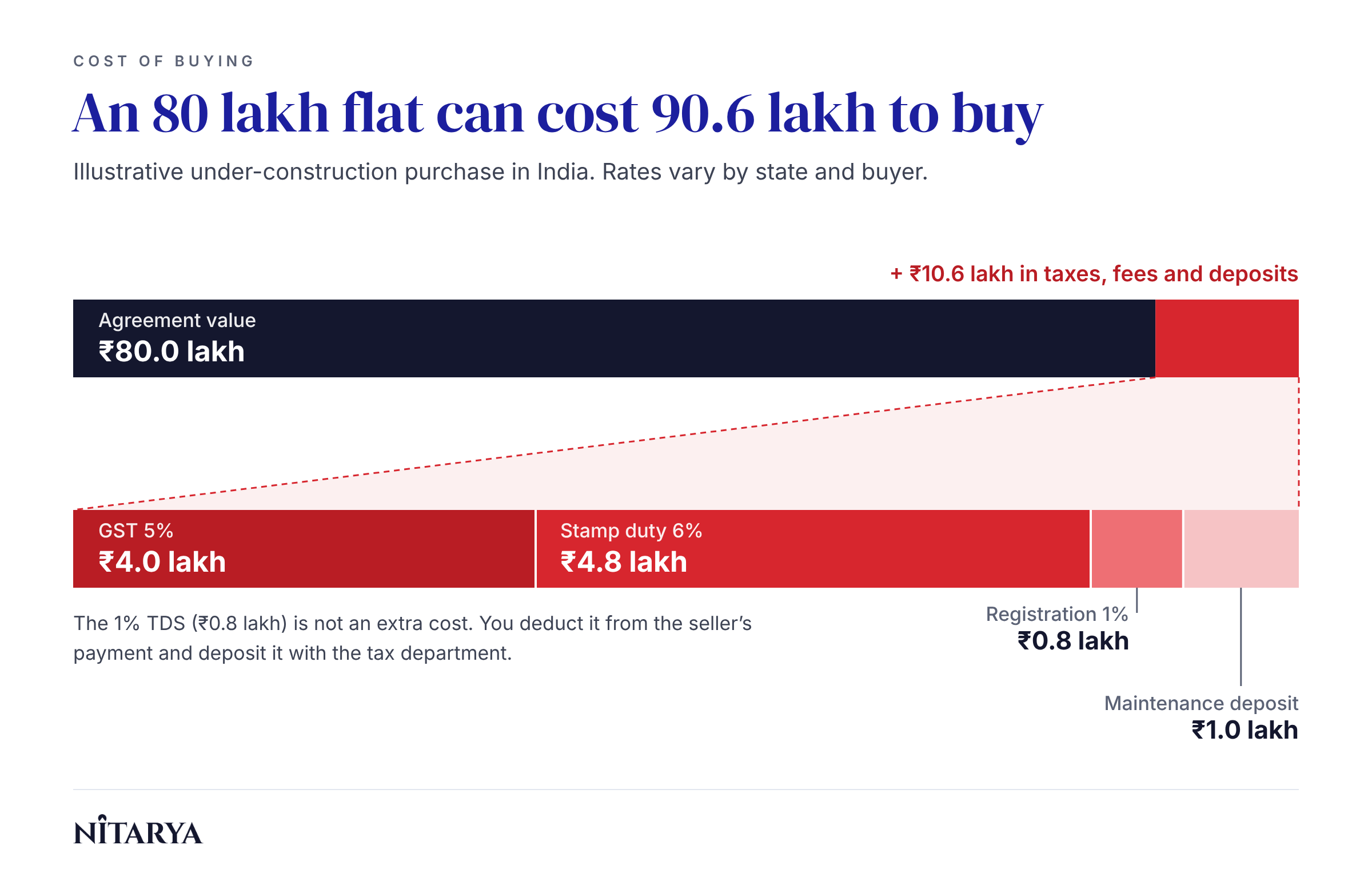
The 1% TDS (₹80,000 here) is not an extra cost: you deduct it from the amount paid to the seller and deposit it with the tax department.
Formula 4: Cash needed on day one (Dubai example)
Cash = Down payment + Transfer fee + Trustee and title fees + Agency + Mortgage registration + Valuation gap
Illustrative example: an AED 2,000,000 apartment with an 80% loan-to-value mortgage. Fees are approximate; confirm the current Dubai Land Department schedule.
| Item | Bank values at AED 2,000,000 | Bank values at AED 1,700,000 |
|---|---|---|
| Down payment | 400,000 | 640,000 |
| DLD transfer fee (4%) | 80,000 | 80,000 |
| Trustee fee (AED 4,000 + VAT) | 4,200 | 4,200 |
| Title deed fee | 580 | 580 |
| Agency commission (2% + VAT) | 42,000 | 42,000 |
| Mortgage registration (0.25% of loan + AED 290) | 4,290 | 3,690 |
| Total cash needed (AED) | 531,070 | 770,470 |
A 15% lower bank valuation means you need about AED 239,400 more in cash. Get the valuation before you sign, not after.
Documents You Will Need
The document names differ by country, but each set answers the same 10 questions above.
| Document | India | Dubai | Thailand |
|---|---|---|---|
| Ownership proof | Title deed and full chain of link deeds | Title deed (or Oqood for off-plan) | Title deed, ideally a Chanote |
| Registry or land record | Land record and mutation entry | Current title status (Dubai REST) | Land Department record |
| Loans and charges | Encumbrance certificate | Title status; lender NOC if mortgaged | Land Department record of encumbrances |
| Project approvals | RERA certificate, approved plan, occupancy or completion certificate | Project registration, escrow account details | Building permit; foreign-quota letter for condos |
| Dues | Property tax receipts, society NOC | Developer NOC for transfer, service charge statement | Debt-free letter from the condominium juristic person |
| Sale paperwork | Agreement for sale, seller's PAN and ID | Form F (MOU) for resale, seller's passport and Emirates ID | Sale agreement, seller's ID, proof of foreign-currency remittance for foreign buyers |
Red Flags: When to Walk Away
A lower price never fixes a defective title. Walk away, or pause and negotiate in writing, if you see any of these:
- The seller sends only photos or PDFs and resists you verifying on the official portal.
- There is a gap in the title chain that no legal document explains.
- The name on the deed does not match the seller, or the power of attorney cannot be verified.
- The property is mortgaged and there is no lender NOC.
- The project is not on the regulator's portal.
- You are asked to pay in cash or into a personal or third-party account.
- There is a pending court case or attachment on the property.
Should You Do It Yourself or Hire a Professional?
You can do a lot yourself: portal checks, measuring the property, visiting the site and calculating costs. Hire a lawyer for the parts that need legal judgement: reading a long title chain, inheritance or power-of-attorney issues, litigation searches and reviewing the sale agreement. Professional help is especially worth it if you are buying from abroad, buying off-plan, or the property has passed through several owners.
For a straightforward property with documents ready, the core checks typically take 1-5 working days, and litigation searches can add 2-3 days. Nitarya's verification team runs all 10 checks in parallel and gives you one report showing the document checked, the portal used, a pass or fail result and the next step for each. Explore our India property due diligence services, Dubai property due diligence services or Thailand property due diligence services.
Property Due Diligence Checklist
Do not pay until every item is ticked. For a printable version, download our India property due diligence checklist and adapt the portals to your country.
Title deed or registry entry verified by you on the official portal
Title chain complete, with no unexplained gaps
Seller's name matches the deed, ID and land record, and any power of attorney is verified
No encumbrance, or lender NOC and outstanding amount in writing
Project registration active and matching the brochure (occupancy or completion certificate for ready property)
Developer or seller track record and complaints checked
Usable area measured and within 3% of the agreement
Registry or bank valuation obtained and any cash gap calculated
Taxes, fees, dues and service charges calculated, with an arrears statement in writing
No pending litigation, attachment or execution on the property
Agreement reviewed: payment schedule, possession date, delay compensation, defect liability, default and exit terms
Payment route confirmed: escrow or project account, or the seller account named in the agreement - never a personal or third-party account
If the first five items fail, walk away. If the rest raise issues, pause and negotiate in writing. For more tools and guides, visit Nitarya's property due diligence guides and tools.
FAQs
What is property due diligence in simple words?
It means checking a property's title, ownership, approvals, loans, area, price and agreement on official records before you pay. It confirms the seller can legally sell and that nothing will block the transfer.
When should I do property due diligence?
Before you pay any token, booking amount or deposit. Do the basic title and registration checks first, the full checks before signing the agreement, and a final title and encumbrance check just before registration.
How long does property due diligence take?
For a straightforward property with documents ready, the core checks usually take 1-5 working days. Litigation searches can add 2-3 days. Older properties with long or complicated title chains take longer.
How much does property due diligence cost?
It depends on the country, the property value and how many checks are included. Ask for a fixed quote that lists exactly which checks are covered. It is usually a small fraction of the deposit you would otherwise be putting at risk.
Is due diligence needed for a RERA-registered or approved project?
Yes. Registration confirms the project is approved. It does not confirm that your specific unit has a clear title, no loan against it, the correct area or a fair agreement.
What documents are needed for property due diligence?
Typically the title deed and chain of previous deeds, an encumbrance or title-status record, the project registration and approved plans, a completion or occupancy certificate, tax and dues receipts, NOCs and the seller's ID. See the country table above.
Can I do property due diligence myself?
You can do the portal checks, site inspection and cost calculations yourself. Use a lawyer to interpret the title chain, search litigation and review the agreement, especially for off-plan, inherited or cross-border purchases.
What happens if a problem is found?
If the title, ownership, encumbrance or approvals fail, walk away. For smaller issues, such as an area shortfall, unpaid dues or unclear clauses, get the fix or price correction in writing before you pay.

