
Dubai Property Due Diligence Checklist: What to Verify Before You Sign
Dubai property due diligence checklist for UK buyers, with 2025 data on off-plan sales and delays: title, Form F, NOC, escrow, snagging and costs.


Free Dubai ownership guide Book a free 15-minute call
On this page
- 1. Know which route you are on: ready resale or off-plan
- 2. Verify the title deed, the property status and the person selling it
- 3. Read Form F before you sign it, not after
- 4. NOC, service charges and building liabilities
- 5. If the unit is tenanted, you are buying the tenancy too
- 6. Off-plan: verify the developer, the project status and the escrow account
- 7. Inspect the unit, not just the paperwork
- 8. Put the full cost in writing
- 9. What a review should include, what it costs and how long it takes
- 10. Agent, lawyer or independent review: who should do it?
- 11. How Nitarya structures a Dubai property review
- Final checklist before you sign Form F or an SPA
- Sources and method
- FAQs
TL;DR: Before you sign Form F on a resale or an SPA on an off-plan unit in Dubai, verify the title deed or Oqood record with the Dubai Land Department, confirm the seller's authority and any mortgage, read the Form F default and mortgage clauses, check the developer NOC and service charge position, review any tenancy, confirm off-plan payments go into the registered project escrow account, inspect the unit and get the full cost in writing.
Our analysis of 2025 market data shows nearly three in four Dubai home sales are off-plan, and fewer than half of the homes due for completion in 2025 were delivered, so the off-plan checks in this guide are where most buyers' risk now sits.
Dubai has one of the most digitised property registries a UK buyer will deal with.
Title is centrally registered, off-plan payments run through regulated escrow accounts, and the Dubai Land Department (DLD) lets you check title deeds and project status online.
That makes it easy to assume the system has done the due diligence for you. It has not. The registry tells you who owns a unit.
It does not tell you what your Form F commits you to, whether the service charges are about to rise, whether a tenant can stay, whether the unit has hidden defects, or whether an off-plan payment plan matches what is happening on site.
This Dubai property due diligence checklist covers both ready resale and off-plan purchases, whether you are looking at Downtown, Dubai Marina, Dubai Hills or Jumeirah Village Circle.
It is the gap Dubai property due diligence is meant to close before your deposit is committed.
At Nitarya, we review Dubai property from the buyer's side, independently of developers, agents and sales commissions.
Here is what to check, what the latest data says about where the risk sits, what a useful review should include, what drives the cost and who should do it.
1. Know which route you are on: ready resale or off-plan
The checks depend on how you are buying.
| Stage | Ready resale | Off-plan |
|---|---|---|
| Main contract | Form F, the standard memorandum of understanding | Sale and purchase agreement (SPA) with the developer |
| Deposit | Usually around 10% of the price, held by the broker | Booking payment, then staged instalments |
| Registration | Transfer at a DLD trustee office, new title deed issued | Interim registration on Oqood, title deed at handover |
| Key third party | Developer NOC, and the seller's bank if mortgaged | The project escrow account and construction progress |
Foreign buyers can own freehold property in Dubai's designated freehold areas. Confirm the unit sits in one, and that its permitted use (residential, commercial, hotel apartment) matches your plan.
Nitarya insight: most Dubai buyers are now buying something that is not built
Off-plan made up 72.9% of Dubai residential sales in 2025, up from 69.3% in 2024 and 61.7% in 2023, according to Cavendish Maxwell's analysis of Property Monitor data.
That is 146,400 off-plan sales against 54,400 sales of ready homes.

Other trackers measure this differently and put the 2025 share somewhere between roughly 63% and 73%, depending on how some villa and townhouse sales registered as title deeds are classified.
On any of those figures, the majority of buyers are relying on a project that is not finished yet.
What this means for you: if you are buying in Dubai, the odds are that section 6 of this checklist, on the developer, project status and escrow, is the most important part for you.
2. Verify the title deed, the property status and the person selling it
For a ready unit, start with the record, not the listing. DLD's online services and the Dubai REST app let you:
- Verify that a title deed is genuine and current
- Run a property status enquiry on the unit
- Check that the broker is licensed by RERA
Then:
- Match the unit number, building, plot and registered area to Form F and the listing.
- Confirm the seller is the registered owner, or that their power of attorney is valid, specific to this sale and properly attested if signed abroad.
- If the property is mortgaged, ask for the bank's liability letter. The seller's loan has to be cleared at or before transfer, and that sequencing should be agreed in writing.
- If the unit is jointly owned, confirm every owner will sign.
Our guide to verifying Dubai title deeds walks through the DLD steps. Units in jointly owned buildings also carry obligations under Dubai's strata framework, covered in our guides to strata law and owners associations.
3. Read Form F before you sign it, not after
Form F is a standard document, which is why buyers skim it. It becomes binding once it is signed and the deposit is handed over, so read it the way the other side's lawyer would.
Check:
- Price: the price on Form F must be the real price. Under-declaring to reduce the 4% DLD fee is not a saving worth taking.
- Default terms: what happens to the deposit if either side walks away, and what counts as a valid reason.
- Mortgage clause: if you are borrowing, add wording that covers your deposit if the bank's valuation or approval falls short.
- Transfer deadline: whether it is realistic once you allow for the NOC, mortgage approval and an international money transfer.
- Fee allocation: who pays the DLD transfer fee, the agency commission and the trustee fee.
- Vacant or tenanted: and, if tenanted, which tenancy terms come with the unit.
- Additional terms: furniture, outstanding snagging, service charges up to transfer, and any addendum the agent proposes.
A bank valuation below the agreed price can leave a buyer needing more cash at completion. Our guide to Dubai property valuation methods explains how that gap arises.
4. NOC, service charges and building liabilities
A transfer will not go through without a no objection certificate (NOC) from the developer, which is generally issued once the seller has cleared what they owe.
Treat the NOC as the start of the building check, not the end of it.
Before signing, look at:
- Annual service charges per square foot as filed through the DLD's Mollak system and Service Charge Index, not as quoted in the listing
- Arrears on the unit and the building's reserve fund position
- District cooling or chiller charges, which can be a separate and significant cost
- Community rules on short-term or holiday letting, if your yield depends on it
- Major works, defect claims or disputes involving the owners association
Our guides to service charges and Mollak, chiller charges and rental restrictions in Dubai communities cover each of these.
5. If the unit is tenanted, you are buying the tenancy too
A tenancy registered on Ejari does not end because the property is sold. The buyer steps into the landlord's position.
Check:
- The tenancy contract and its Ejari registration
- Rent, payment schedule and security deposit, and how they will be handed over
- When the lease renews and how far rent can rise under the RERA rental index
- Whether any notice has already been served, and on what grounds
If you want vacant possession, plan for it. Ending a tenancy because of a sale or for owner occupation is tightly regulated and generally requires 12 months' notice served through a notary public or registered mail.
Our guide to the Dubai rent cap explains how renewal increases are limited.
6. Off-plan: verify the developer, the project status and the escrow account
Off-plan buyers in Dubai have protections that buyers in many markets do not. They only help if you check that they apply to your purchase.
- Confirm the developer and the project are registered with DLD and RERA. DLD's project status enquiry shows the official completion percentage and project details. Check it before you sign and again before each milestone payment.
- Under Dubai's escrow law, off-plan payments should go into the project's registered escrow account with a DLD-accredited escrow agent. Check that the escrow details in the SPA match DLD's records, and never pay an agent or a developer's general account.
- Confirm the sale is registered on Oqood, the interim register for off-plan units.
- Read the payment plan against the construction timeline: what triggers each instalment, and how much you will have paid before the structure exists.
- Know what happens if you cannot keep paying. Under Dubai law, how much of the price a developer can keep on termination is linked to the project's completion percentage.
- Check the SPA for handover delay remedies, permitted area variance, specification changes and the defects position after handover.
For more detail, see our guides to Dubai escrow law, Oqood registration, off-plan property risks and decennial liability in the UAE, which covers structural defects after completion.
Nitarya insight: a handover date is a forecast, not a promise
Cavendish Maxwell estimates that 82,600 homes were projected for completion in Dubai in 2025 and about 40,400 were actually completed, a materialisation rate of 48.9%.

For 2026, 110,500 homes were projected. At the start of the year, 34.3% of them were less than a quarter built and only 25.4% had passed 75% completion.
Cavendish Maxwell expected actual 2026 deliveries of 33,000 to 50,000 units, based on historical completion rates.

The data cuts both ways. Completions in 2025 were 16.4% higher than in 2024, and the average construction cycle fell from about 4.1 years for homes finished in 2021 to about 2.6 years in 2025.
Delivery is improving, but slippage is still the norm rather than the exception.
What this means for you: before each milestone payment, check the project's completion percentage on DLD, compare it with what your payment plan assumes, and read what your SPA says about delay.
If you are buying a unit due for handover soon, ask where it sits in that progress picture before you assume the date.
7. Inspect the unit, not just the paperwork
Legal checks confirm what you are buying. A physical inspection, usually called snagging in Dubai, confirms what condition it is in.
- Ready resale: check air conditioning and chiller performance, water ingress and damp, electrics, plumbing, windows and balcony doors, and any alterations the owner has made without approval.
- Off-plan handover: inspect against the SPA specification and floor plan before accepting the keys, and log defects in writing with the developer.
- Building and community: look at the condition of common areas, lifts, car parks and facades, which flows back into service charges.
If you cannot travel, use an independent inspector rather than the listing agent, and ask for a dated report with photos.
8. Put the full cost in writing
The price on Form F is not the amount leaving your account. Typical buyer-side costs on a resale include:
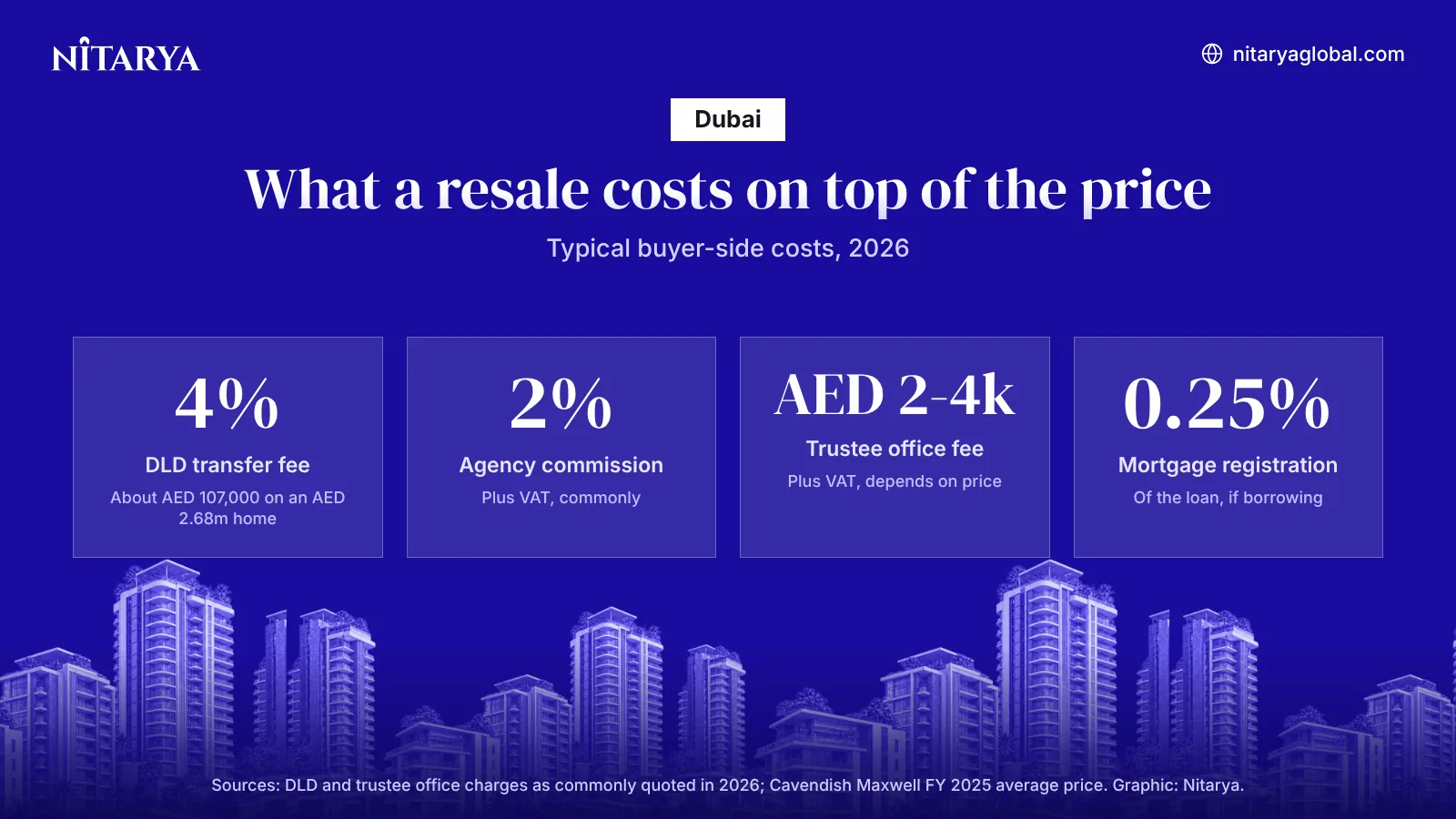
- DLD transfer fee: 4% of the purchase price. The split can be negotiated, but market practice usually puts it on the buyer, so confirm it in Form F.
- DLD administration and title deed fees
- Registration trustee office fee: roughly AED 2,000 to AED 4,000 plus VAT, depending on the price
- Agency commission: commonly 2% plus VAT
- NOC fee: charged by the developer, and varies between developers
- Mortgage registration, if borrowing: 0.25% of the loan plus an administration fee
- Ongoing costs: service charges, chiller, utilities and, if you let the unit, management fees and any holiday home permit costs
To put that in scale: the average ready-home sale in Dubai in 2025 was about AED 2.68 million, according to Cavendish Maxwell. On that price, the 4% DLD fee alone is roughly AED 107,000.
For off-plan, the 4% DLD fee is paid at Oqood registration rather than at handover. Our guide to Dubai property transfer fees breaks down who pays what.
UK residents should also remember that rental income from Dubai can be taxable in the UK even though the UAE does not levy personal income tax on it. See UK tax on foreign rental income.
9. What a review should include, what it costs and how long it takes
If you are paying for Dubai property due diligence, judge the output, not the label. A useful review should give you:
- DLD verification of the title deed or Oqood record and the unit's status
- The seller's identity, authority, any power of attorney and the mortgage position
- A Form F or SPA review listing the clauses to change before you sign
- The NOC position, service charge filings, arrears and chiller arrangements
- A tenancy review, if the unit is let
- For off-plan: developer and project registration, completion percentage, escrow details and a payment plan check
- An inspection or snagging report
- A cost schedule and a clear split between what is verified, what is pending and what is missing
Cost. There is no single price for Dubai property due diligence.
It depends on what you commission: a contract review by a UAE-licensed lawyer, a snagging or condition inspection (usually priced by unit size), document services, and an independent review that pulls it together.
Ask each provider for a fixed fee and a written scope, and check whether the inspection is included.
Time. Most checks on a ready resale can be completed within one to three weeks, and many DLD record checks are much faster.
The key is to start before you sign Form F, because once it is signed the transfer timetable is running and your deposit is at risk.
10. Agent, lawyer or independent review: who should do it?
What matters is whose side each person is on:
- The broker should hold a RERA licence and can manage the Form F, NOC and transfer process. Brokers are usually paid on completion, so they are not independent of whether the deal goes ahead.
- The developer's sales team works for the developer on off-plan sales.
- A UAE-licensed property lawyer should review Form F addenda, the SPA and any power of attorney, especially if you are completing from the UK.
- An independent buyer-side review brings the legal, physical and financial checks into one decision file, and covers UK-side questions, such as how rental income is reported to HMRC.
Nitarya works in that last role. We do not replace your lawyer or inspector. We make sure the right questions are asked, and that you can see the answers in one place before you commit.
11. How Nitarya structures a Dubai property review
We keep the decision process in three stages.
Step 1: Buying: Asset Fit
Define the purpose first: rental yield, holiday use, a future move, or a long-term hold.
Then test the community, service charge levels, nearby supply pipeline, realistic achievable rent and the likely resale audience for that unit type.
Step 2: Verifying: Evidence Check
Match the DLD record, the seller's authority, Form F or the SPA, the NOC, service charge filings, any tenancy, the escrow account, the project's completion percentage and the cost schedule.
Legal questions are routed to appropriately licensed UAE specialists where required. Our role is to coordinate those questions and show clearly what is verified, what is pending and what is missing.
Step 3: Monitoring: Ownership File
Keep one file for the title deed or Oqood record, payment and escrow receipts, Ejari, service charge invoices and UK tax records. For off-plan, add completion percentage checks before each payment and the handover snagging report.
If you want this structured as an independent file on a specific property, see Nitarya's Dubai property due diligence service.
Final checklist before you sign Form F or an SPA
- The title deed or Oqood record has been verified with DLD and matches the unit being sold.
- The seller's identity, authority and any mortgage release are confirmed.
- The Form F default, mortgage and deadline clauses work for your situation.
- The NOC position, service charges and any arrears are checked.
- Any tenancy has been reviewed, and your plan reflects it.
- For off-plan, the project's completion percentage has been checked on DLD, and payments go only to the verified escrow account.
- The unit has been inspected, in person or independently on your behalf, and any defects are priced in.
- The total acquisition and ongoing cost is in writing.
If any of these are unresolved, ask for the evidence before you sign.
Need a second pair of eyes on a specific Dubai property? Nitarya can review the documents you have and separate what is verified, what still needs confirmation and what is missing.
This article is general information only. It is not legal, tax, technical, investment or valuation advice. Obtain advice from appropriately licensed professionals for your transaction.
Sources and method
- Off-plan share of sales, transaction volumes, completions, the 2026 pipeline, construction progress, construction cycle times and average ticket prices: Cavendish Maxwell, Dubai Residential Market Performance FY 2025, using Property Monitor data.
- Range of other estimates for the 2025 off-plan share: published 2025 annual market reports from other Dubai trackers, which classify some villa and townhouse sales differently.
- The 25–74% construction band and the 4% DLD fee on the average ready-home price: Nitarya calculations from the figures above.
- Fees: standard DLD and trustee office charges as commonly quoted in 2026. Confirm current amounts at the time of your transaction.
FAQs
Can UK citizens buy property in Dubai?
Yes. Foreign buyers, including UK citizens, can buy freehold property in Dubai's designated freehold areas and register it in their own name with the Dubai Land Department.
Is most Dubai property sold off-plan?
Yes. Off-plan accounted for 72.9% of Dubai residential sales in 2025 according to Cavendish Maxwell, up from 61.7% in 2023. Other trackers estimate a lower share, but all put it well above half.
Are Dubai off-plan projects delivered on time?
Often not on the original schedule. About 40,400 homes were completed in 2025 against 82,600 projected, a materialisation rate of 48.9%. Check the project's completion percentage on DLD before each payment.
How do I check an off-plan project's status in Dubai?
Use DLD's project status enquiry through its website or the Dubai REST app. It shows the project's registration details and official completion percentage.
Then check that the escrow details in your SPA match DLD's records.
How much does property due diligence cost in Dubai?
It depends on scope. A contract review by a UAE-licensed lawyer, a snagging inspection and an independent review are usually priced separately. Ask for fixed fees and a written scope before you instruct anyone.
How long does property due diligence take in Dubai?
One to three weeks for most resale purchases, with many DLD record checks available much faster. Start before you sign Form F.
Do I need a lawyer to buy property in Dubai?
It is not compulsory, but a UAE-licensed lawyer is worth instructing for Form F addenda, SPA review and any power of attorney, particularly if you are buying from abroad.
The broker and the developer do not act for you.
What is Form F in Dubai?
Form F is the standard memorandum of understanding used for resale transactions. It records the price, the deposit, the transfer timeline and what happens if either side defaults, and it becomes binding once signed.
How much deposit do you pay on a resale property in Dubai?
Market practice is around 10% of the purchase price, usually by manager's cheque held by the broker until transfer.
It is a convention rather than a legal requirement, so the amount and the conditions attached to it should be clear in Form F.
What is a developer NOC and why does it matter?
The NOC is the developer's confirmation that it has no objection to the transfer, generally issued once the seller has no outstanding dues. Without it, the transfer cannot be completed at the trustee office.
What are the total costs of buying property in Dubai?
On a resale, buyers commonly budget for the 4% DLD transfer fee, DLD administration and title deed fees, the trustee office fee, around 2% agency commission plus VAT, the developer NOC fee and, if borrowing, mortgage registration.
Add a year of service and chiller charges for ongoing costs.
Can I buy property in Dubai from the UK without travelling?
Yes. Many UK buyers complete through a properly drafted and attested power of attorney. The power should be specific to the transaction, and the checks in this guide matter more, not less, when you are not there in person.
When should due diligence be done in Dubai?
Before you sign Form F or an SPA and hand over a deposit. Once Form F is signed, walking away can cost you the deposit.

